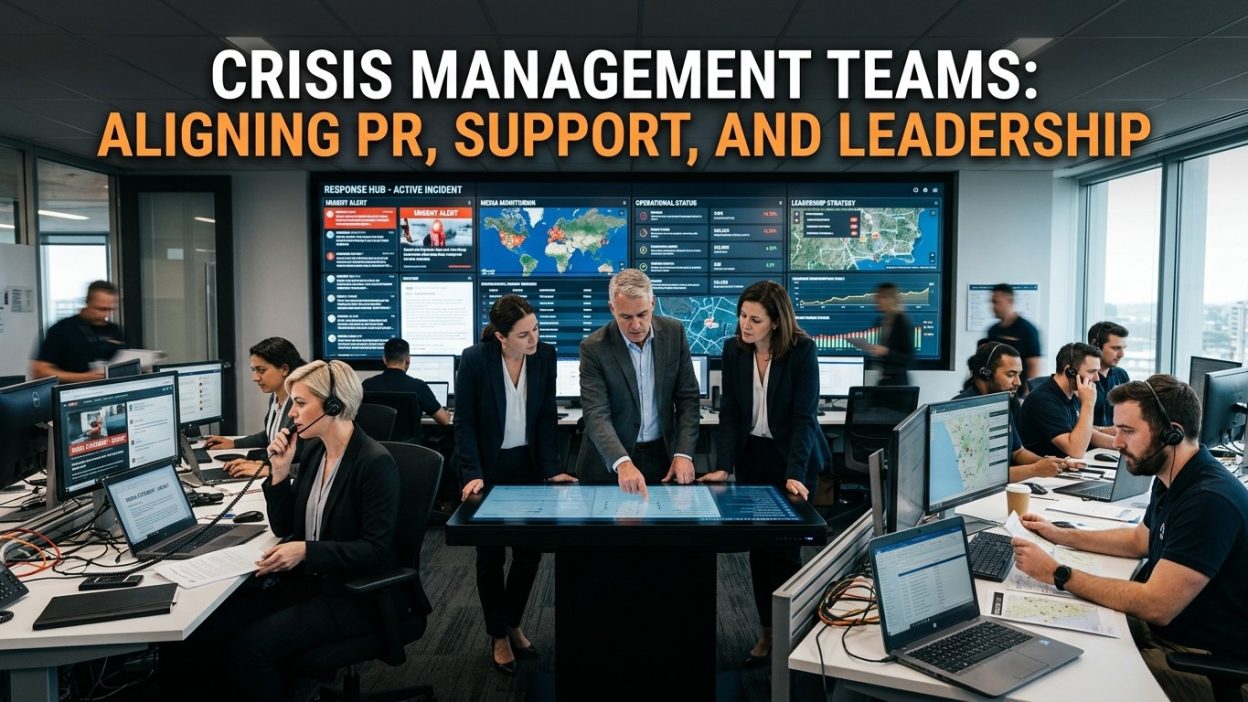
Crisis Management Teams keep trust stable when pressure rises, because Crisis Management Teams align facts, approvals, and messaging before confusion takes over.
Crisis Management Teams matter because trust can break faster than most organizations can explain what happened. When a public issue appears, the team that wins is rarely the one with the loudest statement; it is usually the one that moves with structure, clarity, and restraint. Current NIST incident-response guidance emphasizes preparation, detection, response, recovery, and continuous improvement, while Ready.gov stresses planning communication, identifying audiences, and coordinating how information gets out during emergencies. That means Crisis Management Teams are not just a back-office function; they are the system that keeps communication believable when the brand is under pressure.
Crisis Management Teams also matter because people under stress do not want complexity. They want to know who is deciding, what is confirmed, and when the next update is coming. If the organization does not provide that structure, speculation fills the gap and the situation gets harder to control. Ready.gov’s planning pages and crisis communications guidance both point to the value of clear communication routes, audience planning, and message development before an incident happens. Crisis Management Teams reduce panic by making the response feel ordered instead of improvised.
Crisis Management Teams are also a leadership discipline. The hardest part is often not the public statement itself; it is the internal coordination needed to get one accurate statement out on time. When PR, support, and leadership each operate from different assumptions, the brand can send mixed signals within minutes. NIST’s incident-response lifecycle exists because response works better when the organization has already prepared for the moment pressure arrives. Crisis Management Teams create that preparation so the first hour is spent stabilizing the issue, not arguing about the basics.
Why alignment matters before the crisis
Crisis Management Teams should be built before anyone is tempted to improvise. If the organization waits until a problem is already public, the team ends up making decisions under emotional pressure, and the early response is often too slow or too defensive. NIST’s guidance says incident response should be integrated into risk management and continuously improved, which means the real work happens in advance. A good team knows the trigger, the owner, the reviewer, and the message pathway before the issue ever escalates. Crisis Management Teams work best when the playbook is already familiar.
Crisis Management Teams also need a clear definition of what actually counts as a crisis. If one department thinks a situation is routine while another thinks it is reputationally dangerous, the response will split instantly. That is why the activation threshold should be written in plain language and agreed on by PR, support, and leadership together. CISA’s incident-response basics describe a written plan for before, during, and after incidents, which is useful here because it shows the value of an agreed escalation path. Crisis Management Teams become much faster when the trigger is objective rather than emotional.
Crisis Management Teams also help the organization avoid the “silent gap” problem. When people see no message, they assume the brand is hiding, confused, or unconcerned. Ready.gov’s crisis communications guidance stresses identifying audiences, contact points, media handling, and message development. That means silence should never be the default. The best teams get an initial holding statement out quickly, even if the full details are still being verified. Crisis Management Team reduce uncertainty by filling the gap with a short, honest, and accountable first response.
Building the response architecture

Crisis Management Teams need a response architecture that is simple enough to use when the room is tense. The architecture should cover trigger, owner, backup owner, message approval, internal update path, and external channel order. CISA and NIST both emphasize structured incident handling and continuous improvement, and those ideas translate well to brand crises too. If the team knows exactly where facts go, who drafts the first note, and who checks accuracy, then the crisis becomes a managed sequence rather than a scramble. Crisis Management Team perform best when the architecture is short and visible.
Crisis Management Teams should also have one place where the current facts live. A shared incident sheet or central doc prevents the common mistake of five people carrying five slightly different versions of the truth. NIST’s response and recovery guidance, together with Ready.gov’s emergency planning approach, both support the idea that communication depends on clarity and common operating focus. If support, PR, and leadership all read from the same source, the message is more likely to stay consistent across channels. Crisis Management Team need one current truth, not several competing drafts.
Crisis Management Team should also define what gets verified first. That means deciding which facts are mandatory before the public message goes out and which facts can be updated later. The first update should be accurate enough to be trusted but not so long that it delays action. ASPR TRACIE’s risk-communication resources stress actionable messaging and rapid correction of misinformation, which is useful here because the early phase of a crisis often moves faster than fact gathering. Crisis Management Teams become more credible when they protect accuracy without becoming slow.
Crisis Management Teams also need a backup path for every critical role. If the spokesperson is unavailable, if the legal reviewer is unreachable, or if the support lead is offline, the plan still has to work. This is why an emergency structure should name alternates as clearly as it names primary owners. CISA’s incident-response planning material and NIST’s lifecycle model both suggest that resilient response depends on preparation and continuity. Crisis Management Teams are strongest when the organization can keep moving even if one person is out of the loop.
PR, support, and leadership each have a distinct job
Crisis Management Teams work best when PR does not try to become support and support does not try to become PR. PR should shape the public narrative, support should handle customer confusion, and leadership should make strategic decisions and provide accountability. If those jobs blur, the organization tends to double-message or over-explain. Ready.gov’s business crisis communications guidance makes it clear that communication planning, audience targeting, and media handling all need to be intentional. Crisis Management Teams are more effective when each function stays in its lane but stays coordinated.
Crisis Management Teams should give PR a message development role, not just a publishing role. PR is often the team best equipped to translate facts into tone, timing, and public clarity. But PR cannot do that well without support from operations and leadership. ASPR TRACIE’s guidance emphasizes trusted messengers and empathy, which means PR should focus on language that reassures rather than performs. Crisis Management Teams do not need clever phrasing; they need communication that sounds like the organization understands the impact.
Crisis Management Teams should give support the role of reality check. Support sees the direct questions, repeated complaints, and recurring misunderstandings before most other groups do. That makes support one of the earliest warning systems in the entire response process. The support team should feed the incident lead with clean summaries of what customers are asking and where confusion is highest. Crisis Management Teams become smarter when support is treated as a listening function, not just a ticket queue.
Crisis Management Teams should give leadership the role of decision and accountability. The public often reads leadership behavior as proof of whether the organization is serious. If leaders are absent, slow, or contradictory, the response loses credibility. NIST’s incident-response model and CISA’s plan basics both support the idea that leadership should be involved in the structure of the response, not just the aftermath. Crisis Management Teams are stronger when leaders make fast decisions and then back the team’s communication path.
Crisis Management Teams should also agree on who can overrule whom in an emergency. If the process is unclear, people spend precious time negotiating authority instead of solving the problem. A short approval hierarchy is usually better than a long one because a crisis is not a normal meeting. The organization can still include legal and executive review, but the route should be obvious. Crisis Management Teams that reduce approval friction usually communicate more clearly and recover faster.
Message flow, audience routing, and public tone
Crisis Management Teams need message flow that is easy to follow. The first message should acknowledge the issue, the second should add verified facts, and the third should explain the next step. That sequence matters because audiences often read tone before content. Ready.gov’s crisis communications guidance stresses audience planning and message development, while ASPR TRACIE emphasizes actionability and trusted messengers. Crisis Management Teams should therefore treat the message as a sequence, not as a single paragraph that must solve everything at once.
Crisis Management Teams should also map audience groups carefully. Customers want service clarity, employees want internal direction, partners want operational reassurance, and investors want risk framing. The same facts can be shared with all of them, but the emphasis should differ. Ready.gov’s planning and communications pages support this kind of audience differentiation, because effective communication depends on knowing who needs what first. Crisis Management Teams gain credibility when they do not dump one generic message into every channel at the same time.
Crisis Management Teams should maintain a calm tone even when the facts are uncomfortable. Panic sounds like incompetence, while excessive defensiveness sounds like guilt. The best tone is direct, specific, and measured. ASPR TRACIE’s risk-communication material stresses empathy and rapid correction of misinformation, and that is a good fit for public crisis response because the audience needs confidence that the organization understands the human side of the issue. Crisis Management Teams should sound like they are solving, not spinning.
Crisis Management Teams should use the website as the source of truth and the other channels as amplifiers. If support, social media, and leadership statements all point to one central update, the audience is less likely to find contradictions. ASPR TRACIE’s communication-system resources and Ready.gov’s crisis communications pages both reinforce the value of coordinated public information. Crisis Management Teams become much more believable when the same answer appears wherever the audience looks.
Crisis Management Teams should also make sure the first public note is short enough to be readable quickly but strong enough to show accountability. A holding statement is not the final word; it is the bridge between silence and clarity. NIST’s response and recovery guidance supports this kind of measured progression because incident handling is a process, not a single event. Crisis Management Teams that use a simple holding statement usually avoid the confusion that comes from trying to say too much too soon.
Support, monitoring, and real-time listening

Crisis Management Teams need support teams to serve as a live pulse on what the public is asking. Repeated questions often reveal which part of the message is unclear, which assumption is spreading, and which issue the audience cares about most. Ready.gov’s emergency-response guidance says organizations should identify how they will communicate with management and employees during emergencies, which supports support-team visibility inside the response structure. Crisis Management Teams improve when support feedback is treated as a strategic input.
Crisis Management Teams also need monitoring leads who watch social, media, and direct feedback channels together. ASPR TRACIE’s social-media-in-emergency-response material highlights how public information officers use social media in emergency situations, and that is useful here because rumor often spreads faster than correction. Monitoring is not about chasing every comment; it is about spotting patterns early enough to respond responsibly. Crisis Management Teams work best when the monitoring summary is clean, factual, and frequent.
Crisis Management Teams should also define what counts as a real escalation signal. A few angry comments may be noise. A repeated theme across channels may be a message gap. A surge in support tickets may mean the public has a practical problem that needs a direct response. NIST’s incident-response guidance and CISA’s playbook approach both emphasize structured decision-making, and that is exactly why escalation rules matter. Crisis Management Teams need a threshold that helps them act before confusion becomes a reputation problem.
Crisis Management Teams should not allow monitoring to become a second crisis room. The purpose is to clarify what people are actually seeing, hearing, and misunderstanding, not to amplify panic internally. A monitoring lead should summarize themes, not dump raw noise into the response channel. Crisis Management Teams become calmer when the observation function is disciplined. That discipline helps leadership and PR focus on what matters instead of reacting to every emotional spike.
Crisis Management Teams should also remember that support and monitoring are feedback loops. Once the message changes, the audience reaction changes too. The team should watch for that shift and adjust the response if needed. NIST’s recovery and improvement model is useful because it frames incident handling as continuous learning. Crisis Management Teams that keep listening after the first statement usually catch unresolved confusion sooner and can correct it before the problem drags on.
Paid media and demand protection
Crisis Management Teams should decide in advance what happens to paid media during a live issue. If the message is outdated, if the public mood has changed, or if the brand is under scrutiny, the media plan may need to be paused or revised. Integrating Paid Ads into crisis response should be treated carefully because a normal campaign can look insensitive when the context changes. Crisis Management Teams protect the brand better when ads are reviewed through the crisis lens rather than the conversion lens.
Crisis Management Teams should also think about paid media as an information channel, not only a growth channel. In some cases, paid distribution can help push the official statement or support page to the right audience, especially when misinformation is spreading broadly. But the message must be precise and the objective must be clarity, not promotion. CISA’s planning resources and Ready.gov’s communications guidance both support the idea that the response should be coordinated, controlled, and audience-aware.
Crisis Management Teams are also connected to the B2B Demand Gen Engine because demand depends on trust. If the company handles the crisis well, the pipeline is more likely to stay intact. If the response is clumsy, the funnel may slow or weaken because buyers become cautious. Crisis Management Teams therefore influence more than reputation; they influence revenue confidence. That is why the plan should be seen as part of business continuity, not just public relations.
Crisis Management Teams should coordinate with growth teams so that recovery communication does not conflict with demand generation. For example, a campaign may need to pause while the company stabilizes the issue, then restart once the facts and corrective action are clear. Ready.gov and NIST both stress structured recovery and improvement, which fits this staged approach. Crisis Management Teams work best when the brand knows when to hold, when to update, and when to move again.
Crisis Management Teams should also be careful not to treat the audience as a funnel segment during the emergency itself. People need honesty before persuasion. Once the issue is stable, growth logic can return. But during the crisis, clarity is the product. That distinction helps the team avoid sounding opportunistic. Crisis Management Teams that respect the emotional moment tend to preserve more trust, which later supports the B2B Demand Gen Engine more effectively.
Breaks, drills, and the habit of preparedness
Crisis Management Teams should rehearse their process, because rehearsal exposes weak points before the public does. NIST’s incident-response publication and recovery guidance both emphasize testing, lessons learned, and continual improvement. A tabletop exercise can show whether the approval chain is too slow, whether the spokesperson is clear, and whether support knows where to send customer questions. Crisis Management Teams improve fastest when they treat drills as learning sessions instead of performance tests.
Crisis Management Teams should also use a Break Glass-Crisis Management Plan so that the emergency route is obvious. The plan should show what happens when normal handling is no longer enough, who initiates the break-glass path, and which roles are automatically notified. CISA’s incident-response planning basics are helpful here because they describe a written plan for before, during, and after an incident. Crisis Management Teams that rely on memory are vulnerable; the break-glass path makes the first move much cleaner.
Crisis Management Teams also benefit from testing message tone under pressure. A statement that looks fine in a calm meeting may sound evasive once the issue is public. ASPR TRACIE’s guidance on risk communication underscores how important empathy, trusted messengers, and actionable messaging are during crises. Crisis Management Teams should therefore rehearse not just the facts, but the voice of the response. That is where credibility is often won or lost.
Crisis Management Teams should practice handoffs between PR, support, and leadership because those transitions often break down first. If support learns the plan too late, customers may get inconsistent answers. If leadership learns it too late, the public note may be delayed. If PR learns it too late, the tone may not match the situation. A drill reveals these seams before the crisis does. Crisis Management Teams that practice the handoff are more coordinated in real life.
Crisis Management Teams should also keep a record of each drill. The goal is to note what took too long, what caused hesitation, and what language felt too complicated. NIST’s improvement model makes that review essential because incident response gets better through feedback. Crisis Management Teams should never let a drill disappear into memory. The next crisis should benefit from what the last practice revealed. That is what makes preparedness a living habit instead of a checkbox.
Recovery, lessons, and trust repair

Crisis Management Teams should define recovery as more than “the noise has died down.” Recovery means the issue is stabilized, the public understands the current reality, support has a coherent answer, and leadership knows what changed. NIST’s response and recovery guidance stresses continuous improvement and resilience, which fits this stage perfectly. Crisis Management Teams should close the loop by documenting what happened, what was changed, and what future readers should learn from the event.
Crisis Management Teams should also hold a post-incident review that is blunt but fair. What slowed the first response? Which fact took too long to confirm? Did PR, support, and leadership read from the same source? Were updates frequent enough? Those questions matter because they reveal process, not blame. CISA’s incident-response model and NIST’s continuous-improvement approach both suggest that recovery should feed the next version of the plan. Crisis Management Teams become mature when the review changes the playbook.
Crisis Management Teams should record what worked as well as what failed. If the support team handled escalation well, that should be documented. If leadership approved the first statement quickly, that should be noted. Positive reinforcement helps the team repeat good behavior. NIST’s incident-response and recovery resources support this idea because resilience grows when organizations learn from both strengths and weaknesses. Crisis Management Teams are healthier when the review is balanced, specific, and useful.
Crisis Management Teams should also consider the long-term brand effect. A crisis handled well can actually strengthen trust because people see how the organization behaves under pressure. Brand Crisis Management is not only about limiting damage; it is about showing competence, empathy, and follow-through. Ready.gov’s communication guidance and ASPR TRACIE’s trusted-messenger emphasis both support this trust-repair perspective. Crisis Management Teams can help a brand recover more fully when the public sees that the organization actually learned something.
Crisis Management Teams should finally update the operating system after every serious event. Contact lists change, spokespersons change, channel strategies change, and the public’s expectations change. That means the crisis document should be living, not static. NIST and CISA both frame incident handling as a cycle of preparation, response, recovery, and improvement. Crisis Management Teams are strongest when every incident leaves behind a better playbook than the one that existed before it.
Keeping the team human
Crisis Management Teams should remember that the people affected by the crisis are not reading the response as analysts; they are reading it as humans. That means the tone, timing, and clarity of the response matter just as much as the procedural correctness. If the team sounds cold, the public feels distance. If the team sounds rushed, the public feels uncertainty. If the team sounds honest and calm, trust has a better chance of holding. Crisis Management Teams are operational structures, but they succeed through human judgment.
Crisis Management Teams should also make room for empathy in internal communication. Employees feel the pressure too, especially when they are the ones fielding questions. A brief internal note that explains the facts and the expectations can prevent confusion and reduce fear. Ready.gov’s planning guidance emphasizes communication pathways, and that applies just as strongly inside the company as outside it. Crisis Management Teams work better when the workforce feels informed, supported, and part of the response rather than left out of it.
Crisis Management Teams should also understand that not every crisis can be solved quickly, but every crisis can be handled clearly. That distinction matters because stakeholders often confuse a fast answer with a good answer. Sometimes the best move is to acknowledge the issue, explain what is being verified, and promise a specific next update. NIST’s response lifecycle supports that measured approach because response and recovery happen in stages. Crisis Management Teams should aim for steady truth, not rushed certainty.
Crisis Management Teams become better when leadership treats them as part of normal business resilience instead of a rare emergency bolt-on. The most reliable organizations are the ones that practice, document, and review without drama. That culture makes hard moments easier because the structure is already familiar. Crisis Management Teams are not just about surviving the incident. They are about making the organization steadier, clearer, and more trustworthy the next time pressure appears.
Conclusion
Crisis Management Teams work when PR, support, and leadership are aligned around one truth: clarity beats improvisation. The strongest response systems are written before the issue is public, tested before the issue is real, and reviewed after the issue is over. NIST, CISA, Ready.gov, and ASPR TRACIE all point to the same practical lesson: preparation, coordination, empathy, and improvement matter more than dramatic statements. When the team has clear roles, a single source of truth, and a short path from trigger to action, the organization can respond with steadiness instead of panic. That is how trust survives pressure and how the response becomes a lesson instead of a liability.
Frequently Asked Questions (FAQ)
1. What do Crisis Management Teams do first?
Crisis Management Teams should first verify the facts, activate the right roles, and issue a short holding statement if the issue is public. The first goal is stabilization, not perfection. NIST’s incident-response lifecycle and Ready.gov’s crisis communications guidance both support this approach because early structure reduces confusion and keeps the team from improvising under pressure.
2. Why is PR important in Crisis Management Teams?
PR shapes how the public interprets the event, which can determine whether the brand sounds responsible, defensive, or confused. Crisis Management Teams need PR because public tone matters as much as the facts. Ready.gov and ASPR TRACIE both emphasize message development, trusted messengers, and audience clarity, which are all central to how PR should operate during a crisis.
3. How does support help Crisis Management Teams?
Support hears the earliest and most repeated customer questions, which makes it one of the best listening channels in the crisis. Crisis Management Teams should use support feedback to see where confusion is highest and what the audience needs clarified. Ready.gov’s communication planning guidance and NIST’s improvement model both support this idea because response gets better when real questions are treated as important signal.
4. What is the role of leadership in Crisis Management Teams?
Leadership should make fast decisions, approve the direction of the response, and show accountability publicly when needed. Crisis Management Teams cannot function well if leadership is absent or contradictory. NIST and CISA both stress structured response and continuity, which is why leadership should support the plan rather than bypass it. Leadership presence makes the organization look coordinated and reduces uncertainty for employees and the public.
5. What is a Break Glass-Crisis Management Plan?
A Break Glass-Crisis Management Plan is the emergency path the team activates when normal handling is no longer enough. Crisis Management Teams use it to define trigger conditions, roles, approvals, and message flow. CISA’s incident-response planning basics fit this idea closely because they describe a written plan for before, during, and after an incident. The break-glass concept helps the team move quickly when the pressure rises.
6. Should Crisis Management Teams pause paid media?
Often yes, at least temporarily, until the message is reviewed in the crisis context. Integrating Paid Ads into the response should be done carefully because a normal campaign can look tone-deaf if the public mood has changed. Crisis Management Teams should treat paid media as a controlled channel and only restart or redirect it once the statement and the situation are aligned.
7. How do Crisis Management Teams protect the B2B Demand Gen Engine?
They protect demand by preserving trust. If the crisis is handled clearly and responsibly, buyers are more likely to stay engaged. If the response is messy, demand can weaken because prospects become cautious. Crisis Management Teams therefore support long-term pipeline confidence, which is a key part of the B2B Demand Gen Engine. Recovery and credibility are directly connected.
8. How often should Crisis Management Teams train?
They should train regularly, because NIST’s recovery guidance says resilience improves through testing and lessons learned. Crisis Management Teams should rehearse the trigger, the first message, the approval path, and the handoff between PR, support, and leadership. A drill helps reveal weak spots before the public does, which is much cheaper than learning the hard way.
9. What makes a crisis message believable?
A message is believable when it is direct, calm, specific, and updated as facts are confirmed. Crisis Management Teams should avoid vague language and avoid sounding overly legal or defensive. ASPR TRACIE’s risk-communication guidance stresses actionable messaging, empathy, and trusted messengers, which are all useful principles for making a statement feel credible and human.
10. What is the biggest mistake Crisis Management Teams make?
The biggest mistake is waiting too long to define roles and triggers. If the team has to argue about who leads, what counts as a crisis, and what the first statement should be, it has already lost time and clarity. Crisis Management Teams work best when the process is already written, rehearsed, and easy to activate. That preparation is what keeps the response believable.