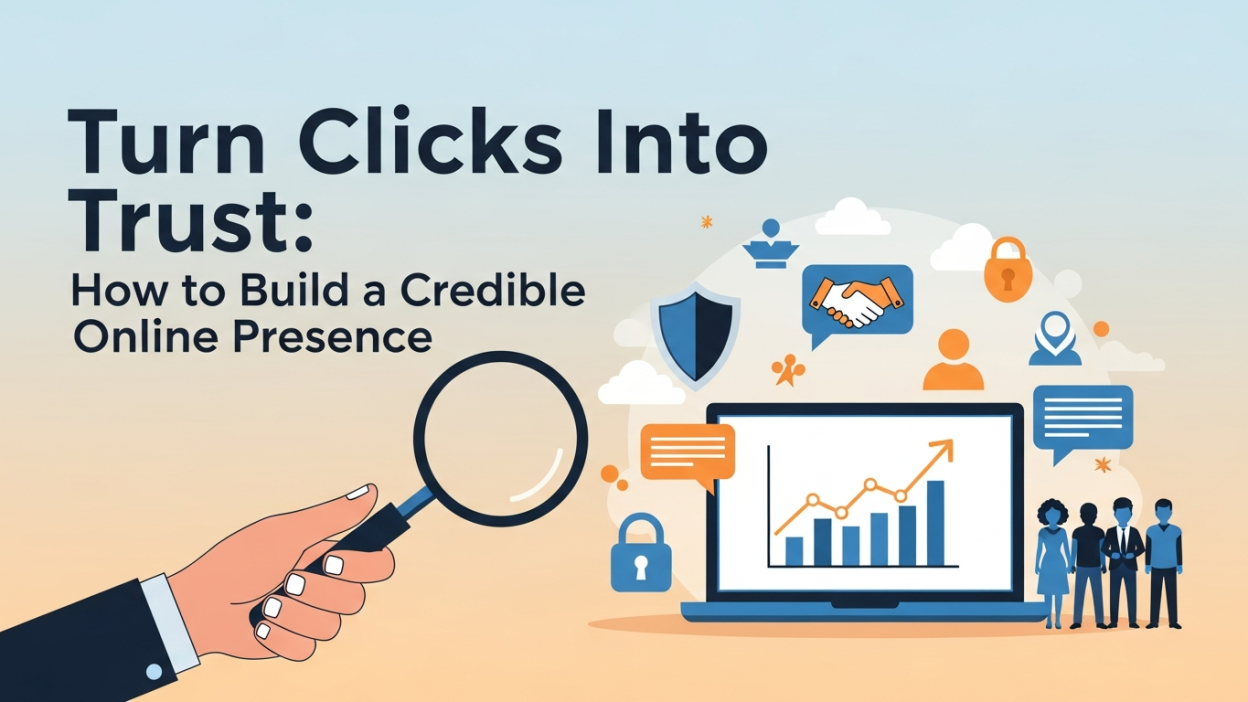
In a digital-first economy, your virtual handshake happens long before a meeting. Learning the art of how to Turn Clicks Into Trust is the ultimate foundation for sustainable growth.
This comprehensive guide explores the intersection of brand trust and digital strategy. We cover online reputation management (ORM), AI-powered sentiment analysis, and actionable methods to Turn Clicks Into Trust, transforming digital footprints into powerful opportunities for brand resilience and long-term financial success in an evolving AI landscape.
Turn Clicks Into Trust: How to Build a Credible Online Presence
In the modern marketplace, trust is the new currency. Whether you are a solo entrepreneur or a Fortune 500 company, your digital footprint acts as a 24/7 spokesperson. When a user clicks your link, they aren’t just looking for a product; they are looking for a reason to believe in you. To Turn Clicks Into Trust is the process of ensuring that when they look, they find a narrative of excellence, transparency, and authority.
The Foundation: What is Digital Reputation Management?
At its core, digital reputation management is the practice of monitoring, addressing, and shaping how your brand is perceived across the internet. It is more than just responding to a Yelp review; it involves search engine reputation management, social media sentiment, and the strategic positioning of your brand’s voice.
Today, it encompasses everything from personal branding vs reputation to corporate reputation management. Understanding what online reputation management is is the first step toward controlling your narrative in a crowded digital space. If you fail to define your brand, the internet will define it for you.
Why Building Online Credibility is Non-Negotiable
The ROI of online reputation management is often measured in the customers you don’t lose. In a world where a single viral post can tank a stock price, your ability to Turn Clicks Into Trust determines your market longevity.
- First Impressions: 95% of consumers read reviews before purchasing. Your digital presence is your first, and sometimes only, chance to convert.
- Trust and Authority: High brand authority allows for premium pricing and better brand positioning.
- Crisis Resilience: A credible brand can weather a “PR storm” better than a brand with no established trust.
Proactive vs. Reactive ORM Strategies
To effectively Turn Clicks Into Trust, you must balance a proactive online reputation management stance with a swift reactive online reputation management plan.
Proactive Strategies: Building the Fortress
- Building Brand Consistency: Ensure your brand voice is identical on LinkedIn as it is on your website. Inconsistency is the enemy of trust.
- High-Quality Content: Use blogging, whitepapers, and guest posting services to establish yourself as a thought leader.
- Google Business Profile Optimizing: Ensure your local listing is verified, updated, and filled with high-quality photos. This helps you Turn Clicks Into Trust at a local level before a customer even visits your site.
Reactive Strategies: Putting Out Fires
- How to Manage a Negative Review: Never ignore it. Respond with empathy and a tangible solution. This shows onlookers that you care about the customer experience.
- Recovering Online Reputation: If a crisis hits, use rebranding case studies as a roadmap to pivot and rebuild.
- Removing Negative Content: While difficult, working with specialists for removing negative content that is defamatory is sometimes a necessary defensive measure.
Leveraging AI and Modern Tools for Credibility

The future of your ability to Turn Clicks Into Trust lies in technology. We are moving toward AI-driven online reputation management, where algorithms handle the heavy lifting of monitoring.
- AI-Powered Sentiment Analysis: Tools can now scan thousands of mentions to determine if the “mood” around your brand is shifting.
- AI Chatbots and Machine Learning: These provide instant customer service, improving the customer journey mapping experience.
- Social Media Monitoring: Tools help you track what is social media monitoring in real-time, allowing you to catch a “micro-trend” before it damages your credibility.
Transforming Negative Feedback into Growth
In e-commerce reputation management, a negative review isn’t a failure—it’s structured intelligence. Every complaint reveals friction and highlights where your brand promise breaks down. To Turn Clicks Into Trust, you must:
- Identify the Friction Point: Is it logistics, quality, or response time?
- Publicly Acknowledge: This signals accountability. Prospective customers often read your responses more than the reviews themselves.
- Implement a Business Recovery Plan: Corrective action must follow words. Update your reputation management policy to ensure the mistake isn’t repeated.
- Follow Up: When customers see that feedback led to real improvements, they often become loyal advocates.
AI-Synthesized Search: The Rise of GEO and AEO
By 2026, the way you Turn Clicks Into Trust is increasingly shaped by AI agents. Users turn to AI-powered answer engines (AEO) for recommendations.
- Generative Engine Optimization (GEO): Focuses on making your brand “citable” by AI models like Gemini or ChatGPT.
- Answer Engine Optimization (AEO): Creating concise, factual responses and using schema markup so AI can confidently reuse your info.
- The Shift: AI answers now rely more on third-party citations. To Turn Clicks Into Trust, you must be talked about by other trusted sources.
Advanced Threats: Deepfakes and AI Safety
In 2026, deepfakes AI reputation management is a mandatory skill. Fake audio or video can spread faster than official corrections. To Turn Clicks Into Trust, you must:
- Invest in brand safety in digital marketing systems.
- Use digital watermarking or blockchain-backed authenticity signals (Digital Provenance).
- Maintain a building business recovery plan specifically for synthetic media attacks.
Key 2026 Trust Metrics Table
| Metric | Traditional Definition | 2026 Definition |
| Authority | Backlinks & PageRank | AI Citation Frequency & GEO Presence |
| Sentiment | Ratio of Positive/Negative Reviews | Multi-Platform Emotional Tone Consistency |
| Response Time | Within 24–48 Hours | Under 2 Hours (Human or AI Agent) |
| Visibility | Google Page 1 Ranking | Share of Voice in AI-Synthesized Answers |
The “Human-in-the-Loop” Premium
As AI begins to handle the majority of digital interactions, a “Trust Paradox” has emerged. The more automated the world becomes, the more consumers value human intervention. To Turn Clicks Into Trust in 2026, you must signal exactly where the “human” lives in your brand.
- Emotional Escalation: Ensure that any interaction involving high emotional stakes is immediately routed to a digital marketing expert.
- Authentic Imperfection: Move away from “over-polished” AI content toward raw, human-recorded updates.
- The “Transparency Badge”: Disclose which parts of your service are AI-driven. Paradoxically, brands that admit to using AI are seen as more trustworthy than those that hide it.
The Psychology of “Social Proof Cascades”

To Turn Clicks Into Trust, you must understand the “Social Proof Cascade.” This is a psychological phenomenon where a small group of early adopters triggers a massive wave of public confidence.
- Micro-Influencer Anchoring: Instead of one celebrity, use 20 “Nano-Influencers” within a specific niche. Their high engagement rates create a concentrated “Trust Pocket” that feels more authentic to modern consumers.
- The Power of Numbers: Displaying real-time data—such as “150 people are looking at this right now” or “Over 5,000 resolved tickets this month”—provides immediate, data-driven credibility.
- Actionable Tip: Use integrated marketing to feature “Customer of the Month” stories. Highlighting real people behind the reviews makes your brand personality in marketing feel accessible and honest.
Agentic Trust: Preparing for the “Post-Search” World
In 2026, a significant percentage of “clicks” come from AI agents acting on behalf of humans. To Turn Clicks Into Trust, your brand must be “Agent-Verified.”
- Verifiable Metadata: AI agents don’t browse websites; they ingest data. Ensure your SaaS development services prioritize clean, structured JSON-LD that includes your brand equity metrics, such as years in business and verified security certifications.
- Machine-to-Machine (M2M) Credibility: When an AI agent recommends your product, it is because your online reputation management with AI and social listening has created a high “Reliability Score” in the agent’s database.
High-Fidelity Transparency: The “Glass Box” Strategy
The old way of marketing was a “Black Box” (hiding the process). The new way to Turn Clicks Into Trust is the “Glass Box”—showing everything.
- Live Supply Chain Tracking: Use blockchain for supply chain transparency to let customers see exactly where their product is. This is a game-changer for luxury brand marketing and ethical branding.
- Open-Source Values: Publish your internal “Reputation Management Policy” and employee handbook. Showing your internal culture builds massive external brand awareness.
Biometric Authentication as a Trust Signal
As identity theft and bot accounts proliferate, using biometric signals can actually help you Turn Clicks Into Trust.
- Verified Human Interactions: Implementing biometric “Proof of Personhood” for your high-level consultants or customer service leads. This ensures that the user knows they are talking to a real expert, not a sophisticated bot.
- Secure Payment Gateways: Integrating digital payment solutions that use facial recognition or fingerprinting reduces friction and reinforces the feeling of brand safety in digital marketing.
The “Trust-First” Content Funnel
Traditional funnels focus on “Awareness > Interest > Decision.” A modern funnel designed to Turn Clicks Into Trust flips the script.
- Top of Funnel (ToFu): High-value, objective education. No sales pitch.
- Middle of Funnel (MoFu): Detailed video testimonials, online reputation, and third-party brand audit results.
- Bottom of Funnel (BoFu): Radical guarantees and buildinga business recovery plan promises.
- Actionable Tip: Use inbound marketing to create a “Trust Kit”—a downloadable PDF that includes your certifications, ethics report, and top 50 customer reviews.
Navigating the “Synthetic Reality” Crisis
With AI-generated video becoming indistinguishable from reality, how do you Turn Clicks Into Trust when people don’t believe their own eyes?
- Content Authenticity Initiative (CAI): Join global standards that provide “Digital Provenance” for your media. This puts a “seal of authenticity” on your brand storytelling videos.
- Deepfake Defense: Regularly scan for unauthorized “Synthetic Brand Ambassadors.” Rapidly addressing these through online PR services is vital for corporate reputation management.
Community Governance: Giving Users the Keys
One of the most powerful ways to Turn Clicks Into Trust is to move from a “Monologue” to a “DAO-lite” (Decentralized Autonomous Organization) model.
- Co-Creation: Invite your most loyal customers to vote on new product features or brand voice strategy updates.
- Transparency Reports: Monthly “State of the Brand” reports that disclose not just wins, but also negative reviews and how they were resolved. This is the hallmark of sustainable online reputation management.
- Hyper-Local “Trust Moats”
Global trust is hard; local trust is resilient. To Turn Clicks Into Trust, you must dominate your immediate digital vicinity.
- Local SEO Services: Ensure your Google Business Profile optimization is flawless.
- Regional Advocacy: Partner with local charities or events. This builds brand perception in marketing as a “neighbor,” not just a corporation.
- Actionable Tip: Use SMS marketing for local “Community Alerts” or exclusive regional offers, creating a sense of belonging.
Zero-Party Data and the “Respectful” UX
If your website feels like a surveillance state, you will never Turn Clicks Into Trust.
- Asking, Not Tracking: Use interactive quizzes to gather zero-party data. Customers are 80% more likely to trust a brand that asks for their preferences rather than tracking them via cookies.
- Privacy-First Design: Clearly label your “Opt-Out” and “Data Deletion” buttons. Ironically, making it easy to leave makes people more likely to stay.
The ROI of “Trust-Centered” UX/UI

Your website design is the visual language of your reputation. To Turn Clicks Into Trust, the interface must feel secure and authoritative.
- Sonic Branding: Use subtle, high-quality sound cues for successful actions (like a secure checkout). This is part of sensory branding.
- Micro-Interactions: Smooth, fast-loading animations signal a high-tech, reliable backend. Slow websites are the #1 killer of online reputation management.
- Actionable Tip: Audit your site for “Dark Patterns” (manipulative UI). Removing these is the fastest way to improve reputation management and conversion.
Comparison: The Cost of Low Trust vs. High Trust
| Feature | Low Trust Environment | High Trust (Turn Clicks Into Trust) |
| Ad Spend | High (to overcome skepticism) | Low (fueled by referrals) |
| Sales Cycle | Long (multiple touchpoints) | Short (pre-sold on reputation) |
| Pricing Power | Discount-driven | Premium pricing enabled |
| Customer Retention | Low (price-sensitive) | High (Brand loyalty driven) |
The Psychology of “Social Proof Cascades”
To Turn Clicks Into Trust, you must understand the “Social Proof Cascade.” This is a psychological phenomenon where a small group of early adopters triggers a massive wave of public confidence.
- Micro-Influencer Anchoring: Instead of one celebrity, use 20 “Nano-Influencers” within a specific niche. Their high engagement rates create a concentrated “Trust Pocket” that feels more authentic to modern consumers.
- The Power of Numbers: Displaying real-time data—such as “150 people are looking at this right now” or “Over 5,000 resolved tickets this month”—provides immediate, data-driven credibility.
- Actionable Tip: Use integrated marketing to feature “Customer of the Month” stories. Highlighting real people behind the reviews makes your brand personality in marketing feel accessible and honest.
Agentic Trust: Preparing for the “Post-Search” World
In 2026, a significant percentage of “clicks” come from AI agents acting on behalf of humans. To Turn Clicks Into Trust, your brand must be “Agent-Verified.”
- Verifiable Metadata: AI agents don’t browse websites; they ingest data. Ensure your SaaS development services prioritize clean, structured JSON-LD that includes your brand equity metrics, such as years in business and verified security certifications.
- Machine-to-Machine (M2M) Credibility: When an AI agent recommends your product, it is because your online reputation management with AI and social listening has created a high “Reliability Score” in the agent’s database.
High-Fidelity Transparency: The “Glass Box” Strategy
The old way of marketing was a “Black Box” (hiding the process). The new way to Turn Clicks Into Trust is the “Glass Box”—showing everything.
- Live Supply Chain Tracking: Use blockchain for supply chain transparency to let customers see exactly where their product is. This is a game-changer for luxury brand marketing and ethical branding.
- Open-Source Values: Publish your internal “Reputation Management Policy” and employee handbook. Showing your internal culture builds massive external brand awareness.
Biometric Authentication as a Trust Signal
As identity theft and bot accounts proliferate, using biometric signals can actually help you Turn Clicks Into Trust.
- Verified Human Interactions: Implementing biometric “Proof of Personhood” for your high-level consultants or customer service leads. This ensures that the user knows they are talking to a real expert, not a sophisticated bot.
- Secure Payment Gateways: Integrating digital payment solutions that use facial recognition or fingerprinting reduces friction and reinforces the feeling of brand safety in digital marketing.
The “Trust-First” Content Funnel
Traditional funnels focus on “Awareness > Interest > Decision.” A modern funnel designed to Turn Clicks Into Trust flips the script.
- Top of Funnel (ToFu): High-value, objective education. No sales pitch.
- Middle of Funnel (MoFu): Detailed video testimonials, online reputation, and third-party brand audit results.
- Bottom of Funnel (BoFu): Radical guarantees and buildinga business recovery plan promises.
- Actionable Tip: Use inbound marketing to create a “Trust Kit”—a downloadable PDF that includes your certifications, ethics report, and top 50 customer reviews.
Navigating the “Synthetic Reality” Crisis
With AI-generated video becoming indistinguishable from reality, how do you Turn Clicks Into Trust when people don’t believe their own eyes?
- Content Authenticity Initiative (CAI): Join global standards that provide “Digital Provenance” for your media. This puts a “seal of authenticity” on your brand storytelling videos.
- Deepfake Defense: Regularly scan for unauthorized “Synthetic Brand Ambassadors.” Rapidly addressing these through online PR services is vital for corporate reputation management.
Community Governance: Giving Users the Keys

One of the most powerful ways to Turn Clicks Into Trust is to move from a “Monologue” to a “DAO-lite” (Decentralized Autonomous Organization) model.
- Co-Creation: Invite your most loyal customers to vote on new product features or brand voice strategy updates.
- Transparency Reports: Monthly “State of the Brand” reports that disclose not just wins, but also negative reviews and how they were resolved. This is the hallmark of sustainable online reputation management.
Hyper-Local “Trust Moats”
Global trust is hard; local trust is resilient. To Turn Clicks Into Trust, you must dominate your immediate digital vicinity.
- Local SEO Services: Ensure your Google Business Profile optimization is flawless.
- Regional Advocacy: Partner with local charities or events. This builds brand perception in marketing as a “neighbor,” not just a corporation.
- Actionable Tip: Use SMS marketing for local “Community Alerts” or exclusive regional offers, creating a sense of belonging.
Zero-Party Data and the “Respectful” UX
If your website feels like a surveillance state, you will never Turn Clicks Into Trust.
- Asking, Not Tracking: Use interactive quizzes to gather zero-party data. Customers are 80% more likely to trust a brand that asks for their preferences rather than tracking them via cookies.
- Privacy-First Design: Clearly label your “Opt-Out” and “Data Deletion” buttons. Ironically, making it easy to leave makes people more likely to stay.
Comparison: The Cost of Low Trust vs. High Trust
| Feature | Low Trust Environment | High Trust (Turn Clicks Into Trust) |
| Ad Spend | High (to overcome skepticism) | Low (fueled by referrals) |
| Sales Cycle | Long (multiple touchpoints) | Short (pre-sold on reputation) |
| Pricing Power | Discount-driven | Premium pricing enabled |
| Customer Retention | Low (price-sensitive) | High (Brand loyalty driven) |
Conclusion
To Turn Clicks Into Trust is a marathon, not a sprint. By integrating AI-driven online reputation management, maintaining a consistent brand voice, and prioritizing customer feedback strategies, you create a digital presence that is not only visible but invincible. Take control of your narrative today—your reputation is the most valuable asset you own in 2026.
FAQs
1. What is the difference between personal branding and reputation?
Personal branding is intentional—it’s the message, image, and values you deliberately project through content, visuals, and positioning. Reputation, however, is earned—it’s shaped by customer experiences, reviews, conversations, and third-party validation. To truly Turn Clicks Into Trust, these two forces must align when branding promises match real-world experiences, trust compounds. When they don’t, skepticism spreads faster than traffic ever could.
2. How do I remove fake reviews from my Google Business Profile?
Fake reviews should first be reported for policy violations such as spam, conflicts of interest, or false experiences. When removals are delayed or denied, advanced online reputation management services shift the strategy from removal to credibility dominance—using authority-building content, review velocity, and SEO suppression so harmful reviews lose visibility and influence. The objective is not perfection, but trust at scale.
3. What is AI-powered sentiment analysis?
AI-powered sentiment analysis uses machine learning to evaluate language patterns across reviews, social posts, forums, and news articles. It classifies mentions as positive, neutral, or negative—and flags unusual spikes before they go viral. This allows brands to act early, not react late. When used correctly, sentiment analysis becomes a trust radar that helps you Turn Clicks Into Trust by preventing reputational blind spots.
4. Why is video SEO important for credibility?
Video creates emotional certainty faster than text. Seeing real people speak, react, and explain experiences removes doubt at a subconscious level. Video SEO ensures these trust-building assets—testimonials, explainers, behind-the-scenes clips—surface prominently in search results. When prospects encounter human proof before sales messaging, it becomes far easier to Turn Clicks Into Trust and shorten decision cycles.
5. How does social listening help to Turn Clicks Into Trust?
Social listening reveals what people say when they’re not talking to you. By monitoring sentiment, questions, and complaints across platforms, brands can respond proactively, correct misinformation, and demonstrate accountability. Addressing issues before they escalate publicly shows maturity and transparency—two qualities essential to turning passive clicks into active trust.
6. Can I build a credible presence without a large budget?
Absolutely. Trust is built through consistency, not spending. Publishing expert content, responding thoughtfully to reviews, showcasing customer stories, and optimizing your Google Business Profile are some of the highest-ROI actions available. These efforts signal reliability and competence, proving that you can Turn Clicks Into Trust even with minimal financial investment.
7. What is a brand crisis management plan?
A brand crisis management plan is a pre-defined playbook for moments when reputation is threatened—such as viral complaints, misinformation, or operational failures. It outlines who responds, how fast, on which channels, and with what tone. Strong plans emphasize empathy, transparency, and resolution. How you respond in a crisis often matters more than the crisis itself when trying to Turn Clicks Into Trust.
8. How does customer feedback build brand equity?
Customer feedback is living proof of performance. Positive reviews reinforce reliability, while well-handled criticism demonstrates integrity. Over time, these signals accumulate into brand equity—reducing buyer hesitation, increasing perceived value, and making conversions easier. In essence, feedback is the raw material that transforms visibility into trust.
9. What is the role of a Digital Marketing Expert in ORM?
A Digital Marketing Expert connects search visibility with perception control. They ensure that authoritative content, positive reviews, and trust assets dominate search results while negative or outdated information fades into irrelevance. Their role is not manipulation, but alignment—making sure what people find accurately reflects what the brand delivers, helping consistently Turn Clicks Into Trust.
10. Why is ethical branding important now?
Modern consumers evaluate brands beyond products—they assess values, transparency, and responsibility. Ethical branding, such as honest messaging, clear disclosures, and fair practices, reduces backlash risk and builds long-term loyalty. In an era of screenshots and instant amplification, ethics are no longer optional—they are foundational to trust that survives algorithm changes and social scrutiny.
For targeted B2B growth, discover how account-based marketing services drive business success.