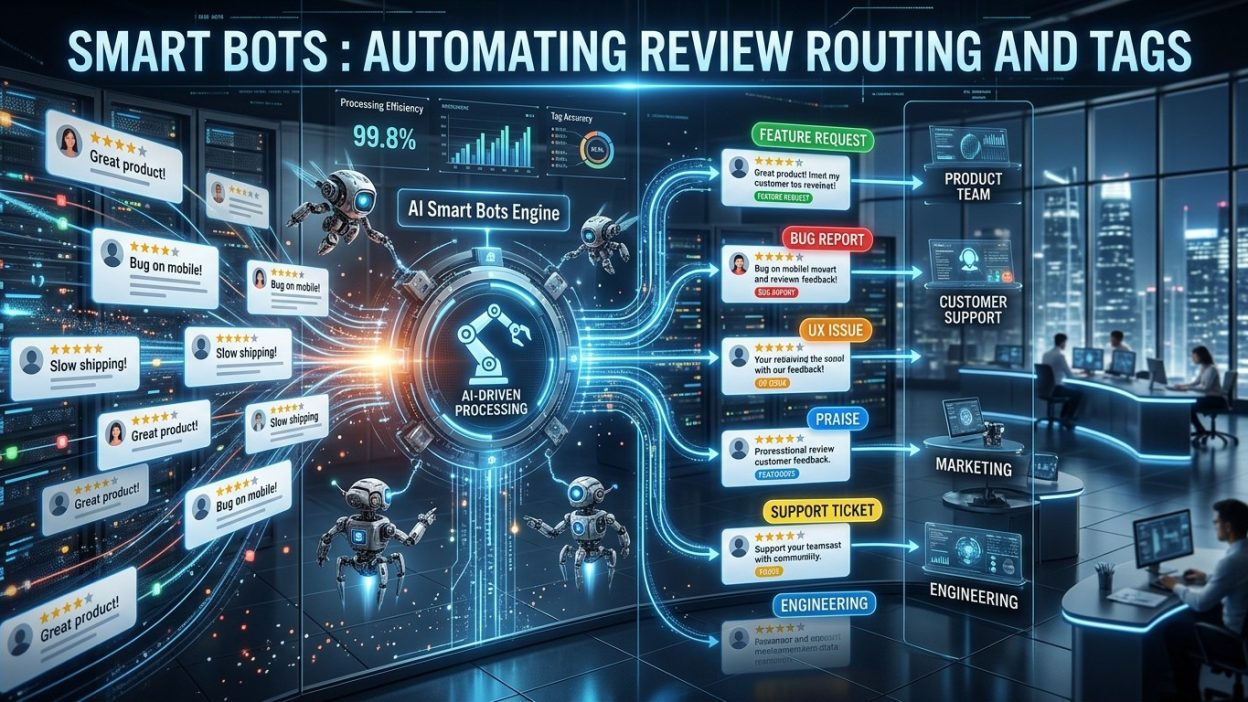
Smart Bots organize customer reviews by detecting themes, applying tags, routing feedback to the right teams, escalating priority issues, and turning scattered opinions into actionable operational signals quickly.
Smart Bots solve a problem that grows quietly with every new review: information becomes abundant while attention stays limited. A business may receive feedback through Google, marketplaces, social channels, surveys, chat, and support systems, yet employees still sort much of it manually. Automation creates a repeatable layer between feedback and the people responsible for acting.
Smart Bots are especially useful because not every review deserves the same response, owner, urgency, or analysis. A five-star review praising delivery can support advocacy, while a two-star comment about a failed payment may need immediate operational investigation. Smart Bots can recognize those differences and route records according to defined business rules rather than leaving every item in one undifferentiated queue.
Smart Bots also make tagging more useful than a simple label such as “positive” or “negative.” A good taxonomy can capture product area, customer intent, service stage, issue type, urgency, sentiment, location, channel, and outcome. These tags create structured data that managers across teams and channels can search, filter, compare, and connect to wider customer-experience systems.
How Smart Review Automation Works
Smart Bots usually begin at the intake layer. Reviews arrive from connected platforms, feeds, forms, APIs, or internal systems, and the automation process normalizes the information into a consistent record. The record might contain review text, rating, source, author metadata, product, timestamp, language, and available customer or transaction context.
Smart Bots then analyze the incoming record against a set of classification rules or language models. The first pass can identify obvious attributes such as rating level, topic, product category, and language. A second pass can interpret meaning, for example recognizing that “the app crashed at checkout” belongs to a payment or technical-experience category even when the reviewer never uses the word “error.”
Smart Bots can apply multiple tags to the same review because customer feedback is rarely one-dimensional. A single comment might be tagged as “delivery,” “damaged item,” “high urgency,” “negative sentiment,” and “repeat customer.” Multi-label tagging preserves more context than forcing every review into one category.
Smart Bots can also assign confidence scores or trigger human review when classification is uncertain. That matters because automated systems should not treat every prediction as equally reliable. A clear phrase such as “the package arrived late” is easier to categorize than sarcasm, mixed feedback, indirect complaints, or comments with missing context.
Smart Bots can create a routing decision after classification. The workflow might send product defects to operations, billing concerns to finance, delivery problems to logistics, reputation-sensitive complaints to customer experience, and praise about employees to an advocacy or people team. Routing becomes a practical bridge between feedback intelligence and accountable action.
A Simple Review Routing Model
| Review signal | Example tag | Suggested owner | Typical action |
|---|---|---|---|
| Delivery delay | delivery_delay | Logistics | Investigate fulfillment timeline |
| Billing problem | billing_issue | Finance/Support | Review transaction and assist customer |
| Product defect | product_quality | Product/Operations | Inspect issue and identify root cause |
| Service complaint | service_experience | Customer Experience | Review interaction and resolve |
| Feature request | feature_request | Product | Add to roadmap or feedback queue |
| Employee praise | employee_praise | People/Customer Experience | Recognize employee and preserve advocacy |
| High-risk complaint | escalation | Management/CX | Review quickly and coordinate response |
Building a Practical Tagging Taxonomy
Smart Bots perform best when the taxonomy is designed around decisions rather than around every possible word. Before creating dozens of labels, ask what the organization actually needs to know. If a tag will never change an owner, workflow, report, or decision, it may not deserve a permanent place in the taxonomy.
Smart Bots can support a layered taxonomy with parent and child tags. For example, “Delivery” may be a parent category with “late delivery,” “missing parcel,” “wrong item,” and “damaged package” beneath it. The hierarchy allows leadership to view broad trends while operational teams retain the detail required to solve individual problems.
Smart Bots can also separate descriptive tags from action tags. “Mobile app,” “subscription,” and “checkout” describe the subject of a complaint, while “urgent,” “needs response,” and “escalate” describe what should happen next. Keeping these tag types conceptually separate prevents reporting data from becoming confused with workflow instructions.
Smart Bots become more reliable when tag definitions include examples and exclusion rules. A team might define “billing issue” as a complaint involving charges, refunds, invoices, or payment processing, while excluding general comments about pricing. Clear boundaries reduce overlap and make automated classification easier to test.
Smart Bots can help maintain taxonomy consistency as the review library grows. Without governance, teams often create duplicate tags such as “late shipment,” “shipping delay,” “delivery delay,” and “delayed shipping.” A controlled vocabulary makes trend analysis cleaner and reduces the effort required to reconcile reports later.
Designing Routing Rules
Smart Bots should route based on business relevance, not simply on sentiment. Positive reviews can contain product ideas, neutral comments can reveal friction, and negative reviews may include multiple issues requiring different owners. Routing logic should therefore consider topic, severity, customer context, channel, language, product, and operational impact.
The automation can use rule combinations such as “product defect + two stars or lower = operations escalation” or “billing issue + account-specific information = support queue.” Rules become more powerful when they combine several signals instead of treating one keyword or star rating as sufficient evidence.
Smart Bots can also route one review to multiple destinations when responsibility is shared. A complaint about a broken delivery item may belong with logistics for the shipment investigation and product operations for packaging quality. Parallel routing reduces the risk that one team assumes another department is handling the issue.
Smart Bots can introduce priority tiers so teams are not overwhelmed by equal treatment of unequal problems. High-priority cases might include safety concerns, repeated service failures, privacy complaints, or posts likely to generate significant customer harm. Lower-priority cases can remain in a standard queue for analysis and response.
Smart Bots should preserve an audit trail for routing decisions. Teams need to know which tags were assigned, why a route was selected, whether a person changed it, and when the case moved forward. Traceability makes automation easier to improve and reduces confusion when a customer issue crosses multiple departments.
Connecting Reviews With Broader Customer Journeys

Smart Bots become more valuable when review signals are connected to the wider customer journey instead of isolated inside a reputation dashboard. A complaint may originate after discovery, purchase, delivery, onboarding, or renewal, and its meaning changes depending on where the friction occurred.
Smart Bots can connect review themes with channels where customers already interact. For example, a company that uses WhatsApp Commerce may discover that complaints about order confirmation, payment, and delivery can be routed from reviews into a broader service workflow rather than being treated as reputation-only data.
Smart Bots can also connect customer feedback to proactive messaging workflows. When review data consistently reveals confusion around a particular journey step, teams can redesign notifications, help content, or follow-up experiences. A review therefore becomes not merely a public opinion to answer, but a signal about where customers need clearer guidance.
Smart Bots can complement automated conversational campaigns when customer communication requires richer context. For instance, teams using RCS Marketing Automation can use recurring review themes to inform message timing, support prompts, educational content, and post-purchase follow-up design.
Smart Bots can also reveal where customer experience breaks across channels. A business may notice strong product satisfaction but recurring frustration with customer support, or good service but poor delivery communication. Cross-channel tagging helps leaders see which parts of the journey are driving the overall perception.
Using Sentiment Without Oversimplifying It
Smart Bots can use sentiment as one classification signal, but sentiment should not become the entire decision system. A positive sentence can contain a serious issue, and a negative tone can reflect a temporary inconvenience rather than a structural problem. Context and topic should remain part of the routing logic.
Smart Bots can combine sentiment with topic and urgency to create more useful queues. A “disappointed” review about a minor cosmetic issue may receive a different workflow from an angry review alleging a safety problem. Both are negative, but their operational implications are very different.
Smart Bots can also identify mixed sentiment, which is common in real reviews. A customer might write, “The product is excellent, but delivery was painfully slow.” A single positive or negative label would hide the most useful insight. Aspect-level analysis can separate product satisfaction from logistics dissatisfaction.
Smart Bots are more effective when human reviewers can inspect the underlying text behind each sentiment decision. A manager should be able to move from a dashboard metric to the actual comments that created the signal. Transparency prevents aggregate scores from becoming detached from customer reality.
Smart Bots can work with AI Sentiment Analysis to surface changing emotional patterns across review streams. The strategic value comes from combining those patterns with topic, customer stage, channel, and operational data so the organization can investigate what is causing the shift.
Creating an Escalation Framework
Smart Bots should treat escalation as a controlled workflow, not a vague instruction to “send important issues to a manager.” Define escalation triggers in advance, identify owners, specify response windows, and document what information must accompany each escalated case.
Smart Bots can escalate based on combinations of signals. For example, a low rating plus a safety-related keyword may require immediate review, while a repeated complaint from multiple customers about the same product feature could trigger a cross-functional investigation even when individual ratings vary.
Smart Bots can also recognize repeat-review patterns. When the same customer posts multiple complaints across channels, routing should preserve the relationship history instead of treating each review as a disconnected event. That context can help support teams understand whether the customer is experiencing one unresolved issue or several unrelated problems.
Smart Bots can reduce escalation noise by separating “needs attention” from “needs leadership attention.” Without that distinction, managers often receive too many alerts and begin ignoring automated notifications. A tiered framework protects the value of genuine escalation by keeping senior queues focused.
Smart Bots should include feedback loops after escalation. Teams can record whether the issue was correctly routed, whether the assigned tags were accurate, and whether the priority was appropriate. Those corrections can improve future classification rules and reveal weaknesses in the taxonomy itself.
Human-in-the-Loop Review Design
Smart Bots should automate repetitive decisions while preserving human judgment for ambiguity, sensitivity, and high-impact outcomes. The best systems are rarely fully automatic because customer language contains sarcasm, cultural nuance, unusual product terminology, and context that a model may not understand.
Smart Bots can send uncertain reviews to a verification queue instead of forcing a confident-looking classification. Human reviewers can correct the tags, choose the right destination, and record an explanation. Those examples then become valuable training material for improving prompts, rules, or model behavior.
Smart Bots can prioritize human review by confidence and business risk. A low-confidence but low-impact comment may wait for batch review, while a high-confidence classification involving a serious complaint may still require a person because of the consequences of the action.
Smart Bots also benefit from periodic quality sampling. Even when automation appears stable, teams should manually inspect a sample of processed reviews each week or month. This can reveal drift caused by new products, changing customer language, new channels, or emerging complaint categories.
Smart Bots should make corrections easy for employees. If changing a tag requires several screens, people may tolerate errors rather than fix them. A simple correction interface increases the quality of the data that feeds reporting, routing, and future automation.
Measuring the Business Impact
Smart Bots should be evaluated by operational outcomes, not by how impressive the automation dashboard looks. Useful metrics include routing accuracy, time to assignment, first-response time, escalation rate, resolution time, repeat complaint rate, and the percentage of reviews requiring manual intervention.
Smart Bots can also help measure tag quality over time. If hundreds of reviews are consistently placed into “other,” the taxonomy may be too broad. If employees repeatedly override the same automated label, the classification rule may need adjustment. These patterns turn operational corrections into measurable improvement opportunities.
Smart Bots can support trend reporting by making review data easier to segment. Managers can compare topics by product, region, location, channel, customer stage, or time period. That makes it easier to distinguish a temporary spike from a recurring structural issue.
Smart Bots can contribute to closed-loop customer experience programs when routed cases are connected to outcomes. Teams can ask whether a resolved complaint reduced repeat contacts, whether a product fix changed review themes, or whether response speed influenced follow-up satisfaction.
Smart Bots become strategically meaningful when review intelligence influences actual operational decisions. Product teams can prioritize recurring defects, operations can identify service bottlenecks, marketing can collect authentic advocacy themes, and leadership can monitor emerging reputational risks using one feedback stream.
Avoiding Common Automation Mistakes

Smart Bots can fail when organizations try to automate a poorly defined process. If ownership is unclear, the automation may simply move confusion from one inbox to another. Start by documenting who owns each category, what evidence they need, what action they should take, and when the process should be considered complete.
Smart Bots can also underperform when teams create too many tags too early. A taxonomy with hundreds of categories may look sophisticated but become difficult to maintain. Begin with a smaller set of categories tied to business decisions, then expand when the data demonstrates a genuine recurring need.
Smart Bots should not rely on raw keyword matching alone. Customers may describe the same issue using different language, spelling, slang, abbreviations, or indirect statements. Conversely, a keyword can appear in a review without representing the actual complaint. Semantic classification with clear rules is usually more useful than a simple word-trigger system.
Smart Bots should avoid routing based solely on star ratings. A five-star review may still contain a valuable complaint, while a one-star review may result from an expectation mismatch that a particular department cannot solve. Ratings provide useful context, but they should work alongside text and business rules.
Smart Bots can create hidden risk when automation sends sensitive customer details into systems without appropriate access controls. Review workflows should minimize unnecessary personal data, restrict access by role, and define retention and audit practices. Security should be part of the architecture rather than a later patch.
AI and Reputation Operations
Smart Bots can contribute to a broader reputation workflow by turning unstructured feedback into signals that teams can monitor consistently. Rather than asking staff to scan thousands of comments for patterns, automated tagging can create a structured first layer for investigation, response, and reporting.
Smart Bots become more valuable when reputation teams connect automated classification with response strategy. A serious complaint may need private resolution before any public response, while a strong customer story might be suitable for advocacy. The workflow should distinguish operational handling from public communication.
Smart Bots can support teams exploring the AI Advantage in Reputation Management by making review information easier to organize before deeper analysis begins. Clean tags and reliable routing create a stronger foundation for identifying patterns, prioritizing issues, and learning from customer feedback.
Smart Bots can also help reputation teams identify emerging themes before they become large reporting categories. New complaints may first appear as scattered comments using inconsistent language. Analysts can review these clusters, define a formal category, and then update automation so future feedback becomes easier to track.
Smart Bots should not replace reputation specialists because reputation management depends on judgment, context, brand policy, and communication quality. Automation can improve consistency and speed, but people remain responsible for deciding how the organization should respond to sensitive or high-visibility situations.
Practical Implementation Roadmap
Smart Bots are easier to launch when implementation starts with one review source and a small set of high-value categories. Teams can prove the workflow, identify false positives, and collect employee feedback before connecting additional platforms or expanding the taxonomy.
Smart Bots can then be configured around three core layers: classify, route, and learn. Classify determines what the review is about; route determines who owns the next action; learn captures corrections and outcomes. Keeping these layers clear makes troubleshooting much easier than building one giant automation with hidden logic.
Smart Bots should be tested against historical reviews before going live. A representative test set should include positive, negative, mixed, neutral, sarcastic, short, long, ambiguous, and multilingual examples where relevant. Compare automated results with human decisions and document the most important failure patterns.
Smart Bots can be introduced gradually using a shadow mode. During this stage, the automation produces suggested tags and routes while employees continue making the final decision. Comparing the two reveals whether the system is accurate enough for more automation without disrupting current operations.
Smart Bots should have governance rules covering taxonomy ownership, prompt or model changes, routing updates, escalation thresholds, access permissions, and review schedules. Assigning a clear owner prevents the workflow from becoming “nobody’s system” after launch.
A Sample Operating Workflow
Smart Bots can follow a simple sequence: receive review, normalize data, classify topic, detect sentiment, identify urgency, apply tags, check business rules, select owner, create task, and record the outcome. Each step should have a clear purpose and a fallback path when information is missing.
Smart Bots can enrich the record with context such as product, store, order stage, customer segment, location, or campaign source when that data is legitimately available. Context improves routing because the same phrase can require different actions depending on where and how the experience occurred.
Smart Bots can create standardized task descriptions for receiving teams. Instead of forwarding a raw review, the system can summarize the issue, list the tags, show the evidence used for classification, identify priority, and link back to the original record. This reduces the cognitive load placed on the employee.
Smart Bots can close the loop by recording outcomes such as “resolved,” “duplicate,” “misrouted,” “feature accepted,” or “no action required.” Outcome tags help teams understand what happened after a review entered the workflow and which categories create the most operational effort.
Smart Bots can generate weekly exception reports highlighting misclassifications, unresolved escalations, frequent overrides, rising topics, and categories with unusual volume. Those exceptions are often more useful than a dashboard packed with dozens of vanity metrics.
Privacy, Governance, and Responsible Automation
Smart Bots should process only the information necessary for classification, routing, and reporting. Review systems can contain names, contact details, order information, or other personal data, so teams should limit fields, apply access controls, and avoid copying sensitive information across unnecessary platforms.
Smart Bots need a clear retention policy. Not every review record needs to remain in every system forever. Define how long raw text, classification data, routing history, and audit records should be kept based on business, contractual, and legal requirements that apply to the organization.
Smart Bots should provide an easy path for human override. A reviewer needs to be able to correct a classification, change an owner, pause automation, or flag a problematic rule. Override capability is a safety mechanism and a source of continuous improvement data.
Smart Bots can be governed through regular audits that examine accuracy, bias, routing outcomes, data access, and operational effectiveness. The purpose is not merely to confirm that the system works, but to verify that it continues working as the business, products, customers, and communication channels change.
Smart Bots should be introduced with clear expectations for employees. People may resist automation when they believe it is designed to remove judgment rather than reduce repetitive work. Training should explain which decisions are automated, which decisions remain human, and how employees can correct the system.
What a Mature System Looks Like
Smart Bots become mature when review automation is treated as an operational capability rather than a one-time software project. The system has defined ownership, stable taxonomies, measurable accuracy, clear escalation paths, transparent overrides, and a regular process for reviewing exceptions.
Smart Bots can eventually support predictive workflows when historical data is strong enough. For example, a company may identify combinations of topic, sentiment, product, and customer stage that frequently lead to repeat complaints. Those patterns can help teams focus preventive action, although predictive signals should still be validated before high-impact decisions are automated.
Smart Bots can support executive reporting by translating thousands of reviews into a smaller set of business questions. Which issues are increasing? Which categories generate the most escalations? Which teams face the longest resolution times? Which customer journey stages create recurring friction? Structured review data makes those questions easier to investigate.
Smart Bots can help organizations move from reactive reputation management to continuous experience improvement. When reviews are consistently classified, routed, resolved, and measured, feedback becomes part of an operating loop. The business learns from customer language instead of merely responding to individual comments.
Smart Bots are most effective when automation remains accountable, understandable, and connected to real business decisions. The objective is not to automate every human judgment. The objective is to remove avoidable sorting work so employees can spend more time on resolution, relationship building, and meaningful improvement.
Key Takeaways for Teams Getting Started

Smart Bots give teams a practical way to turn review volume into structured work. The strongest implementations begin with a focused taxonomy, clear owners, useful routing rules, human review for uncertainty, and metrics that reflect operational impact rather than automation activity alone over time.
Smart Bots can be implemented without replacing every existing tool at once. Start with one review source, define the most important categories, test against historical examples, monitor overrides, and expand after the workflow proves reliable. This staged approach reduces operational risk and creates evidence for each next improvement.
Smart Bots should always be designed around customer and business intent. A classification is valuable only when it helps someone understand, prioritize, resolve, measure, or prevent an issue. That principle keeps the automation useful as review volume, channels, and customer expectations change.
Conclusion
Smart Bots can transform review management from a repetitive sorting task into a structured customer-experience workflow. By combining classification, tagging, routing, escalation, human oversight, and measurement, businesses can respond faster while learning more from every customer comment. The biggest gains come from disciplined taxonomy design, clear ownership, transparent automation, and continuous quality checks. Instead of treating reviews as isolated reputation events, teams can turn them into operational signals that guide service improvements, product decisions, and customer communication. The goal is not maximum automation; it is a smarter system where routine work is automated consistently and important human judgment remains visible.
Frequently Asked Questions (FAQ)
What are Smart Bots in review management?
Smart Bots are automation systems that analyze incoming reviews, apply structured tags, identify important signals, and route each item to the right workflow or team. Their purpose is to reduce repetitive manual sorting while keeping customer feedback actionable and organized.
How do Smart Bots decide where a review should go?
Smart Bots can use topic, sentiment, urgency, rating, product, customer stage, channel, language, and business rules to determine routing. Organizations define the routing logic and can include human review for ambiguous or high-impact cases.
Can Smart Bots apply multiple tags to one review?
Yes. Smart Bots can assign multiple relevant labels when a review covers several issues. For example, one comment could relate to delivery, damaged packaging, urgency, and customer support. Multi-label classification gives teams more useful reporting and routing context.
Are Smart Bots accurate enough to replace human review?
Smart Bots can automate many routine classifications, but human oversight remains important for ambiguous language, sensitive complaints, unusual situations, and high-impact decisions. A human-in-the-loop design also provides corrections that can improve the automation over time.
Can Smart Bots route negative reviews automatically?
Yes. Smart Bots can route negative reviews, but strong workflows usually consider more than sentiment. Topic, severity, customer context, and operational impact can help determine whether a complaint belongs with support, operations, product, management, or another team.
How should a company create review tags?
Smart Bots work best with a taxonomy based on real business decisions. Start with categories that affect ownership, reporting, or action, then add detail only when recurring data demonstrates a useful need. Definitions and examples should be documented.
Can Smart Bots help identify recurring customer problems?
Yes. By standardizing tags across large review volumes, Smart Bots make repeated issues easier to detect. Teams can compare trends by product, location, channel, time period, or journey stage and investigate the underlying causes.
What metrics should be used to evaluate Smart Bots?
Useful metrics include classification accuracy, routing accuracy, assignment time, first-response time, resolution time, escalation rate, manual override rate, repeat complaint rate, and unresolved-case volume. The exact mix should reflect the organization’s operating goals.
Are Smart Bots suitable for small businesses?
They can be. Smart Bots may provide value even at lower review volumes when staff spend significant time monitoring multiple channels. Smaller businesses can begin with simple categories and routing rules rather than adopting a complex workflow.
What is the best way to start using Smart Bots?
Begin with one review source, a small high-value taxonomy, clearly assigned owners, and a test set of historical reviews. Run the automation alongside human decisions, study mistakes and overrides, then gradually expand routing and coverage after the workflow becomes dependable.