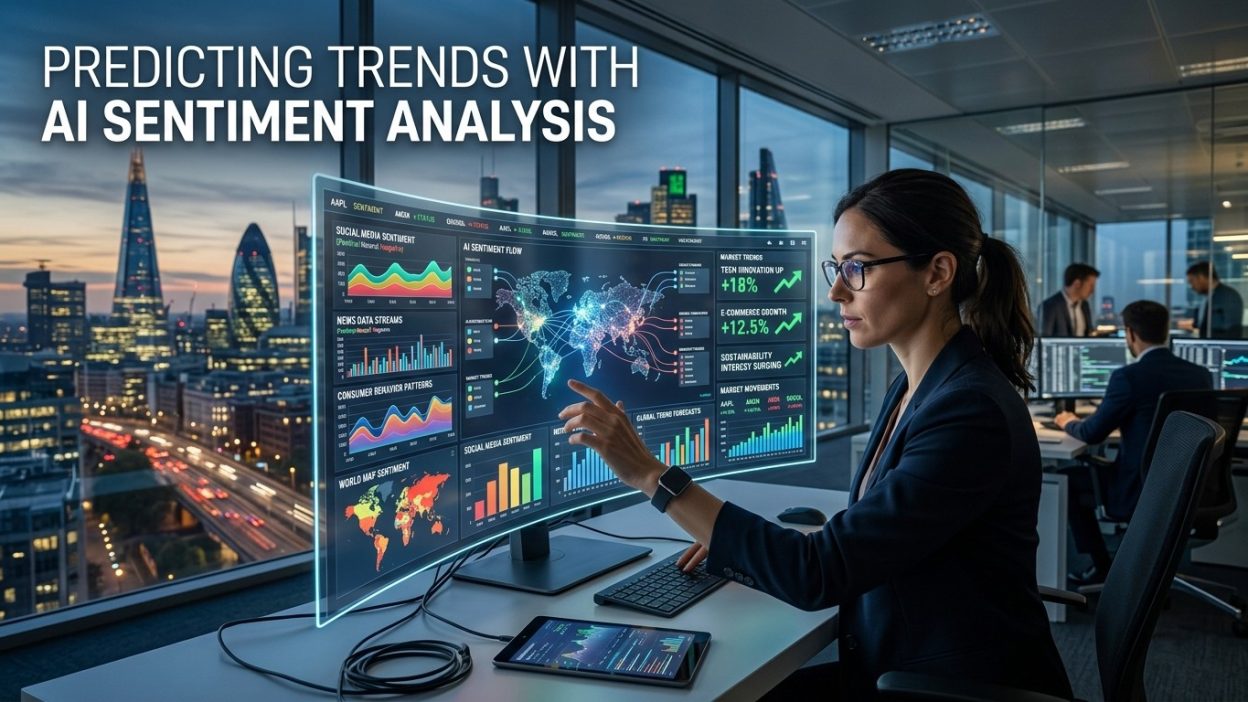
AI-driven sentiment intelligence helps businesses detect emerging customer attitudes, recognize meaningful patterns, anticipate market shifts, and turn scattered feedback into timely strategic decisions with greater confidence and speed.
Customer opinion rarely changes in one dramatic moment. More often, it moves through small signals: a few frustrated reviews, a change in social conversation, repeated questions about a product feature, growing praise for a competitor, or a sudden increase in discussion around a specific issue. Businesses that notice these signals early can investigate what is changing before the pattern becomes obvious. AI Sentiment Analysis helps make that process scalable by examining large volumes of human language and organizing it into useful signals.
The real value is not simply knowing whether comments are positive or negative. A sophisticated system needs to understand what people are discussing, how strongly they feel about it, which groups are driving the conversation, and whether the pattern is becoming stronger or weaker over time. AI Sentiment Analysis can support this deeper interpretation by combining sentiment with topics, timing, customer segments, channels, and behavioral context.
Trend prediction also requires discipline. A spike in negative comments does not automatically mean a reputation crisis. A rise in positive mentions does not necessarily mean customers are becoming more loyal. AI Sentiment Analysis becomes useful when it helps teams distinguish temporary noise from sustained movement.
That makes sentiment intelligence less of a reporting exercise and more of an early-warning and decision-support system.
What Is AI Sentiment Analysis?
AI Sentiment Analysis is the use of artificial intelligence and language-processing techniques to classify and interpret opinions, emotions, attitudes, and perceptions expressed in text or other forms of customer feedback.
Traditional sentiment tools often reduce feedback to three simple categories: positive, neutral, and negative. That can be useful for a basic overview, but businesses usually need more detail.
A customer might be unhappy with delivery speed but extremely positive about product quality. Another customer may write a neutral-looking sentence that actually signals serious frustration. Someone else may use humor or sarcasm that a basic classifier misunderstands. AI Sentiment Analysis attempts to recognize these nuances by examining the context surrounding the words.
A stronger system can identify dimensions such as:
| Analysis Layer | Example Insight |
|---|---|
| Sentiment | Positive, neutral, negative |
| Emotion | Frustration, excitement, disappointment, trust |
| Topic | Pricing, delivery, support, quality |
| Intensity | Mild concern versus severe dissatisfaction |
| Intent | Complaint, recommendation, question, praise |
| Entity | Product, feature, competitor, location |
| Time | Emerging, stable, declining |
| Audience | Customer segment or market |
AI Sentiment Analysis therefore works best as a contextual intelligence layer rather than a simple sentiment counter.
How Sentiment Signals Become Trend Signals
Trend prediction starts with repeated observations.
One negative comment is an event. Ten similar comments from different customers over several weeks may indicate a pattern. If those comments suddenly increase across different channels, the pattern becomes more important.
AI Sentiment Analysis can detect these changes by processing conversations at scale and identifying recurring relationships between sentiment, topics, and time.
Imagine that customers gradually begin mentioning “slow onboarding” in reviews. Initially, the issue represents a tiny percentage of all feedback. Two weeks later, it appears in customer support conversations, social comments, and community discussions. A month later, competitors begin highlighting easier onboarding in their marketing.
The business now has a trend, not merely isolated complaints.
AI Sentiment Analysis helps connect those fragments into a broader signal. It can identify rising topic frequency, changes in emotional intensity, unusual vocabulary, and shifts within particular customer groups.
The objective is not to predict an exact future event. It is to improve the probability of noticing meaningful changes early enough to investigate and respond intelligently.
Where the Data Comes From
The quality of trend prediction depends heavily on data coverage.
Businesses can analyze reviews, surveys, support tickets, social media posts, community discussions, chat transcripts, feedback forms, comments, product reviews, public forums, and other appropriate sources.
First-party sources often provide rich context because the organization knows the customer relationship, purchase history, product usage, and support journey. Public sources can provide broader market visibility.
AI Sentiment Analysis becomes more reliable when sources are combined while maintaining awareness of their differences.
For instance, social media may contain shorter and more emotional messages, while survey responses may contain detailed explanations. Review websites may attract customers with particularly strong experiences, while support tickets may represent people currently experiencing problems.
Teams should therefore avoid combining everything blindly.
Understanding different Intent Data Sources can also help when businesses want to add behavioral research signals to their broader customer and market intelligence framework.
Separating Signal From Noise
One of the hardest parts of sentiment monitoring is deciding whether a change is meaningful.
Online conversations naturally fluctuate. A campaign can create a temporary increase in mentions. A seasonal event may generate unusually positive or negative feedback. A news story can trigger thousands of discussions that disappear after a few days.
AI Sentiment Analysis helps separate signal from noise by examining more than raw mention volume.
Useful validation questions include:
- Did the change happen across multiple channels?
- Is the same topic appearing repeatedly?
- Is the sentiment intensity increasing?
- Are multiple customer groups affected?
- Does the shift exceed the normal baseline?
- Is the pattern lasting longer than a temporary event?
AI Sentiment Analysis can also compare current activity with historical behavior. If a brand normally receives 2 percent negative comments about delivery and suddenly reaches 9 percent for several weeks, the difference deserves investigation.
A smart system should therefore flag anomalies rather than treating every fluctuation as an emergency.
Time-Series Analysis and Trend Detection

Time is essential to prediction.
A sentiment score without a timeline tells very little. A score that changes from positive to neutral over six months may indicate gradual dissatisfaction. A sudden shift from neutral to strongly negative within three days may represent a different type of event.
AI Sentiment Analysis can support time-series analysis by calculating sentiment movement across defined intervals.
Teams can compare:
Daily changes
Useful for fast-moving crises or viral conversations.
Weekly changes
Useful for recurring customer experience issues.
Monthly changes
Useful for broader brand and product trends.
Quarterly changes
Useful for strategic perception shifts and market positioning.
The right timeframe depends on the business.
AI Sentiment Analysis becomes especially useful when organizations establish a baseline before measuring deviations. Without a baseline, even a large number may be difficult to interpret.
Historical comparisons also reduce overreaction because teams can distinguish normal seasonal behavior from unusual movement.
Combining Sentiment With Topics
Sentiment alone cannot explain why people feel a certain way.
A brand might see negative sentiment rise by 15 percent. The important question is what caused it.
AI Sentiment Analysis becomes considerably more valuable when sentiment is linked to topic classification.
Suppose negative sentiment increases around “shipping,” while sentiment around “product quality” improves. The overall brand score may look stable, even though one operational problem is worsening.
Topic-level sentiment exposes that difference.
A topic matrix can look like this:
| Topic | Current Sentiment | Direction | Possible Action |
|---|---|---|---|
| Product quality | Positive | Rising | Promote strengths |
| Delivery | Negative | Rising | Investigate operations |
| Support | Mixed | Stable | Improve consistency |
| Pricing | Neutral | Rising concern | Clarify value |
| Onboarding | Negative | Declining | Review customer journey |
This kind of analysis allows teams to move from “people are unhappy” to “customers are becoming increasingly frustrated with one specific part of the experience.”
That is a much more useful business insight.
Detecting Emotional Intensity
Two negative comments may have very different business implications.
“Delivery took longer than expected” indicates a mild problem.
“This was the worst service experience I’ve had and I will never order again” contains a much stronger emotional signal.
AI Sentiment Analysis can help estimate intensity by examining language, context, repetition, and other linguistic features.
Intensity becomes especially valuable when reputation teams need to prioritize large volumes of feedback.
A practical model could categorize comments as:
Low intensity: Minor dissatisfaction or suggestion.
Moderate intensity: Clear frustration or repeated concern.
High intensity: Strong anger, serious accusation, or threat to discontinue.
Critical intensity: Potential safety, legal, ethical, or major reputational issue.
AI Sentiment Analysis can then combine intensity with reach, topic severity, customer value, and growth rate.
This helps teams avoid spending equal attention on every negative message.
Social Listening and Emerging Conversations
Social platforms often reveal trends before traditional research catches them.
Customers may discuss frustrations publicly before submitting formal complaints. Industry communities may discover a product weakness before the brand notices it. Influencers may introduce a new narrative that spreads quickly.
AI Sentiment Analysis can process these conversations at scale and help identify clusters of related language.
For example, a software company might notice a growing number of posts mentioning “unexpected complexity” alongside words such as “migration,” “setup,” and “implementation.” That combination could indicate a broader perception issue.
The important part is not simply counting the posts. It is understanding whether the same idea is appearing across independent conversations.
AI Sentiment Analysis can also reveal which channels are generating the strongest emotional response. A topic that is barely visible in reviews but rapidly growing on social media may require a different monitoring strategy.
Understanding Customer Reviews at Scale
Reviews contain valuable information because customers often explain why they gave a certain rating.
A five-star review may praise delivery speed, while a two-star review may complain about packaging. Averaging the ratings alone loses that detail.
AI Sentiment Analysis can classify thousands of reviews by topic and emotional tone, allowing businesses to discover which factors consistently affect satisfaction.
For example, a hotel might discover that guests praise staff friendliness but repeatedly mention room cleanliness. A restaurant might learn that food quality is praised while service delays dominate lower ratings.
This helps management prioritize improvements.
Review analysis can also identify changes after a product update, service-policy adjustment, pricing change, or operational redesign.
When the customer voice is tracked continuously, organizations can compare perception before and after major changes instead of relying on anecdotal feedback.
Reputation Management and Sentiment Trends
Reputation is shaped by repeated public experiences.
A small number of complaints may not materially affect a brand, but recurring criticism can create a narrative that spreads across channels.
The AI Advantage in Reputation Management becomes stronger when sentiment systems can identify emerging complaints, compare them with historical patterns, and route significant issues to the appropriate team.
AI Sentiment Analysis can support this process by connecting emotional shifts to specific topics.
For instance, rising negativity around customer support may point to staffing or training problems. Increased positivity around a newly launched feature may indicate that product improvements are resonating.
The value comes from connecting reputation signals to underlying business conditions.
AI Sentiment Analysis should therefore not be treated as a standalone reputation metric. It should work alongside review analysis, customer experience data, operational information, and human investigation.
Product Trend Prediction
Customer language can reveal what people want next.
Repeated requests for a feature, growing frustration with an existing process, or increasing praise for a particular capability can point toward future product opportunities.
AI Sentiment Analysis helps product teams organize these signals by detecting recurring themes across feedback.
Imagine a SaaS company receiving hundreds of comments that mention automation, integrations, and reporting. Individually, each request may seem minor. Collectively, the pattern can suggest an emerging expectation.
The product team can then compare those insights with strategic priorities, technical feasibility, revenue potential, and customer segments.
AI Sentiment Analysis becomes especially valuable when product managers can move from anecdotal statements toward measurable patterns.
However, feedback frequency should not automatically determine the roadmap. The loudest request is not always the most valuable request.
Sentiment intelligence should inform product strategy rather than replace strategic judgment.
Predicting Market and Competitor Trends
Sentiment does not only describe your own customers.
Businesses can monitor public conversations about competitors, categories, technologies, and broader market issues.
AI Sentiment Analysis can identify themes associated with competitor strengths and weaknesses, helping organizations understand changing expectations.
Suppose customers increasingly praise one competitor for faster implementation while criticizing another for poor support. That information can influence positioning, customer experience strategy, and sales messaging.
Competitor sentiment should be handled carefully because online conversations can be unrepresentative. Certain platforms attract particular audiences, and high-volume discussions may not reflect the entire market.
AI Sentiment Analysis can still be useful as an early indicator when combined with other research methods.
The goal is not to declare that one competitor is universally better. It is to identify what attributes customers are increasingly discussing and why those attributes may matter.
Building an Early-Warning System
An early-warning system should recognize meaningful deviations before they become obvious.
Start by defining normal conditions.
What percentage of feedback is typically negative? Which topics are common? How frequently do complaints occur? Which channels usually create the most activity?
Then create thresholds for unusual movement.
AI Sentiment Analysis can detect situations where a topic suddenly becomes more negative, a customer segment changes its language, or a conversation spreads faster than normal.
A practical alert might say:
Topic: Delivery
Sentiment: Strongly negative
Change: 3.2× historical average
Channels: Reviews + social
Timeframe: Seven days
Primary region: Northeast market
Recommended owner: Operations + customer experience
The value of such an alert is that it provides context.
AI Sentiment Analysis should reduce the time needed to understand what changed, while people remain responsible for determining why it changed and what should happen next.
Automation, Smart Bots, and Workflow Efficiency

Sentiment systems become more useful when insights automatically reach the people who can act on them.
A customer complaint may belong to support. A product issue may belong to engineering. A reputation risk may require communications. A recurring billing complaint may belong to finance.
Manual routing creates delays.
AI Sentiment Analysis can classify incoming feedback and recommend or initiate routing based on predefined rules.
For repetitive workflow tasks, Smart Bots can support automated tagging, categorization, and routing processes that would otherwise require repeated manual work.
The result is a shorter distance between customer feedback and internal action.
Automation should still have safeguards. Sensitive cases, legal allegations, safety concerns, highly influential public posts, and ambiguous comments should receive human review.
AI Sentiment Analysis is strongest when automation handles scale while people handle judgment.
Connecting Sentiment With Behavioral Intent
Sentiment tells you what people feel. Behavioral signals can tell you what they are doing.
Combining both can create a more complete picture.
A prospect may show strong research activity around a product category while public sentiment toward that category is becoming more skeptical. Another audience may research a brand while customer sentiment is becoming increasingly positive.
When connected appropriately, Intent Data can provide behavioral context around research activity while sentiment intelligence provides perception context.
AI Sentiment Analysis can then help teams understand whether rising attention is associated with enthusiasm, concern, curiosity, frustration, or uncertainty.
This combination can improve campaign planning and message development.
For example, if research activity rises while customers repeatedly complain about setup complexity, marketing may need to address implementation concerns directly rather than simply increasing promotional activity.
AI Sentiment Analysis does not replace behavioral intelligence. It adds another layer that helps explain the emotional context surrounding the behavior.
Measuring Sentiment Trends With the Right Metrics
A good measurement system avoids relying on one score.
Useful metrics include:
| Metric | What It Reveals |
|---|---|
| Sentiment distribution | Overall emotional mix |
| Sentiment velocity | How quickly perception is changing |
| Topic frequency | Which issues dominate conversation |
| Negative-topic growth | Emerging problems |
| Positive-theme growth | Emerging strengths |
| Emotion intensity | Severity of reactions |
| Channel variation | Where the shift is happening |
| Segment variation | Who is experiencing the change |
| Resolution sentiment | Whether responses improve perception |
| Trend persistence | Whether the pattern lasts |
AI Sentiment Analysis should be evaluated based on whether it produces useful business intelligence rather than attractive dashboards.
A trend that cannot influence a decision may not deserve operational priority.
Teams should also measure false positives. If the system repeatedly flags harmless events as major reputation risks, people will eventually ignore the alerts.
Building a Reliable Sentiment Dashboard
A dashboard should help users answer practical questions quickly.
What changed?
Where did it change?
Why did it change?
Who is affected?
How serious is it?
Is the trend accelerating?
What should be investigated?
AI Sentiment Analysis can power a dashboard that displays current sentiment, historical movement, topic clusters, emotional intensity, and emerging anomalies.
But visual simplicity matters.
A dashboard filled with dozens of charts may make information harder to understand. Decision-makers should see the most important changes first, followed by supporting evidence.
A useful layout could contain:
Trend overview
Current sentiment compared with the previous period.
Emerging topics
Themes showing unusual growth.
Risk areas
Topics with increasing negativity or intensity.
Positive opportunities
Areas where customers are showing stronger approval.
Action queue
Issues requiring human investigation.
AI Sentiment Analysis becomes more operational when the dashboard moves from passive reporting toward prioritized action.
Creating a Practical Implementation Framework
Businesses do not need a massive AI program to start.
Begin with a limited set of sources and a few high-value questions.
Step 1: Define the Objectives
Decide whether the primary goal is reputation monitoring, customer experience, product feedback, market research, or campaign intelligence.
Step 2: Select Data Sources
Choose sources that are relevant, reliable, legally appropriate, and sufficiently representative.
Step 3: Create a Topic Taxonomy
Define the subjects that matter most to the business.
Step 4: Establish Baselines
Understand normal sentiment patterns before creating alerts.
Step 5: Configure Analysis
Set up sentiment, emotion, topic, intensity, and trend detection.
Step 6: Create Escalation Rules
Define which signals need immediate human review.
Step 7: Connect Workflows
Route relevant insights to customer experience, product, communications, marketing, or sales teams.
Step 8: Measure Outcomes
Track whether the intelligence leads to useful action and measurable improvement.
AI Sentiment Analysis becomes easier to manage when the initial program is narrow, measurable, and connected to clear business decisions.
Common Mistakes That Reduce Prediction Accuracy
Mistake 1: Treating Sentiment as a Truth Machine
AI classification is an estimate. It can be wrong.
Mistake 2: Ignoring Context
The word “bad” can describe a product, a competitor, a situation, or even an example in educational content.
Mistake 3: Looking Only at Percentages
Sentiment percentages can hide the actual topic causing the change.
Mistake 4: Ignoring Sampling Bias
Public online conversations are not always representative of every customer.
Mistake 5: Reacting to Temporary Spikes
A viral event may create temporary sentiment movement without changing the long-term trend.
Mistake 6: Forgetting Language Differences
Slang, sarcasm, cultural expressions, and multilingual conversations can reduce classification accuracy.
Mistake 7: Automating High-Stakes Responses
Important reputation and customer issues need human review.
Mistake 8: Failing to Validate Predictions
Teams should compare predicted trends with actual outcomes.
AI Sentiment Analysis improves over time when errors are measured and the system is continuously refined.
Human Psychology and Sentiment Prediction
Trend analysis works because human decisions are influenced by repeated perceptions.
People notice consistency. Repeated praise can strengthen confidence. Repeated complaints can create doubt. Sudden controversy can increase uncertainty. Positive customer stories can reduce perceived risk.
AI Sentiment Analysis helps businesses observe these psychological patterns across large populations.
But interpretation still requires empathy.
A sudden increase in frustration may reflect a real emotional experience that a dashboard cannot fully explain. Leaders should ask what customers were trying to accomplish, what went wrong, and what outcome they expected.
The strongest reputation and customer experience systems therefore combine quantitative analysis with qualitative review.
AI Sentiment Analysis can tell the team where the pattern is moving. Human investigation helps explain what the pattern means.
Measuring the Business Impact
The final question is whether sentiment intelligence changes business outcomes.
Potential measures include:
- Complaint resolution time
- Customer satisfaction
- Retention
- Repeat purchases
- Review ratings
- Positive mention growth
- Product adoption
- Support escalation
- Campaign response
- Conversion rate
- Brand consideration
These metrics should be connected carefully.
A sentiment improvement does not automatically prove that AI caused revenue growth. Many factors influence commercial outcomes.
Instead, organizations should look for patterns and test interventions.
For example, if a recurring support complaint is identified early, a process change can be introduced. The business can then track whether complaint frequency declines and whether related customer satisfaction improves.
AI Sentiment Analysis becomes valuable when it contributes to a measurable improvement loop.
Future of Sentiment-Based Trend Prediction
The next generation of sentiment systems will likely move beyond simple positive-versus-negative classification.
Multimodal analysis can combine text with other signals. More advanced models can understand conversational context, identify nuanced emotions, cluster emerging narratives, and summarize long-term changes.
Organizations may also use AI to compare sentiment across customer segments, markets, competitors, products, and channels in a single analytical environment.
AI Sentiment Analysis will increasingly become part of broader customer intelligence rather than a standalone tool.
Even as models become more capable, the fundamentals will remain important: quality data, representative samples, clear taxonomy, strong governance, historical baselines, and human review.
The best systems will not simply generate more predictions. They will generate more useful predictions that decision-makers can understand and act upon.
Creating a Long-Term Sentiment Intelligence Strategy

A sustainable strategy requires continuous learning.
Start with the signals that matter most to your business. Build reliable data pipelines. Establish baselines. Monitor changes. Investigate anomalies. Connect insights with responsible action.
AI Sentiment Analysis can then become part of a continuous cycle:
Listen → Analyze → Detect → Investigate → Act → Measure → Learn
The cycle is more important than any single dashboard or model.
Over time, teams can identify which signals predict meaningful outcomes, which data sources are most useful, and which types of sentiment changes require intervention.
The organization becomes better at understanding not only what customers are saying today but also what those conversations may indicate about tomorrow.
AI Sentiment Analysis should ultimately serve that larger goal: turning human feedback into better decisions without reducing human experience to a number.
Frequently Asked Questions (FAQ)
1. What is sentiment-based trend prediction?
Sentiment-based trend prediction uses patterns in customer opinions and emotional language to identify changes that may indicate emerging market, product, service, or reputation trends.
2. Can sentiment analysis predict the future accurately?
No system can guarantee future outcomes. Sentiment analysis can identify signals and patterns that may indicate emerging trends, but those signals should be validated with other evidence.
3. What data is useful for sentiment trend analysis?
Useful sources can include reviews, surveys, customer support conversations, social posts, community discussions, feedback forms, product comments, and other appropriate customer or market conversations.
4. Why is topic analysis important?
Sentiment tells you the direction of an opinion, while topic analysis helps explain the reason behind that opinion. Together, they provide more actionable insight.
5. How can businesses identify a real trend?
A real trend usually has stronger evidence when it persists over time, appears across multiple sources, involves multiple audiences, and represents a meaningful change from the normal baseline.
6. Can AI understand sarcasm?
AI systems can sometimes detect sarcasm, but it remains a challenging area. Context, cultural language, slang, and ambiguous phrasing can cause classification errors.
7. Can sentiment analysis help product development?
Yes. Recurring praise, complaints, feature requests, and emotional reactions can reveal customer priorities and help product teams identify areas worth investigating.
8. How does sentiment analysis support reputation management?
It helps organizations monitor perception, identify emerging complaints, detect unusual changes, and prioritize conversations that may require investigation or response.
9. Should businesses automate sentiment-based responses?
Routine workflows can be automated, but sensitive, high-visibility, legal, safety-related, or ambiguous issues should generally receive human review before public action.
10. How should companies measure sentiment intelligence success?
Success can be measured through operational and business outcomes such as faster issue detection, shorter resolution times, improved customer satisfaction, lower recurring complaints, stronger retention, and better decision-making.
Conclusion
Sentiment intelligence gives businesses a practical way to detect changes in customer perception before those changes become impossible to ignore. Its real value comes from connecting emotional signals with topics, timing, customer groups, channels, and historical baselines. Strong systems do not treat every negative comment as a crisis or every positive comment as proof of loyalty. They look for persistent patterns, meaningful deviations, and signals that deserve human investigation. When combined with responsible automation, customer feedback, behavioral intelligence, and clear business objectives, sentiment-based trend prediction can help organizations respond earlier, understand customers more deeply, improve products and services, and make strategic decisions with stronger evidence.