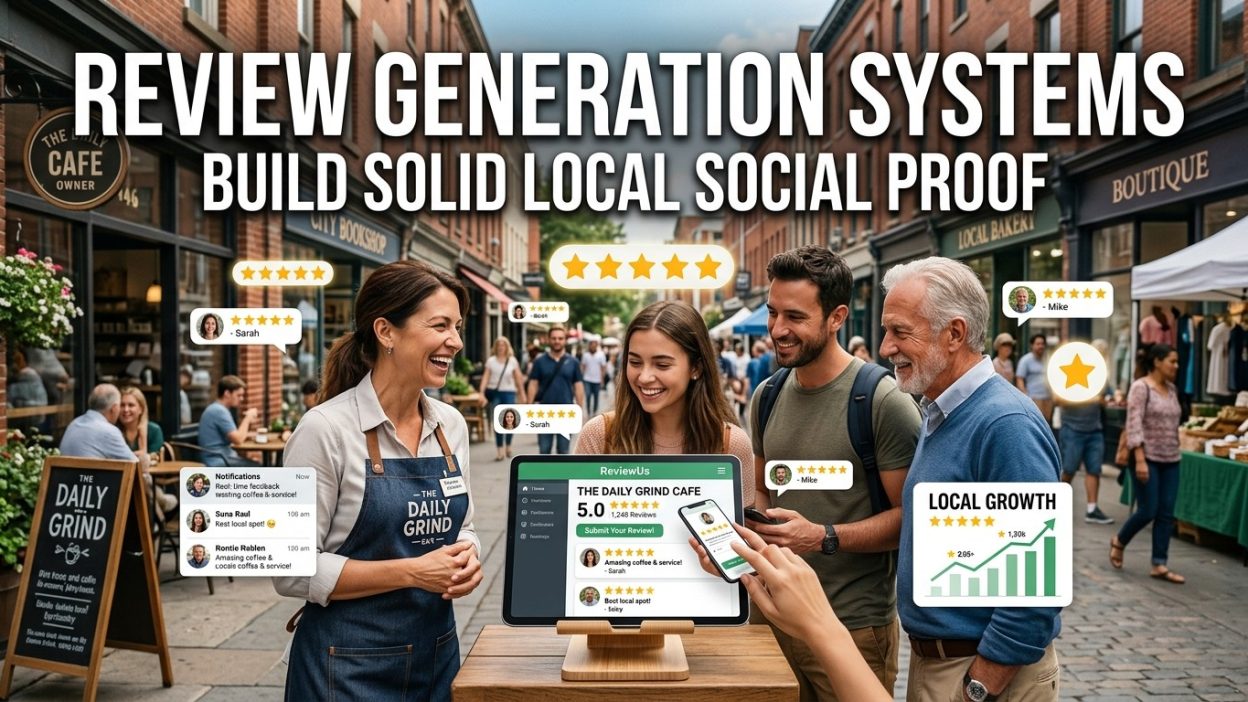
Review Generation Systems help local businesses consistently earn authentic customer feedback by improving timing, convenience, follow-up, trust, response quality, and long-term reputation management.
Customer reviews have become one of the most visible forms of local social proof. Before contacting a business, people often look for evidence that others have already had a positive experience. They want reassurance that the company is legitimate, dependable, responsive, and capable of delivering what it promises.
That makes Review Generation Systems much more important than a simple request asking customers to “leave a review.” A strong system creates a repeatable process that identifies the right moment to request feedback, delivers a convenient request, makes the experience easy, follows up appropriately, and ensures the business continues responding to feedback after reviews are published.
The objective is not to manufacture positive sentiment. It is to create a reliable mechanism that gives genuine customers a clear opportunity to share their experience.
Review Generation Systems should therefore be built around customer experience rather than rating manipulation. Businesses that consistently deliver useful service are in a stronger position because their review process can simply make it easier for satisfied customers to tell others what happened.
This approach also creates operational value. Reviews can reveal recurring customer questions, service weaknesses, employee strengths, delivery issues, and points of confusion. A business that treats feedback as data can use it to improve both its reputation and its actual customer experience.
Local businesses face another challenge: competitors often provide similar products or services. When customers compare several nearby businesses, social proof can become a practical trust signal. A company with clear, recent, detailed customer experiences may appear easier to evaluate than one with little public feedback.
Review Generation Systems create structure around this process. Instead of depending on employees to remember to ask customers, the business establishes triggers, messaging, channels, tracking, and response workflows.
What Are Review Generation Systems?
Review Generation Systems are structured processes that help businesses consistently request, collect, monitor, analyze, and respond to customer feedback across relevant review platforms.
The system can be manual, automated, or hybrid.
A small local business may use a CRM reminder and a simple email template. A larger organization may connect customer records, messaging tools, review monitoring software, analytics, and location-level reporting.
Review Generation Systems are not simply “review software.” Software can support the process, but the quality of the system depends on when the request happens, what customers are asked to do, how friction is reduced, and how the organization handles the feedback afterward.
The Core Components
A useful review system normally contains several connected components:
| Component | Purpose |
|---|---|
| Customer trigger | Identifies when a review request should happen |
| Request message | Explains the reason for asking |
| Review destination | Sends customers to the appropriate platform |
| Follow-up | Recovers customers who missed the first request |
| Monitoring | Tracks incoming reviews |
| Response process | Handles public feedback |
| Reporting | Measures volume, recency, themes, and trends |
| Improvement loop | Converts feedback into operational changes |
Review Generation Systems become sustainable when these components work together instead of operating independently.
Why Reviews Matter to Local Businesses
Reviews perform several jobs simultaneously.
First, they provide social proof. A potential customer sees that other people have interacted with the business.
Second, they provide information. Detailed reviews can explain what customers appreciated, how the service worked, how staff behaved, and what the experience actually felt like.
Third, reviews reduce uncertainty. Buying from an unfamiliar business creates risk. Other customers’ experiences can reduce that perceived risk.
Fourth, reviews create feedback for the company itself.
Review Generation Systems support all four functions when they are designed around genuine customer experiences.
Social Proof Reduces Perceived Risk
A new customer does not know exactly what will happen after making contact.
They may wonder whether the business will answer quickly, charge unexpectedly, deliver on time, solve the problem, or provide professional service.
Reviews cannot eliminate uncertainty, but they can provide evidence from other customers.
Review Generation Systems help businesses create more opportunities for those authentic experiences to become visible.
Recency Also Matters
A profile containing reviews from several years ago may not fully communicate the current customer experience.
Recent feedback can provide a stronger indication of ongoing activity, changing service standards, and current customer sentiment.
Review Generation Systems should therefore aim for consistent review acquisition over time rather than occasional bursts.
Build the Process Around Customer Milestones
The best moment to request a review depends on the business.
A restaurant might ask shortly after a successful visit.
A service company might request feedback after the job is completed.
An agency could wait until a project milestone has been delivered.
An e-commerce business might ask after the customer has received and used the product.
Review Generation Systems should identify the point where the customer has enough experience to provide meaningful feedback.
Do Not Ask Too Early
Requesting feedback before the customer understands the service creates a poor experience.
For example, asking for a review immediately after payment may be too early when the service will not be delivered until days later.
Review Generation Systems should be tied to a completed or meaningful customer outcome rather than simply a transaction event.
Do Not Wait Too Long
Waiting several weeks or months can reduce response rates because the experience becomes less immediate.
The ideal timing depends on the customer journey.
Review Generation Systems should therefore be tested against actual response behavior rather than copied blindly from another business.
Identify the Right Review Trigger
A trigger is an event that signals the customer has reached a logical point for feedback.
Possible triggers include:
- Completed service
- Successful delivery
- Appointment completion
- Purchase received
- Project milestone
- Support issue resolved
- Customer renewal
- Positive customer interaction
- Completion of onboarding
Review Generation Systems become more natural when the request is connected to something that already happened.
Use Positive Experience Signals Carefully
Employees often know when a customer expresses satisfaction.
A customer might say, “That solved my problem,” or “Everything was handled perfectly.”
That can indicate a suitable moment to invite feedback.
However, Review Generation Systems should not hide the review request from unhappy customers or manipulate customers into leaving only positive feedback. The goal should be authentic participation.
Make Review Requests Easy
One of the biggest causes of low review participation is friction.
A customer may genuinely like the business but still ignore the request because the process takes too much effort.
Review Generation Systems should reduce the number of steps required.
The customer should understand what to do, where to do it, and why the request is being made.
Minimize Clicks
A long sequence involving account creation, searching for the business, finding the review section, and navigating multiple pages can create abandonment.
Whenever possible, provide a direct path to the relevant review interface.
Review Generation Systems work better when the customer does not have to become a researcher just to leave feedback.
Keep the Request Short
A review request does not need to be a marketing brochure.
A concise message can explain that the business values honest feedback and provide the appropriate destination.
Long messages create unnecessary reading effort.
Review Generation Systems should respect the customer’s attention.
Choose the Right Communication Channel
Review requests can be delivered through email, SMS, messaging platforms, receipts, post-purchase pages, apps, QR codes, or staff-assisted requests.
The best channel depends on how the customer naturally communicates with the business.
Email Requests
Email works well when the customer already receives transactional communications through email.
A good request can appear as a natural post-service follow-up.
Review Generation Systems can automate the timing while allowing the business to maintain a human tone.
SMS Requests
SMS may work well when customers already communicate with the business through text.
Because SMS is immediate, messages should be concise and avoid unnecessary marketing language.
Review Generation Systems should use the channel only when customers have appropriate permission to receive such communications and the process complies with applicable requirements.
In-Person Requests
Face-to-face requests can work particularly well for local businesses.
An employee can mention that honest feedback is appreciated and provide a simple way to submit it.
Review Generation Systems can support employees with QR codes, printed materials, or follow-up messages without requiring the interaction to feel scripted.
Create a Consistent Review Request Message
The wording of the message influences how customers perceive the request.
A strong request generally contains:
- Appreciation for the customer’s business
- A simple explanation that feedback is valuable
- An invitation to share an honest experience
- A convenient review path
The request should not pressure the customer to provide a particular rating.
Review Generation Systems should be designed around authenticity because credibility depends on genuine feedback.
Avoid Asking for a Specific Rating
Messages that explicitly demand a five-star rating can create several problems.
They can make the request feel transactional and may reduce the credibility of the feedback.
The better approach is to ask customers to share an honest review or describe their experience.
Review Generation Systems should encourage genuine expression rather than dictate the outcome.
Avoid Overly Promotional Language
The message is about customer feedback, not another sales pitch.
A line such as “Your experience helps future customers understand what to expect” can communicate purpose without turning the request into advertising.
Review Generation Systems should feel like part of customer communication.
Personalize Without Making It Complicated
Personalization can improve response rates when it makes the request feel relevant.
Use the customer’s name, service type, location where appropriate, or recent transaction context.
However, overpersonalization can make a simple request feel like a marketing automation experiment.
Review Generation Systems should use enough context to feel human while keeping the communication efficient.
Segment by Customer Journey
Different customer types may require different request timing.
A first-time customer has a different experience from a long-term customer.
A recurring service customer may have several meaningful moments that could justify feedback.
Review Generation Systems can create different triggers for different journeys.
Use Staff Training to Improve Review Acquisition
Automation cannot fully replace employee behavior.
Employees often interact with customers at moments when satisfaction is especially visible.
Train staff to recognize appropriate moments to mention feedback without pressuring customers.
A useful script might simply communicate that the business values honest feedback and provide the customer with an easy review option.
Review Generation Systems work better when employees understand the purpose of the process rather than seeing it as another mandatory task.
Avoid Incentive-Based Manipulation
Businesses should be cautious about offering rewards in ways that distort feedback or conflict with platform rules.
The objective should be participation, not artificially positive reviews.
Review Generation Systems should protect the authenticity of the feedback ecosystem.
Create a Review Request Workflow
A practical workflow can look like this:
Step 1: Customer completes a meaningful transaction or service milestone.
Step 2: The CRM records the completion.
Step 3: The review request is sent through the preferred communication channel.
Step 4: The customer receives a simple path to the appropriate review platform.
Step 5: A reminder is sent when appropriate.
Step 6: New reviews are monitored.
Step 7: The business responds.
Step 8: Feedback themes are analyzed.
Step 9: Operational improvements are documented.
Review Generation Systems become powerful when the process continues beyond the initial request.
Follow Up Without Becoming Annoying
Some customers see a message but forget to respond.
A polite follow-up can recover some of those missed opportunities.
But repeated reminders can become irritating.
Review Generation Systems should use controlled follow-up rules.
Use a Limited Follow-Up Sequence
A practical sequence may contain one initial request followed by one reminder after an appropriate interval.
The exact timing depends on the customer journey and communication channel.
The reminder should not create guilt or pressure.
Instead, it can politely explain that feedback remains valuable.
Stop When the Customer Completes the Action
The system should recognize when a review has been submitted.
There is little reason to continue asking the same customer for the same action.
Review Generation Systems should therefore connect request tracking with outcome tracking whenever possible.
Centralize Review Monitoring
Receiving reviews across multiple platforms creates management challenges.
A local business may have feedback on major search platforms, social networks, industry directories, travel sites, marketplace profiles, or specialized review websites.
Review Generation Systems can centralize monitoring so the team does not have to check every platform manually.
Track Location-Level Performance
For multi-location businesses, corporate averages can hide local differences.
One branch may receive frequent reviews while another receives very few.
Review Generation Systems should report performance at the appropriate location level.
Useful metrics include review volume, recency, response rate, themes, and rating distribution.
Responding to Positive Reviews
A response demonstrates that the business is paying attention.
The response does not need to be lengthy.
Mentioning a specific part of the customer’s feedback can make the response feel more genuine.
Review Generation Systems should establish response guidelines while allowing staff to maintain natural language.
Avoid Copy-and-Paste Replies Everywhere
A repeated sentence across hundreds of reviews can appear automated.
Create several response patterns and personalize important details.
A short human response is usually better than a long generic paragraph.
Review Generation Systems should support consistency without eliminating individuality.
Responding to Negative Reviews
Negative reviews require careful handling because public replies can influence how prospective customers interpret the situation.
The goal is not to win an argument.
A useful response can acknowledge the concern, remain professional, avoid revealing private information, and provide an appropriate way to continue the discussion privately when necessary.
Review Generation Systems should include escalation rules for serious complaints.
Do Not Argue Publicly
Defensive responses often shift attention away from the original issue and toward the business’s behavior.
Keep the public response factual and respectful.
If additional investigation is necessary, invite the customer into an appropriate private channel.
Review Generation Systems can define who responds to different categories of feedback.
Learn From Repeated Complaints
One negative review may represent an isolated incident.
Several similar reviews can reveal a process problem.
Recurring complaints about wait times, communication, billing, scheduling, or service quality deserve internal investigation.
Review Generation Systems should therefore feed customer feedback into operational improvement.
Analyze Review Themes
Star ratings tell only part of the story.
The written content contains more detailed information.
Businesses can categorize recurring themes such as:
| Theme | Possible Insight |
|---|---|
| Staff friendliness | Service experience |
| Speed | Operational efficiency |
| Product quality | Product performance |
| Communication | Customer support |
| Pricing clarity | Sales transparency |
| Cleanliness | Physical experience |
| Scheduling | Process reliability |
| Expertise | Trust and competence |
| Delivery | Fulfillment quality |
Review Generation Systems become more valuable when these patterns are shared with relevant teams.
Turn Feedback Into Training
If customers frequently praise a particular employee behavior, that behavior can be documented as a best practice.
If customers repeatedly mention confusion during onboarding, training can address it.
Review Generation Systems should create a feedback loop between customers and operations.
Reviews and Local Search Visibility
Reviews can also contribute to the broader local search presence of a business.
Search visibility is influenced by multiple factors, and review activity should not be treated as a standalone ranking formula.
Businesses can improve their broader local presence by maintaining accurate business information, producing useful local content, strengthening relevance, and earning genuine mentions.
A broader local SEO strategy may include resources such as Google Local Ranking Secrets, but review acquisition should remain focused on authentic customer feedback rather than treating reviews as an isolated ranking tactic.
Review Generation Systems can support that ecosystem by making review collection consistent over time.
Reviews and Citation Consistency
Customer reviews are often displayed alongside business identity information.
If business names, addresses, phone numbers, or other details are inconsistent across the web, customers may become uncertain about whether they are viewing the correct business.
Review Generation Systems should therefore sit alongside a broader local information-management process.
A resource such as The Citation Secret can provide additional context for businesses reviewing citation consistency, while the review workflow remains focused on feedback acquisition and management.
Review Content Can Improve Marketing
Customer language can be incredibly useful.
Customers often describe benefits in words that internal marketing teams never considered.
They may explain why they chose the company, what surprised them, how the service solved a problem, or which feature they valued most.
Review Generation Systems can turn these insights into content research.
Find Repeated Customer Phrases
Look for phrases that appear repeatedly across reviews.
These can inform:
- Website copy
- Service descriptions
- FAQs
- Landing pages
- Sales scripts
- Social content
- Email messaging
- Product positioning
The business should use customer language accurately rather than manufacturing quotes.
Review Generation Systems can therefore improve messaging beyond reputation management.
Build a Review Request Calendar
Consistency is easier when review acquisition becomes part of the operating calendar.
Track review requests by location, customer segment, service category, month, and campaign.
Seasonal businesses can monitor whether review acquisition changes during peak periods.
Review Generation Systems benefit from predictable operating rhythms.
Avoid Sudden Review Surges
A business that receives very few reviews for months and then suddenly generates a large burst may create an unusual pattern.
A consistent, natural process is generally more sustainable.
The goal should be ongoing customer participation rather than artificial volume spikes.
Review Generation Systems should therefore operate continuously rather than only when the business wants to improve its public profile.
Segment Review Requests by Service
Different services can produce different experiences.
A dental practice may have cleaning appointments, cosmetic treatments, emergency visits, and consultations.
A home-service company may provide installation, repairs, maintenance, and inspections.
Review Generation Systems can create service-specific request language while preserving a unified brand voice.
Use Service-Specific Feedback Questions
Instead of asking every customer the same generic question, the business can ask what aspect of the experience was most useful.
This can produce richer insights.
For example:
“What did you find most helpful about the service?”
“What part of the process worked especially well?”
The business should still allow the customer to answer freely.
Review Generation Systems should facilitate feedback, not script it.
Use QR Codes Strategically
QR codes can make review requests easier in physical environments.
They can appear on receipts, packaging, tables, appointment materials, signage, or follow-up cards where appropriate.
The QR code should lead to a relevant destination and include clear instructions.
Review Generation Systems can incorporate QR codes as one channel rather than relying on them exclusively.
Give QR Codes Context
A QR code without explanation may be ignored.
A short line such as “Share your experience” communicates what the customer is being invited to do.
The visual presentation should be uncluttered.
Review Generation Systems should focus on usability.
Measure the Review Funnel
Review acquisition itself has a funnel.
For example:
| Stage | Measurement |
|---|---|
| Eligible customers | Number who completed the trigger event |
| Requests delivered | Successfully delivered requests |
| Request engagement | Clicks or visits |
| Review completion | Submitted reviews |
| Response | Business replies |
| Insight extraction | Feedback themes identified |
| Improvement | Actions taken |
Review Generation Systems should measure this funnel rather than judging performance only by total review count.
Calculate Review Request Conversion
A basic measure is:
Review Conversion Rate = Reviews Submitted ÷ Eligible Review Requests × 100
For example, if 500 eligible customers receive requests and 50 submit reviews, the review conversion rate is 10%.
This number should be interpreted in context because customer journey, channel, timing, industry, and platform can influence behavior.
Review Generation Systems become easier to optimize when the team knows where customers stop participating.
Measure Review Quality, Not Just Quantity
Ten detailed customer experiences may produce more useful insight than one hundred vague comments.
Review Generation Systems can track review length, service references, recurring themes, and specificity alongside volume.
The objective is not to force customers to write long reviews. It is to understand whether the feedback provides useful evidence and operational insight.
Track Recency
A steady flow of legitimate reviews can help maintain an up-to-date reputation profile.
Monitor how long it has been since the last review.
Review Generation Systems should flag locations or service categories where review activity has slowed significantly.
Connect Reviews With Revenue Carefully
It is tempting to assume that more reviews automatically create more customers.
The relationship is more complicated.
Reviews can influence trust and discovery, but revenue is also affected by pricing, competition, offer quality, demand, sales execution, website experience, and many other factors.
Review Generation Systems should therefore use multiple measurements.
Track review volume, inquiry volume, conversion rate, referral traffic, customer acquisition sources, and location-level revenue where appropriate.
When comparing outreach or marketing activities, a broader framework such as Measuring Outreach Channels ROI can help separate review performance from the performance of unrelated acquisition channels.
Common Review Generation Mistakes
Mistake 1: Asking Every Customer Immediately
Timing matters.
Mistake 2: Asking for Only Five-Star Reviews
This undermines authenticity.
Mistake 3: Sending the Same Message Repeatedly
Repetition reduces engagement.
Mistake 4: Ignoring Negative Feedback
Silence can communicate indifference.
Mistake 5: Writing Robotic Replies
Customers notice generic responses.
Mistake 6: Buying Reviews
Purchased reviews can create credibility and policy risks.
Mistake 7: Ignoring Platform Rules
Different platforms can have specific requirements concerning review solicitation and incentives.
Mistake 8: Focusing Only on Volume
More reviews do not compensate for unresolved service problems.
Review Generation Systems should improve the feedback process without trying to manufacture reputation.
Review Generation Systems for Multi-Location Businesses
Multi-location businesses require additional controls.
Each location should have:
- Local customer triggers
- Location-specific review destinations
- Assigned response owners
- Performance reporting
- Escalation rules
- Review monitoring
- Training standards
Review Generation Systems should centralize governance while allowing local teams to respond naturally.
Compare Locations Without Creating Unhealthy Competition
Location-level reporting is useful for identifying operational differences.
One branch may have strong review response rates but low request participation.
Another may have many reviews but recurring complaints about service speed.
The purpose of comparison should be learning.
Review Generation Systems can reveal where processes need support.
Automate Review Requests Responsibly
Automation can improve consistency dramatically.
A CRM can automatically trigger a request after an order is delivered or a service is marked complete.
But automation should contain safeguards.
The system should prevent duplicate messages, exclude customers who should not receive a request, recognize completed reviews when technically possible, and maintain clear communication preferences.
Review Generation Systems should automate timing and administration without removing human judgment from unusual situations.
Keep Automation Invisible When Possible
The customer should experience a natural communication flow.
They should not need to know which software generated the request.
Review Generation Systems become more effective when automation supports the experience instead of becoming the experience.
Use Different Messages by Customer Type
A long-term customer may appreciate a different message from a first-time buyer.
An enterprise client may receive a formal email.
A local retail customer may receive a brief SMS.
A homeowner who just completed a project may receive a follow-up focused on the completed result.
Review Generation Systems should adapt according to context while preserving the same ethical standard of honest feedback.
Create an Internal Review Response Policy
Employees should know:
Who responds?
How quickly should reviews be addressed?
Which complaints require escalation?
What information must remain private?
When should management become involved?
What should never be argued publicly?
Review Generation Systems should document these rules before a crisis occurs.
Escalate Serious Complaints
Certain reviews may involve allegations of safety issues, privacy problems, fraud, discrimination, legal disputes, or serious service failures.
These cases require appropriate internal handling.
The public response should remain professional and avoid exposing sensitive information.
Review Generation Systems should make escalation clear.
Turn Review Acquisition Into Customer Experience Improvement
The strongest businesses do not treat reviews as the final output.
They treat them as a diagnostic tool.
Suppose several customers mention that staff are friendly but appointment confirmation is confusing.
The reviews reveal a communication problem.
Management can improve confirmation messaging.
New customers then receive a better experience.
Those customers may eventually leave better feedback.
Review Generation Systems therefore create a feedback loop:
Experience → Review → Insight → Improvement → Better Experience → Future Feedback
This loop makes the system more valuable than a standalone collection campaign.
Build a Review Content Repository
As reviews accumulate, businesses can categorize them by:
- Service
- Customer type
- Location
- Problem solved
- Product
- Employee experience
- Feature
- Benefit
- Objection
This creates a searchable bank of customer language.
Review Generation Systems can feed this repository automatically or through periodic manual analysis.
Use Reviews in Sales Enablement
Sales teams can identify common customer concerns and use real customer experiences as educational evidence where permitted.
A salesperson might explain how similar customers approached a problem.
The important distinction is between accurately referencing genuine feedback and using fabricated social proof.
Review Generation Systems should preserve that distinction.
Improve the System With Testing
Testing can improve response rates without changing the underlying ethical standard.
Test:
- Timing
- Subject line
- Message length
- Channel
- CTA wording
- Reminder timing
- QR code placement
- Customer segment
- Service-specific language
Review Generation Systems should test one significant change at a time when practical.
Measure Downstream Quality
A higher click rate is not automatically better.
One message may encourage more customers to click but produce fewer completed reviews.
Another may generate fewer clicks but more completed submissions.
Review Generation Systems should optimize for completed, authentic feedback.
Building a Scalable Technology Stack
A technology stack may include:
CRM: Stores customer and transaction data.
Messaging platform: Sends email or SMS requests.
Review monitoring: Tracks published feedback.
Analytics: Measures requests, responses, and business outcomes.
Dashboard: Gives management visibility across locations.
Task system: Assigns response and escalation responsibilities.
Review Generation Systems do not require every business to use every tool. The stack should match operational complexity.
Start Small
A small business may only need a CRM field, automated email, direct review link, and monthly reporting.
As transaction volume grows, additional automation can be introduced.
Review Generation Systems should evolve with the business instead of adding unnecessary complexity.
A 90-Day Review System Implementation Plan
Days 1–30: Build the Foundation
Document the customer journey.
Identify review-worthy milestones.
Choose primary review channels.
Create request messages.
Assign response ownership.
Define escalation rules.
Review platform policies.
Review Generation Systems should begin with process clarity.
Days 31–60: Launch and Test
Activate automated or semi-automated requests.
Monitor participation.
Test timing.
Collect staff feedback.
Track customer responses.
Analyze review themes.
Review Generation Systems should remain flexible during this stage.
Days 61–90: Optimize
Compare performance by service and location.
Improve low-performing request stages.
Expand successful workflows.
Create reporting dashboards.
Introduce structured feedback analysis.
Connect reviews with broader customer experience initiatives.
Review Generation Systems become increasingly valuable as the organization accumulates evidence.
How to Scale Without Losing Authenticity
Scaling creates a temptation to optimize everything for volume.
That is the wrong objective.
Authenticity matters because the entire value of customer reviews comes from their credibility.
Review Generation Systems should make it easier for real customers to speak, not manufacture the appearance of popularity.
Quality Control Checklist
Before launching or expanding a process, verify:
Customer eligibility: Is this a legitimate customer?
Timing: Has the customer experienced the relevant service?
Message: Is the request clear and respectful?
Choice: Can the customer provide an honest opinion?
Destination: Does the link lead to the correct platform?
Frequency: Are duplicate requests prevented?
Privacy: Is customer data handled appropriately?
Monitoring: Is someone responsible for responses?
Review Generation Systems become safer and more effective when these controls are documented.
The Psychology Behind Review Requests
Customers may intend to leave a review but fail to do so because of distraction, effort, uncertainty, or lack of urgency.
A good request addresses these barriers.
The customer should know why the review matters, how long the process is likely to take, and where to complete it.
Review Generation Systems can reduce decision friction by making every part of the process straightforward.
Give Customers a Meaningful Reason
People are more likely to act when the purpose is understandable.
Explain that feedback helps the business improve or helps future customers understand the experience.
Avoid guilt-based language.
Review Generation Systems should create voluntary participation rather than emotional pressure.
Build Trust Before Asking for Reviews
A review request is only as strong as the preceding customer experience.
If customers receive poor communication, unresolved issues, unexpected charges, or inconsistent service, no automated system can permanently fix the underlying problem.
Review Generation Systems should therefore operate downstream of service quality.
Fix Experience Problems First
Look at recurring complaint themes.
Identify where customers are confused.
Measure response times.
Review cancellations and refund reasons.
Analyze support conversations.
Improve the operational issues that appear repeatedly.
Review Generation Systems then become a mechanism for documenting improved experiences.
The Relationship Between Reviews and Brand Reputation
Reputation is broader than review ratings.
It includes how customers experience the company, how the business responds to complaints, how transparent it is, and how consistent its public information remains.
Review Generation Systems can support reputation management but cannot replace it.
A company that responds professionally to criticism demonstrates accountability.
A company that learns from feedback demonstrates responsiveness.
A company that receives regular authentic feedback demonstrates ongoing customer interaction.
Review Generation Systems can help make those signals visible.
Review Generation Systems as a Long-Term Asset
A review database becomes more valuable over time.
Each new review adds another piece of customer evidence.
Each recurring theme reveals another potential operational insight.
Each response creates another public interaction.
Each improved process can influence future customer experiences.
Review Generation Systems therefore compound through consistency.
The system becomes more useful as customer feedback accumulates across services, locations, seasons, and customer types.
Build Institutional Knowledge
Record lessons from the review program.
Which triggers produced better participation?
Which messages generated useful feedback?
Which complaints appeared repeatedly?
Which operational improvements reduced negative comments?
Which locations need additional support?
Review Generation Systems should preserve these answers so future employees do not have to rediscover them.
The Role of Cross-Channel Communication
Review requests may interact with broader customer communications.
A customer might receive an order confirmation, delivery notification, support message, email newsletter, and review request.
Too many messages can become overwhelming.
Review Generation Systems should therefore coordinate with the broader communication calendar.
This is particularly important for businesses using multiple acquisition and communication channels. Adapting Channel Messaging can help maintain consistency in tone and context when customer communication moves between platforms.
The review request itself should remain clearly identifiable as feedback communication.
Review Generation Systems and Business Growth
Customer reviews can influence the research stage of the buying journey.
Someone discovering a nearby business may compare several companies.
They may look at review quantity, recency, detailed comments, owner responses, photos, service descriptions, and other publicly available information.
Review Generation Systems can strengthen the amount of authentic customer evidence available during that research process.
However, reviews are only one part of conversion.
The website, pricing, availability, service quality, location, communication, and overall offer also influence customer decisions.
Review Generation Systems should therefore operate as one component of a broader local growth strategy.
A Practical Review Management Dashboard
A useful dashboard can track:
| KPI | Why It Matters |
|---|---|
| Eligible customers | Review opportunity pool |
| Requests sent | Process volume |
| Delivery rate | Technical reliability |
| Click rate | Initial engagement |
| Completion rate | Review conversion |
| Reviews per location | Distribution |
| Review recency | Current activity |
| Average rating | Sentiment indicator |
| Response rate | Reputation engagement |
| Negative-theme frequency | Operational diagnosis |
| Resolution rate | Complaint handling |
| Revenue indicators | Commercial context |
Review Generation Systems should make this information understandable to managers without requiring technical expertise.
Final Strategic Principles
Review Generation Systems should begin with customer experience.
Review Generation Systems should trigger requests at meaningful milestones.
Review Generation Systems should minimize customer effort.
Review Generation Systems should ask for honest feedback.
Review Generation Systems should avoid manipulative review practices.
Review Generation Systems should support multiple appropriate channels.
Review Generation Systems should monitor incoming feedback.
Review Generation Systems should give staff clear response guidelines.
Review Generation Systems should categorize recurring customer themes.
Review Generation Systems should connect feedback with operational improvement.
Review Generation Systems should measure completed reviews rather than requests alone.
Review Generation Systems should track location-level differences when applicable.
Review Generation Systems should coordinate with broader customer communication.
Review Generation Systems should evolve as the customer journey changes.
Review Generation Systems should prioritize authenticity over artificial volume.
Review Generation Systems should use automation to increase consistency.
Review Generation Systems should retain human judgment for complex situations.
Review Generation Systems should protect customer privacy.
Review Generation Systems should follow applicable platform requirements.
Review Generation Systems should help businesses understand customer expectations.
Review Generation Systems should convert feedback into actionable learning.
Review Generation Systems should support stronger public trust.
Review Generation Systems should connect reputation activity with broader marketing measurement.
Review Generation Systems should be tested using real customer behavior.
Review Generation Systems should be reviewed regularly for efficiency.
Review Generation Systems should identify recurring service problems.
Review Generation Systems should help recognize successful employee behaviors.
Review Generation Systems should create a repeatable feedback loop.
Review Generation Systems should remain simple enough for teams to operate consistently.
Review Generation Systems should be designed around sustainable customer relationships.
Conclusion
Review Generation Systems turn customer feedback into a repeatable operational process that supports trust, reputation, learning, and local marketing visibility. The strongest systems connect review requests to meaningful customer milestones, reduce friction, use appropriate communication channels, encourage honest feedback, and provide consistent monitoring and response. Businesses should avoid manipulative tactics and instead improve the underlying customer experience so authentic reviews become easier to earn. By analyzing recurring themes, measuring participation, training staff, and connecting feedback with service improvements, Review Generation Systems can become a long-term reputation asset rather than a simple review-request campaign.
Frequently Asked Questions (FAQ)
What are Review Generation Systems?
Review Generation Systems are structured workflows used to request, collect, monitor, respond to, and analyze authentic customer reviews across relevant platforms.
Why are Review Generation Systems important for local businesses?
They create a consistent process for collecting customer feedback instead of relying on employees to remember to ask customers manually after individual transactions.
When should a business ask for a review?
The request should generally occur after a meaningful customer milestone, such as completed service, delivered purchase, successful appointment, resolved support issue, or another point where the customer has enough experience to provide feedback.
Should businesses ask customers for five-star reviews?
Businesses should generally request honest feedback rather than asking customers to provide a specific rating. Authenticity is more important than directing the outcome of the review.
Can review requests be automated?
Yes. Businesses can automate review requests using CRM triggers, email, SMS, transaction systems, or other tools. Human oversight should remain available for unusual customer situations and public responses.
How often should a customer receive a review request?
Frequency depends on the customer relationship and transaction cycle. A business should avoid repetitive requests and stop requesting feedback when the appropriate action has already been completed.
How should a business respond to negative reviews?
Remain professional, acknowledge the concern where appropriate, avoid revealing private information, and move complex issues into a suitable private resolution channel when necessary.
Can customer reviews improve local SEO?
Reviews can be part of the broader local search ecosystem, but local visibility depends on multiple factors. Businesses should not treat review quantity alone as a guaranteed ranking mechanism.
What metrics should a review program track?
Useful metrics include eligible customers, requests delivered, engagement, completed reviews, review recency, response rates, recurring themes, resolution rates, and broader business indicators.
How can businesses improve their review process over time?
Analyze timing, channel performance, customer participation, recurring feedback themes, staff behavior, and operational complaints. Then test specific improvements and document what consistently produces better authentic feedback.