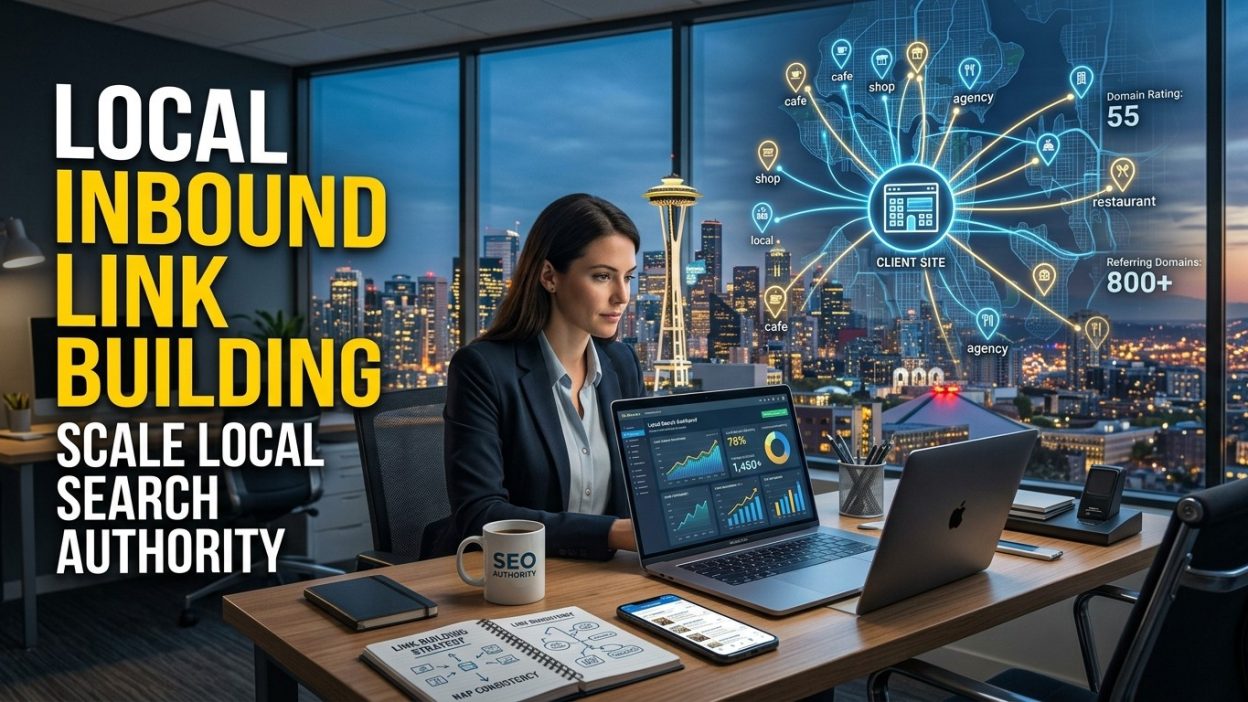
Local Inbound Link Building helps businesses earn relevant local authority through partnerships, media, community resources, useful content, and scalable outreach systems that support sustainable organic visibility.
Local search visibility is rarely built by one tactic. A business may have a strong website, accurate business information, useful services, positive customer experiences, and well-optimized pages, yet still struggle to establish enough authority to compete in a crowded local market.
Local Inbound Link Building focuses on one important part of that authority system: earning links from relevant websites, organizations, publishers, communities, and businesses that already have a relationship with the local area or the same audience.
The important word is “earning.” Sustainable link acquisition is not simply about collecting URLs. It is about creating reasons for other organizations to reference a business. Those reasons can come from partnerships, local data, community involvement, expert contributions, useful resources, original research, local stories, events, sponsorships, and genuinely valuable content.
For a small business, Local Inbound Link Building can feel difficult because established brands already have years of mentions and relationships. However, local markets also create opportunities that large national websites cannot easily reproduce. A local business can become part of neighborhood resources, regional news, professional associations, community organizations, vendor networks, and city-specific information ecosystems.
The strongest programs therefore combine relevance with relationship building. They look for websites where a link would make sense to the reader, not just websites with impressive-looking metrics.
Local Inbound Link Building is also more effective when it is connected to a broader local marketing strategy. Links can support referral traffic, brand discovery, partnerships, reputation, and search visibility at the same time.
What Local Inbound Link Building Really Means
Local Inbound Link Building is the process of attracting inbound links from websites that have genuine geographic, topical, audience, or business relevance to a local company.
That can include a local newspaper mentioning a business, a chamber of commerce listing a member, a community organization referencing a sponsor, a supplier linking to a certified partner, or an industry publication citing a local expert.
The purpose is not to manipulate search results with volume. The purpose is to build a network of credible digital relationships around the business.
Local Inbound Link Building works best when every target has a logical reason to mention the company.
Relevance Has Several Dimensions
A relevant link can be geographically relevant, such as a city publication or regional association.
It can be topically relevant, such as an industry blog discussing the business’s specialty.
It can be audience relevant, such as a local parent resource linking to a family service.
It can also be relationship relevant, such as a manufacturer linking to an authorized local dealer.
Local Inbound Link Building becomes stronger when several of these forms of relevance overlap.
Local Links Are Not Just About Rankings
A useful local link can create more than an SEO signal.
A mention from a local publication can introduce the business to potential customers. A partnership page can send referral visitors. An association profile can improve credibility. A community resource can create brand familiarity.
This means Local Inbound Link Building should be evaluated as a marketing asset rather than a technical checkbox.
Why Local Authority Is Difficult to Build
Local markets can become crowded quickly. Multiple companies may offer similar services, target the same neighborhoods, and publish similar content.
A basic service page may not give publishers a strong reason to reference the business.
Local Inbound Link Building solves part of this challenge by creating assets and relationships that are more reference-worthy than ordinary promotional pages.
A business can become link-worthy by publishing useful local statistics, answering difficult customer questions, developing neighborhood guides, supporting community programs, releasing original research, or providing expert commentary.
Authority Builds Through Association
A website gains contextual credibility when reputable local and topical organizations repeatedly recognize it.
For example, a professional association can establish industry context. A local publication can establish geographic context. A nonprofit relationship can establish community context.
Local Inbound Link Building benefits from this layered authority because no single source has to carry the entire credibility burden.
Start With a Local Link Prospect Map
Do not begin outreach by searching randomly for websites.
First create a prospect map.
Divide potential sources into categories such as:
| Prospect Type | Example Opportunity | Why It Can Matter |
|---|---|---|
| Local media | News, magazines, community sites | Geographic relevance |
| Business organizations | Chambers, trade groups | Business credibility |
| Suppliers | Manufacturers, distributors | Commercial relationship |
| Partners | Agencies, vendors, collaborators | Audience overlap |
| Community groups | Nonprofits, clubs, associations | Local trust |
| Events | Conferences, expos, workshops | Participation and visibility |
| Education | Schools, colleges, training centers | Local resources |
| Resource pages | Guides, directories, lists | Useful referral paths |
| Local creators | Bloggers, podcasts, newsletters | Audience access |
| Government/community resources | Public programs, local initiatives | Local context |
Local Inbound Link Building becomes much more scalable when prospects are organized before outreach starts.
Build a Prospect Qualification System
Not every local website deserves equal effort.
Evaluate each prospect based on relevance, editorial quality, audience fit, relationship potential, content fit, and realistic outreach access.
A highly relevant niche publication may be more valuable than a large generic website.
Local Inbound Link Building should therefore prioritize fit before superficial authority metrics.
Find Existing Business Relationships First
One of the easiest sources of legitimate links is often already within the company’s network.
Think about suppliers, distributors, manufacturers, professional memberships, associations, strategic partners, clients, vendors, contractors, event organizers, consultants, and community organizations.
These relationships already contain a reason for the company to be mentioned.
Local Inbound Link Building can begin with a simple asset inventory: who already knows this business, who has a website, and where could an accurate business reference improve their users’ experience?
Supplier and Vendor Links
Suppliers often maintain partner directories, dealer pages, case studies, or customer stories.
A local company that sells, installs, distributes, or implements a supplier’s products may qualify for a useful partner mention.
The key is authenticity. The business should genuinely hold the stated relationship.
Local Inbound Link Building is strongest when the link documents a real connection instead of being requested simply because a website has high authority.
Professional Association Opportunities
Membership organizations can create profiles, member directories, event pages, speaker pages, and resource listings.
These pages can be highly relevant because they explain why the business belongs in that professional ecosystem.
Before requesting a link, verify that the profile adds real information and that the association is legitimate and relevant.
Local Media and Community Publications
Local media can be one of the strongest sources of geographically relevant exposure.
However, sending generic “please link to my website” emails usually provides little reason for coverage.
Journalists and editors need something useful to their audience.
Local Inbound Link Building through media relationships should therefore start with a story, data point, expert insight, community event, or unusual local angle.
Create Local Data Stories
Original data can create natural citation opportunities.
A business can analyze anonymized internal trends, public datasets, customer questions, neighborhood patterns, seasonal demand, pricing ranges, service demand, or other legitimate information.
The output should be genuinely informative and transparent about methodology.
Local Inbound Link Building becomes easier when a local publisher can reference a specific fact rather than merely promoting a company.
Offer Expert Commentary
Businesses can become sources for local stories when their expertise intersects with current community concerns.
A home-service professional may explain seasonal maintenance patterns. A technology consultant may discuss local business security. A financial professional may explain a business trend.
The key is editorial usefulness.
Local Inbound Link Building works better when the pitch helps the publisher create a better article.
Build Linkable Local Assets
A linkable asset is something other websites have a practical reason to reference.
Common local assets include:
- Original research
- Statistics pages
- Local calculators
- Neighborhood guides
- Industry glossaries
- Public checklists
- Interactive tools
- Local event calendars
- Cost guides
- Comparison resources
- Expert interviews
- Templates
- Educational resources
Local Inbound Link Building becomes easier when the website has assets that are genuinely useful outside its own sales process.
Create Resources People Can Reference
A page called “Our Services” is designed primarily to explain the company.
A page called “Small Business Event Planning Checklist” may be useful to many organizations even when they are not customers.
The second type of resource has more natural link potential.
Local Inbound Link Building is helped by content that solves a problem independently of a transaction.
Make Local Guides Specific
Avoid generic “complete guide to our city” pages that simply repeat information found elsewhere.
Instead, build guides around a specific audience or use case.
Examples include:
- Local guide for new business owners
- Accessibility guide for neighborhood venues
- Weekend maintenance checklist for local homeowners
- Small business relocation checklist
- Seasonal service planning guide
Specificity creates a clearer editorial purpose.
Local Resource Page Outreach
Many local websites publish resource pages for residents, businesses, students, parents, professionals, or visitors.
These pages can be useful prospects when the company’s resource genuinely complements the page.
Local Inbound Link Building should never depend on inserting a link where it does not belong.
Instead, explain which resource exists, why it helps the audience, and where it would logically fit.
Make the Resource Better Than the Existing Alternative
A publisher has little incentive to replace a useful resource with a weaker one.
Before outreach, review the existing page.
Identify whether your resource provides newer data, clearer instructions, better examples, a useful tool, or a missing perspective.
Local Inbound Link Building improves when the suggested link makes the destination page more useful.
Competitor Backlink Gap Analysis
Competitor research can reveal patterns.
Look at which local organizations mention several competitors. Then determine whether the relationship or resource is also relevant to your business.
Do not copy every competitor link blindly.
A competitor may have a link because of sponsorship, ownership, a unique partnership, a historical event, or an editorial relationship that your company does not share.
Local Inbound Link Building should use competitor research for discovery, not imitation.
Categorize Competitor Links
Useful categories include:
- Local news
- Associations
- Partnerships
- Sponsorships
- Directories
- Resource pages
- Guest contributions
- Events
- Educational resources
- Interviews
The category tells you what kind of relationship or asset produced the mention.
Local Inbound Link Building becomes more strategic when patterns are translated into opportunity types.
Partnerships as a Link Acquisition Engine
Partnerships can generate links naturally because both organizations have reasons to discuss each other.
Examples include complementary service providers, local vendors, manufacturers, referral partners, event collaborators, consultants, and nonprofit relationships.
A business should not create artificial partnerships purely for links.
Local Inbound Link Building is strongest when the link is a secondary outcome of genuine collaboration.
Co-Create Valuable Resources
A local accountant and business consultant might create a small-business planning guide.
A real-estate professional and home inspector might publish a buyer checklist.
A fitness professional and physical therapist might collaborate on an educational resource.
Each partner has a legitimate reason to share the content.
Local Inbound Link Building can then emerge from the shared audience and shared expertise.
Sponsorships and Community Involvement
Community sponsorships can produce legitimate visibility when the business is genuinely supporting an event, organization, scholarship, initiative, or local program.
The value is not simply the link.
The business becomes part of a real community activity, and any web mention documents that participation.
Local Inbound Link Building should not encourage sponsorships solely for SEO. The community relationship needs to make sense on its own.
Event Pages and Speaker Profiles
Businesses that contribute speakers, workshops, demonstrations, or educational sessions may receive inclusion on event pages.
These pages can also generate referral traffic from people researching the event.
Local Inbound Link Building can therefore overlap with brand awareness and professional networking.
Digital PR for Local Businesses
Digital PR can create authority by turning business expertise or original information into media-worthy stories.
A local company may have access to unusual data, operational insight, customer trends, or subject-matter expertise that reporters can use.
The business should prepare short, evidence-based pitches rather than mass-send generic press releases.
Local Inbound Link Building improves when PR focuses on public value and editorial relevance.
Build a Media Angle Bank
Maintain a list of possible story angles.
Consider seasonal trends, local events, common customer problems, industry shifts, public data, community issues, expert commentary, and original research.
When a relevant event occurs, the company can respond faster.
Local Inbound Link Building becomes easier when media outreach is prepared before the news cycle begins.
Guest Contributions Without Generic Content
Contributing to a relevant local or industry publication can help establish expertise and relationships.
The content should be original and genuinely useful.
Avoid producing low-value articles solely because a site accepts guest posts.
Local Inbound Link Building works best when the contribution would still be worth publishing even without the link.
Choose Topics Based on Audience Needs
Review what the publication already covers.
Find questions that remain unanswered or topics where your expertise can add a useful perspective.
A contribution should fit the publisher’s readers.
Local Inbound Link Building is strengthened when the published content earns attention independently of its backlink.
Internal Assets Support External Links
External links work best when they point to useful destinations.
A company should have strong landing pages, research pages, guides, tools, case studies, and service explanations before launching an aggressive acquisition campaign.
Local Inbound Link Building can underperform when every external link is forced toward a generic homepage.
Match Link Targets to Search Intent
Different links should support different user needs.
A local media article about business security should ideally reference a security resource rather than a generic home page.
A community article about accessibility could reference an accessibility guide.
Local Inbound Link Building becomes more effective when the destination satisfies the visitor’s next question.
Anchor Text and Natural Language
Anchor text should make sense in context.
If every external reference uses the exact same commercial phrase, the profile can look unnatural.
Use descriptive phrases, brand names, page titles, and natural sentence structures according to the editorial context.
Local Inbound Link Building should prioritize readability for humans over rigid anchor-text formulas.
Keep the Link Context Relevant
The sentence around a link matters.
A relevant paragraph can explain why the linked resource is useful.
A random link inserted into unrelated content creates weaker contextual meaning and a poorer reader experience.
Local Inbound Link Building benefits when the surrounding content genuinely supports the destination.
Avoid Dangerous Link Building Patterns
Scaling does not mean buying large quantities of irrelevant links.
Avoid tactics built around manipulative networks, automated spam, irrelevant link exchanges, mass comment links, or content created only to place backlinks.
Search platforms continuously adjust systems designed to identify low-quality practices.
Local Inbound Link Building should therefore emphasize editorial relevance, legitimate relationships, and useful resources.
Quality Control Matters at Scale
A growing outreach team can accidentally damage campaign quality by prioritizing numbers.
Create clear rules for acceptable prospects.
Check website relevance, editorial standards, audience fit, placement context, and the reason the link should exist.
Local Inbound Link Building should have a quality threshold before a prospect enters the campaign.
Outreach Emails That Earn Responses
Outreach works better when it demonstrates that the sender understands the recipient’s page.
A useful email can contain:
- A specific reference to the recipient’s content
- Why the suggested resource is relevant
- The practical value for their audience
- A concise description of the asset
- A low-pressure request
Local Inbound Link Building outreach should avoid long self-introductions.
Focus on Their Audience
The recipient is not usually excited about your SEO campaign.
They care about maintaining a useful website, serving readers, improving content, and protecting editorial quality.
Frame the request around those objectives.
Local Inbound Link Building has a stronger chance of success when the recipient can see a benefit for their visitors.
Relationship-First Outreach
Not every contact should begin with a link request.
You can first engage with relevant organizations by attending events, sharing useful resources, participating in discussions, contributing expertise, or collaborating on projects.
A relationship creates more opportunities than a single backlink.
Local Inbound Link Building becomes sustainable when outreach develops into a network rather than a spreadsheet of one-time requests.
Track Relationships, Not Just URLs
The CRM can record:
- Organization
- Contact
- Relationship type
- Topics of relevance
- Past collaboration
- Published mentions
- Potential future opportunities
- Follow-up date
This turns link acquisition into relationship management.
Local Inbound Link Building can then generate repeat opportunities from the same ecosystem.
Scale Through Templates Without Losing Relevance
Templates are useful for operational efficiency, but they should not eliminate contextual writing.
Build modular components for introductions, value explanations, asset summaries, and follow-ups.
Then customize the parts that genuinely matter.
Local Inbound Link Building at scale should feel organized behind the scenes while remaining natural to recipients.
Create Prospect-Specific Hooks
Instead of one generic template, create hook categories.
For resource pages, focus on missing or improved information.
For publishers, focus on a story angle.
For associations, focus on member value.
For partners, focus on shared audiences.
For event organizers, focus on educational contribution.
Local Inbound Link Building becomes easier when the outreach hook matches the prospect type.
Measuring Local Link Performance
Link counts alone are insufficient.
Track:
| Metric | Purpose |
|---|---|
| Qualified prospects | Shows outreach pool quality |
| Outreach sent | Measures activity |
| Positive replies | Measures message relevance |
| Placement rate | Measures acquisition efficiency |
| Referral visits | Measures audience value |
| Assisted conversions | Shows downstream contribution |
| New referring domains | Measures authority growth |
| Local visibility changes | Shows broader search movement |
| Cost per placement | Measures efficiency |
| Revenue influenced | Connects links to business value |
Local Inbound Link Building becomes a business process when these metrics connect activity to outcomes.
Evaluate Links by Contribution
A link can have modest referral traffic but strong topical relevance.
Another can have many visitors but little commercial value.
Some relationships may produce multiple future opportunities.
Local Inbound Link Building should therefore use a portfolio view rather than treating every link as interchangeable.
Connecting Links to Revenue
A local link campaign should eventually answer a commercial question: did the acquisition effort contribute to meaningful business results?
Use referral analytics, assisted conversions, CRM attribution, lead-source fields, and campaign notes where appropriate.
Do not assume that every organic improvement came from a link.
Local Inbound Link Building should be measured alongside other local SEO and marketing activities.
This is especially relevant when evaluating broader acquisition efficiency. A business comparing content, partnerships, PR, paid channels, and outreach may use Measuring Outreach Channels ROI to understand where resources are producing useful outcomes, provided the attribution model is consistent.
Local Citations Versus Editorial Links
Citations and inbound links can overlap but they are not identical.
A citation typically reinforces business identity information such as name, address, phone number, or other business details across local sources.
An editorial or contextual link points users toward a page and is usually embedded within content or a resource.
Local Inbound Link Building focuses specifically on inbound links, but a broader local authority plan can include both citations and links.
Consistency matters because inaccurate business information can undermine trust across the web.
A useful local SEO reference may explore citation consistency in more detail, including ideas discussed in The Citation Secret, but the link strategy should remain focused on earning genuinely relevant inbound references.
For local context, Google Local Ranking Secrets offers another reference.
Educational and Institutional Opportunities
Schools, colleges, training organizations, libraries, and community education projects often publish resource pages.
A business may be able to contribute workshops, scholarship information, educational resources, career materials, or subject-matter expertise.
The relationship needs to be legitimate and useful.
Local Inbound Link Building should never encourage deceptive tactics aimed at obtaining institutional links.
Create Student-Friendly Resources
Businesses can publish guides that help students understand a profession, prepare for internships, evaluate career paths, or learn practical skills.
If an educational organization references the resource because it helps students, the link has genuine audience value.
Local Inbound Link Building becomes stronger when the resource contributes something beyond commercial promotion.
Build Local Statistics and Benchmarks
Original local benchmarks can become powerful reference assets.
Consider publishing data around common service questions, seasonal demand, business response times, local consumer preferences, service categories, or other information that can be responsibly collected and analyzed.
Document the methodology.
Explain sample size where relevant.
Distinguish observed data from assumptions.
Local Inbound Link Building benefits from content that publishers can cite confidently.
Update Data Regularly
A data page becomes more useful when it is maintained.
Add new periods, explain changes, and preserve historical context.
Publish a clear update date.
Local Inbound Link Building can benefit from evergreen reference pages that publishers return to whenever they need updated numbers.
Local Link Building Through Interviews
Interviews can create useful exposure when a business owner or specialist contributes meaningful knowledge to a publication, podcast website, association, or local blog.
The goal should be expertise sharing.
Local Inbound Link Building can naturally result when the publisher includes the expert’s business profile or source reference.
Prepare a Clear Expert Profile
Maintain a concise bio, subject expertise, credentials, areas of commentary, and relevant published work.
This makes it easier for editors to understand why the person is a useful source.
Local Inbound Link Building becomes easier when the business is prepared to respond quickly to expert opportunities.
Create a Community Resource Hub
A dedicated local resource section can provide a home for reference-worthy material.
It might include neighborhood guides, business checklists, seasonal planning resources, local event information, educational articles, and original research.
Local Inbound Link Building can then use the hub as a destination for outreach rather than repeatedly creating new assets.
Avoid Turning the Hub Into a Content Dump
Quality matters more than volume.
Every resource should have an audience, purpose, and maintenance plan.
Remove outdated information.
Improve pages that receive useful engagement.
Local Inbound Link Building works better when the destination site itself demonstrates editorial quality.
Analyze Lost Outreach Opportunities
Not every outreach failure means the prospect was wrong.
Look at rejection reasons.
A publisher may say the content is not relevant. That could indicate a targeting issue.
A partner may say the resource does not add anything new. That may indicate weak asset quality.
A community organization may ask for a different format. That may reveal a new opportunity.
Local Inbound Link Building improves when rejection data feeds future campaigns.
Build a Learning Loop
Record:
- Prospect category
- Pitch angle
- Asset offered
- Response
- Objection
- Placement result
- Follow-up outcome
After enough campaigns, patterns become visible.
Local Inbound Link Building becomes more efficient because the team stops repeating ineffective approaches.
A 90-Day Local Link Building Framework
A practical 90-day program can be divided into phases.
Days 1–30: Foundation
Audit existing referring domains.
Map current partnerships.
Build prospect categories.
Create priority assets.
Identify local media and organizations.
Define quality standards.
Local Inbound Link Building should begin with this foundation rather than immediate mass outreach.
Days 31–60: Relationship and Outreach
Begin targeted outreach.
Pitch useful resources.
Approach partners.
Contribute expert insights.
Develop local data stories.
Participate in relevant events.
Local Inbound Link Building during this phase should prioritize quality conversations over raw outreach volume.
Days 61–90: Expansion and Optimization
Analyze placement rates.
Review referral traffic.
Identify successful prospect categories.
Expand proven relationships.
Refresh successful assets.
Improve outreach templates.
Local Inbound Link Building should become more focused as the dataset grows.
Scaling Across Multiple Locations
Multi-location businesses face additional complexity.
Each location may have different community relationships, publications, organizations, and link opportunities.
A centralized strategy can create frameworks while local teams identify unique opportunities.
Local Inbound Link Building should avoid duplicating identical resources across every location without adding location-specific value.
Use Location-Specific Evidence
Local stories, local partnerships, neighborhood resources, and area-specific research can create genuinely unique assets.
For example, each branch could contribute to a regional benchmark or community guide where appropriate.
Local Inbound Link Building becomes scalable when the framework is centralized but the actual value remains locally authentic.
Governance for Larger Teams
As more people participate in link acquisition, quality can become inconsistent.
Create standard operating procedures.
Document acceptable prospects, prohibited tactics, email standards, relationship rules, review requirements, asset criteria, and reporting formats.
Local Inbound Link Building is easier to scale when everyone understands what “relevant” means.
Maintain a Shared Prospect Database
A shared database prevents multiple team members from contacting the same organization with conflicting messages.
It can also preserve relationship history.
Local Inbound Link Building benefits from institutional memory because valuable local relationships can continue even when individual employees change.
The Role of Content Strategy
Link acquisition and content strategy should work together.
If the website publishes content solely for search volume, there may be little reason for external publishers to cite it.
A content plan should include pages designed for customers and pages designed to become useful industry or local references.
Local Inbound Link Building should influence content ideation without taking control of the entire editorial strategy.
Design Content Around “Reference Moments”
A reference moment occurs when someone writing content naturally needs a source.
Examples include definitions, statistics, checklists, explanations, local data, calculators, frameworks, or original findings.
Create pages that can satisfy those moments.
Local Inbound Link Building becomes easier when the content is built for reference use.
How Psychology Affects Link Outreach
A recipient decides quickly whether the request deserves attention.
The email must lower uncertainty.
Who are you?
Why are you contacting me?
Why does this resource matter?
Why should I spend time reviewing it?
What does it improve?
Local Inbound Link Building outreach should make these answers easy to find.
Give the Recipient a Reason to Say Yes
Avoid framing the request around the sender’s SEO objective.
Instead, point to audience value.
For example, “This guide may help your readers understand X” is more useful than “We would appreciate a backlink.”
The distinction changes the psychological framing.
Local Inbound Link Building works better when the recipient sees a legitimate editorial reason for the link.
What Makes a Local Link “Good”?
A useful local inbound link generally has a logical relationship to the business, page, audience, or geography.
It should appear in a context where readers can understand why the link exists.
The source should have a credible purpose.
The placement should not depend on deceptive or manipulative tactics.
Local Inbound Link Building is strongest when a link could reasonably exist even if no SEO professional were managing the campaign.
That is an excellent internal test.
A Repeatable Local Inbound Link Building Checklist
Before pursuing a prospect, ask:
Relevance: Is the website genuinely connected to the local market, topic, or audience?
Purpose: Why would the site link to this resource?
Value: Does the resource improve the recipient’s content?
Context: Will the link appear in a relevant editorial environment?
Relationship: Is there an authentic connection?
Quality: Does the source maintain a credible website?
Sustainability: Could this relationship create additional value later?
Measurement: Can the business evaluate referral and commercial contribution?
Local Inbound Link Building becomes much more predictable when every opportunity passes a consistent qualification process.
Final Strategic Principles
Several principles should guide the entire program.
First, prioritize relevance.
Second, create assets worth referencing.
Adapting Channel Messaging keeps outreach consistent while still respecting the expectations of each platform.
Third, build relationships before asking for favors when possible.
Fourth, use local expertise as an advantage.
Fifth, measure business outcomes instead of counting links alone.
Sixth, protect quality as outreach volume grows.
Seventh, treat every campaign as a learning system.
Local Inbound Link Building is not a race to collect the highest number of referring domains. It is a process of becoming more visible within the digital ecosystem that surrounds a local business.
When a company is repeatedly useful to publications, associations, partners, communities, customers, and industry resources, links become a natural by-product of being useful.
That is the foundation for scaling local search authority without turning link acquisition into an automated numbers game.
Advanced Principles for Local Inbound Link Building
Local Inbound Link Building should start with relevance.
Local Inbound Link Building should create a reason for a publisher to care.
Local Inbound Link Building should make the destination page useful.
Local Inbound Link Building should support a clear audience need.
Local Inbound Link Building should prioritize authentic relationships.
Local Inbound Link Building should use local expertise.
Local Inbound Link Building should turn proprietary knowledge into public resources.
Local Inbound Link Building should support community participation.
Local Inbound Link Building should use accurate business information.
Local Inbound Link Building should connect content with real search intent.
Local Inbound Link Building should be measured beyond link counts.
Local Inbound Link Building should track referral value.
Local Inbound Link Building should monitor placement quality.
Local Inbound Link Building should document outreach lessons.
Local Inbound Link Building should improve through testing.
Local Inbound Link Building should avoid irrelevant volume.
Local Inbound Link Building should protect editorial credibility.
Local Inbound Link Building should align with the site’s overall content strategy.
Local Inbound Link Building should strengthen topical relationships.
Local Inbound Link Building should create assets that remain useful after outreach ends.
Local Inbound Link Building should support multiple acquisition channels without creating inconsistent messaging.
Local Inbound Link Building should use personalization where it improves relevance.
Local Inbound Link Building should reserve deep research for valuable opportunities.
Local Inbound Link Building should maintain clear prospect qualification rules.
Local Inbound Link Building should help teams build long-term publisher relationships.
Local Inbound Link Building should connect community activity with digital visibility naturally.
Local Inbound Link Building should be reviewed regularly for quality and commercial contribution.
Local Inbound Link Building should remain useful to people even when search algorithms or marketing priorities change.
The framework also keeps quality checks visible across research, outreach, publishing, reporting, team training, relationship management, and long-term campaign planning consistently.
Local Inbound Link Building also rewards patience and consistency.
Local Inbound Link Building improves as relationships compound.
A strong local program also benefits from ownership. Researchers can identify prospects, content teams can build assets, outreach specialists can develop relationships, and analysts can connect placements with meaningful business outcomes. This division reduces bottlenecks, improves consistency, and makes it easier to learn from unsuccessful campaigns over time, creating a repeatable marketing capability that supports local visibility without making every opportunity manual consistently across multiple campaigns.
Ultimately, Local Inbound Link Building depends on usefulness.
Conclusion
Local Inbound Link Building grows local search authority by earning relevant references from publishers, partners, associations, community organizations, suppliers, educational resources, and other trusted sources. Sustainable growth depends on useful assets, authentic relationships, strong prospect qualification, thoughtful outreach, accurate measurement, and disciplined quality control. Businesses should prioritize relevance and audience value instead of chasing link volume. Competitor research can uncover opportunities, while local data, expert insights, guides, events, and partnerships can create genuine reasons to be referenced. When these activities connect with broader local marketing and content strategy, inbound links can contribute to visibility, referrals, credibility, and long-term digital authority.
Frequently Asked Questions (FAQ)
What is Local Inbound Link Building?
Local Inbound Link Building is the process of earning inbound links from websites that are relevant to a business because of geography, industry, audience, partnerships, community involvement, or topical context.
Why are local links useful for a business?
Relevant local links can support geographic authority, referral traffic, brand discovery, professional credibility, and broader organic visibility when they come from legitimate and useful sources.
How do I find local link opportunities?
Start with existing relationships, local media, chambers, associations, suppliers, partners, community organizations, educational resources, events, local publications, and relevant resource pages.
Should I buy local backlinks?
A sustainable strategy should focus on earning relevant editorial and relationship-based references rather than building campaigns around purchased, irrelevant, or manipulative links.
What types of content attract local links?
Original local data, research, calculators, guides, checklists, community resources, expert commentary, local statistics, event resources, and audience-specific educational content can create legitimate reference opportunities.
How can competitor backlink analysis help?
Competitor research can reveal organizations, publications, partnerships, and resource categories that are active in a market. Each opportunity should then be evaluated for genuine relevance rather than copied automatically.
How important are local partnerships?
Partnerships can be valuable because they create legitimate reasons for businesses to reference one another. Suppliers, vendors, complementary businesses, associations, and community organizations may all create opportunities.
What should a local link outreach email contain?
A strong email should explain why the recipient’s page is relevant, identify the resource being suggested, explain its audience value, and make a concise, low-pressure request.
How do I measure Local Inbound Link Building?
Measure qualified prospects, outreach response, placement rate, referring domains, referral visits, assisted conversions, acquisition cost, and revenue influenced alongside broader local search performance.
How long does local link building take to show results?
The timing varies by website strength, competition, content quality, link acquisition pace, and other SEO factors. Relationship-building and authority development generally require consistent effort rather than a single campaign.