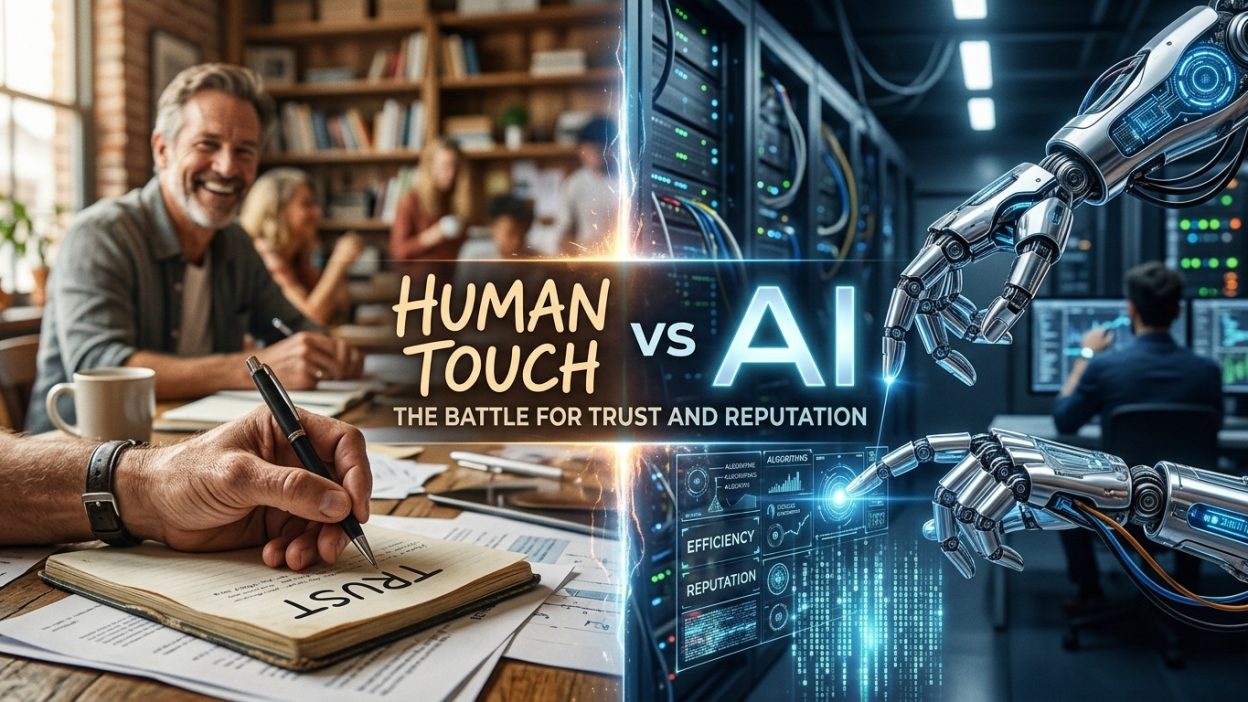
Human-centered AI strategies balance automation with empathy, transparency, accountability, and judgment to protect customer trust while improving speed, consistency, and reputation.
Human Touch vs AI is no longer a question limited to customer support or chatbots. It has become a broader conversation about how modern brands create confidence when customers interact with automated systems at nearly every stage of the digital journey. Marketing automation, AI-generated content, recommendation engines, sentiment monitoring, virtual assistants, and intelligent sales platforms can now influence what customers see, when they receive it, and how quickly businesses respond.
Human Touch vs AI becomes especially important because trust is emotional as well as functional. Customers may appreciate a response that arrives instantly, but they also want to feel heard when something goes wrong. A perfect automated answer can solve a technical question while still leaving a customer emotionally unsatisfied.
Human Touch vs AI therefore should not be treated as a simple choice between replacing people and keeping everything manual. The real opportunity is to understand which parts of a customer journey benefit from machine speed and which moments require human judgment, empathy, creativity, or accountability.
Human Touch vs AI also matters because reputation is cumulative. A brand’s reputation is shaped by hundreds of small interactions: support conversations, review replies, campaign messages, sales outreach, social responses, refunds, complaints, product updates, and even the language used when admitting a mistake. One poorly handled interaction can influence how customers interpret many future interactions.
The organizations that handle this balance well are not necessarily those using the most advanced technology. They are the ones designing thoughtful boundaries around it. They understand when automation improves convenience, when it introduces friction, and when a real person can create disproportionate value.
This article explores that balance through customer psychology, trust formation, reputation protection, workflow design, AI-assisted service, human escalation, sales communication, measurement, and practical implementation.
What Human Touch Really Means in a Digital Business
Many organizations define “human touch” too narrowly. They assume it means every customer must speak to a person. That interpretation misses the deeper idea.
Human Touch vs AI should first be understood as a difference in capability rather than a difference in technology ownership. Human touch represents empathy, contextual understanding, discretion, emotional awareness, accountability, relationship building, and the ability to interpret situations that do not fit a predefined rule.
Human Touch vs AI can therefore exist even inside highly automated companies. A well-designed automated system can preserve a human-centered experience by remembering context, avoiding unnecessary repetition, offering clear choices, and transferring complicated issues to the right employee.
Human Touch vs AI also depends on how customers perceive control. A customer may be perfectly comfortable interacting with automation when the task is simple and predictable. The same customer may become frustrated when the system refuses to understand an unusual situation.
Human Touch vs AI becomes most useful when businesses stop asking whether humans or machines are “better” and instead ask which one is better suited to a particular moment.
A few simple examples illustrate the difference.
A customer checking delivery status may value speed over conversation.
A customer trying to correct a complicated billing problem may value ownership over speed.
A prospect comparing technical platforms may want detailed evidence.
A disappointed customer may first want recognition before they want instructions.
The technology can remain present in all four situations. What changes is the level of judgment and personal involvement required.
Human Touch Is About Context
Human communication is powerful partly because people can interpret context dynamically.
A representative can notice hesitation, frustration, confusion, sarcasm, or uncertainty and change the response accordingly. Humans can also decide when the literal question is not the real question.
Someone asking, “Why does this keep happening?” may not simply want a technical explanation. They may want assurance that the issue will not happen again.
An automated system can provide the explanation.
A human can address the underlying concern.
That distinction becomes increasingly important as automation expands into customer-facing environments.
Why Trust Has Become a Competitive Asset
Trust influences more than whether someone completes a transaction. It affects willingness to provide information, tolerance for mistakes, responsiveness to recommendations, likelihood of returning, and willingness to discuss problems openly.
Human Touch vs AI matters because the way a company communicates becomes part of its perceived identity. Customers rarely separate “technology experience” from “brand experience.” If the automated experience feels dismissive, the brand may be perceived as dismissive. If a human representative takes responsibility and communicates clearly, that behavior becomes part of the company’s reputation.
Human Touch vs AI also affects uncertainty. Buyers often feel uncertain about price, quality, reliability, implementation, security, service, and long-term value. Effective communication reduces that uncertainty.
Human Touch vs AI becomes strategically important because trust is often hardest to build when something goes wrong. Customers may forgive a mistake when a business communicates honestly, investigates the issue, explains the next step, and demonstrates ownership. Silence, generic responses, or automated deflection can produce the opposite reaction.
Human Touch vs AI should therefore be evaluated through the psychology of confidence, not merely operational efficiency.
A useful trust model includes four components:
| Trust Factor | What Customers Look For |
|---|---|
| Reliability | Does the company do what it says? |
| Transparency | Does it communicate honestly? |
| Competence | Can it solve the problem? |
| Care | Does it appear to take the customer seriously? |
AI can contribute to all four.
But it usually does so through systems designed by people.
That is why reputation management remains an organizational responsibility even when customer-facing technology becomes increasingly automated.
Where AI Delivers Real Value
The growth of AI is not happening because machines are inherently better at every customer interaction. AI is valuable because it can perform certain tasks at a scale that humans cannot easily maintain.
Human Touch vs AI becomes much more productive when teams recognize these strengths rather than creating a philosophical conflict around technology.
Human Touch vs AI shows that AI can be particularly effective for repetitive information requests, classification, summarization, recommendation, pattern detection, translation, workflow routing, and rapid response.
Human Touch vs AI also becomes less controversial when AI is working behind the scenes rather than replacing important customer relationships.
Human Touch vs AI can support a customer journey where the machine handles the first layer while a person remains responsible for complicated decisions.
Consider a support center with ten thousand incoming interactions. Many questions may relate to account access, delivery status, subscription details, documentation, or standard troubleshooting. An AI system can identify these common patterns and respond immediately.
That does not remove the need for people.
Instead, it changes what people spend their time doing.
Without automation, representatives may spend hours repeating the same information. With appropriate AI assistance, they can spend more time investigating unusual situations, calming frustrated customers, identifying root causes, or helping high-value accounts.
AI Creates Scale
AI can also improve consistency.
A system does not get tired on Friday afternoon. It can process thousands of requests overnight. It can summarize long conversations, identify repeated complaints, or organize customer questions into themes.
Those capabilities are extremely useful.
The key is that scale should improve the customer experience rather than make the customer feel invisible.
When Automation Starts Damaging the Experience
Automation becomes problematic when the customer has a situation that requires interpretation but receives an inflexible process instead.
Human Touch vs AI becomes most visible in moments of emotional tension. A person may be angry because a service failed, worried because money is involved, embarrassed because they made a mistake, or frustrated because they have already tried several solutions.
Human Touch vs AI can break down when the system responds to those situations using generic language that does not reflect the emotional context.
Human Touch vs AI also becomes weaker when a customer is passed between automated systems without a clear path to a person.
Human Touch vs AI should therefore include escalation rules from the beginning rather than treating human assistance as an emergency backup.
Emotional Complexity Changes the Equation
Routine interactions are relatively easy to automate because the customer generally wants a clear answer.
Sensitive interactions require more.
A customer may ask a short question while carrying a much larger emotional concern underneath it.
For example:
“Can you cancel this?”
The literal request is simple.
But the actual context could involve:
“I feel misled.”
“I cannot afford the charge.”
“I am angry that nobody resolved this.”
“I no longer trust your company.”
A machine can process the cancellation.
A human may need to rebuild confidence.
Repeated Failure Is an Escalation Signal
One of the clearest signs that automation is no longer helping is repeated failure.
If the customer has already attempted the same process multiple times, another automated instruction may increase frustration.
A sensible escalation framework can trigger human involvement when:
- The customer repeatedly asks the same question.
- The automated path cannot resolve the issue.
- The customer explicitly requests a person.
- The issue involves a financial dispute.
- The interaction includes significant reputational risk.
- The case requires discretion.
- The customer appears emotionally distressed.
The goal is not to eliminate automation.
The goal is to make its limits visible and manageable.
Consistency Versus Authenticity
One of the strongest arguments for AI is consistency. Machines can follow structured instructions, maintain approved terminology, and operate within predefined rules.
Human Touch vs AI matters because consistency and authenticity serve different purposes.
Human Touch vs AI can create a strong customer experience when AI preserves brand standards while humans adapt communication to context.
Human Touch vs AI becomes problematic when “consistency” is interpreted as making every customer receive nearly identical language.
Human Touch vs AI should protect consistent values, not necessarily identical wording.
Suppose a company receives three complaints.
The first customer is confused.
The second is frustrated.
The third is furious because the same problem happened three times.
A template can acknowledge all three.
But a truly useful response should not make them feel identical.
The Better Hybrid Model
A strong hybrid model can use AI for:
- Suggested response structures
- Relevant knowledge retrieval
- Conversation summaries
- Policy reminders
- Customer-history context
The representative then adapts the message.
This creates a balance between operational consistency and emotional relevance.
Consistency establishes reliability.
Context creates humanity.
Both matter.
Why Customer Control Matters
Customers do not necessarily demand a human every time.
In many situations, they simply want control over how the interaction proceeds.
Human Touch vs AI becomes more effective when customers can choose automation for speed and humans for complexity.
Human Touch vs AI should give people a clear route to escalation instead of trapping them inside automated menus.
Human Touch vs AI also benefits when the system makes its capabilities understandable. Customers should know what the assistant can do and what requires human involvement.
Human Touch vs AI should minimize repetition during handoffs. If a customer has already explained an issue, asking them to repeat it from the beginning can make the organization appear disconnected.
This is especially important in multi-channel customer journeys.
A person may begin with live chat, move to email, then speak with a representative by phone.
The technology should carry context across those transitions whenever appropriate.
Choice Creates Confidence
A useful design principle is:
Automation should be easy to use, and human help should be easy to reach.
The customer should not have to “fight” the system to speak to someone.
That single principle can dramatically influence perceived control.
Reputation Management in the Age of AI
Reputation management has always required listening before responding. AI changes how much listening can occur.
Human Touch vs AI becomes particularly relevant because online reputation generates massive amounts of information across reviews, social networks, community discussions, support channels, and public comments.
Human Touch vs AI can help businesses monitor those channels at scale while still keeping humans responsible for interpretation.
Human Touch vs AI is strongest when AI identifies what deserves attention and people determine what the organization should do about it.
Human Touch vs AI becomes weaker when automated systems treat every negative comment as identical or every positive comment as proof that the business is performing perfectly.
Reputation is contextual.
A sudden increase in negative sentiment could come from a product defect, delayed shipment, service outage, confusing policy change, misleading advertising claim, or external event.
The important question is not just:
“How negative are people?”
It is:
“What is causing the change?”
Intent and Reputation Signals
Behavioral intelligence can also help marketers understand when audience interest is changing before direct conversations occur. Teams exploring Intent Data Identifies can use that broader perspective to understand how behavioral evidence may indicate increased research or attention.
That intelligence can complement reputation monitoring, but it should not be confused with customer satisfaction.
Different signals answer different questions.
Intent can suggest what people are researching.
Reputation signals can suggest how people feel about an organization.
Business outcomes show what those patterns ultimately mean.
Combining them carefully creates a richer picture.
AI Sentiment Analysis and Human Interpretation
AI can process thousands of customer comments far faster than a human team. This makes sentiment analysis useful for trend detection.
Human Touch vs AI becomes valuable here because AI can surface patterns while humans investigate the reasons behind those patterns.
Human Touch vs AI should recognize that sentiment classification is probabilistic rather than perfectly objective.
Human Touch vs AI can help organizations identify recurring themes, but it should not turn a sentiment label into an unquestioned statement about customer emotion.
Human Touch vs AI works better when sentiment is treated as an alerting system.
For example, imagine that negative mentions increase by 35% in a week.
The number matters.
But the next question is more important.
Why?
Maybe a competitor launched a comparison campaign.
Maybe one product feature stopped functioning correctly.
Maybe a shipping issue affected one region.
Maybe customers are complaining about a recent pricing change.
A human team needs to investigate the cause.
Resources such as AI Sentiment Analysis can be useful for understanding how automated sentiment interpretation can support trend detection.
Why Sarcasm Is Difficult
Consider a comment:
“Fantastic. Another outage.”
A basic classifier could struggle with this sentence because of the positive word “Fantastic.”
Human readers can interpret the contradiction.
The same problem can occur with humor, slang, cultural expressions, and industry-specific language.
That is why high-impact reputation decisions should include contextual human review.
Smart Automation and Intelligent Routing
AI becomes more useful when it does not attempt to solve everything itself.
Human Touch vs AI can support workflows in which machines classify requests and route them toward the correct destination.
Human Touch vs AI becomes more efficient when automation performs the first layer of organization and humans handle judgment-heavy stages.
Human Touch vs AI can reduce response delays by identifying urgent cases quickly.
Human Touch vs AI can also create better internal workflows because the human representative receives useful context before entering the conversation.
Imagine an incoming complaint.
The system detects:
Issue: Repeated billing problem.
Customer history: Two previous unresolved contacts.
Emotion: Strongly negative.
Priority: High.
The representative can now enter the conversation already aware of the situation.
That is far better than simply assigning a ticket number.
Tools and workflow concepts such as Smart Bots show how automated systems can support classification, routing, and organization.
Good Routing Reduces Repetition
The biggest benefit of AI-assisted routing may not be speed.
It may be context preservation.
Customers are more likely to feel understood when they do not have to repeatedly explain what happened.
The machine handles the administrative burden.
The human receives the meaningful context.
That division of responsibility can make automation feel almost invisible.
Transparency About AI
Trust requires accurate expectations.
Human Touch vs AI becomes easier to manage when companies are transparent about where AI participates in the customer experience.
Human Touch vs AI should not rely on creating an artificial impression that every automated response was personally written by an employee.
Human Touch vs AI can actually become stronger when customers know what the automated system can do and how to access human help.
Human Touch vs AI should focus on clarity rather than unnecessary technical detail.
A company does not need to explain every model, dataset, or algorithm.
But customers may reasonably need to know whether:
- They are communicating with an AI assistant.
- Their message may be automatically analyzed.
- Their conversation may be transferred to a human.
- A human is responsible for final resolution when necessary.
Transparency Builds Predictability
Predictability matters because people become uncomfortable when the rules of an interaction are unclear.
If a chatbot appears to be a person but later behaves like a machine, the inconsistency can damage confidence.
If it clearly identifies itself as an assistant and provides a smooth route to a person, the experience becomes easier to understand.
The lesson is simple:
Do not hide automation. Design it well.
Accountability Cannot Be Automated Away
AI can make recommendations.
Organizations remain responsible for outcomes.
Human Touch vs AI therefore has to include explicit ownership.
Human Touch vs AI becomes dangerous when companies use automation as an excuse to avoid responsibility.
Human Touch vs AI should make it clear who can review an automated decision, correct an incorrect answer, or change the outcome.
Human Touch vs AI should never create a situation where the customer hears “the system decided” without any available path for human review.
This matters especially when automated systems influence:
- Billing
- Refunds
- Customer eligibility
- Advertising communication
- Reputation responses
- Account restrictions
- Important service decisions
The Accountability Chain
A reliable system can define:
AI detects.
AI organizes.
Human reviews.
Human decides.
Organization owns the outcome.
This model does not eliminate automation.
It clarifies responsibility.
Customers may not care which internal system made a mistake.
They care whether the company fixes it.
That is why human accountability remains a central part of reputation management.
Human Touch vs AI in Sales and Marketing
Sales communication presents another important use case.
Human Touch vs AI can help sales teams research accounts, summarize previous conversations, identify potential topics, draft communication, organize tasks, and highlight changes in buyer behavior.
Human Touch vs AI becomes useful when AI reduces preparation time while representatives remain responsible for relationship quality.
Human Touch vs AI becomes risky when automation creates fake personalization—messages that sound individualized but contain little genuine understanding.
Human Touch vs AI should therefore use AI to improve relevance rather than simulate intimacy.
A sales representative might use AI to discover that a prospect has been researching implementation challenges.
The representative can then prepare a message focused on deployment considerations.
But the final communication should still reflect the actual account context.
Intent Data Does Not Replace Conversation
Intent information can help indicate what a prospect may be investigating, but it cannot fully explain internal decision-making.
A useful sales process therefore combines:
- Behavioral signals
- Account information
- CRM history
- Business context
- Human research
- Direct conversation
The machine can help determine where to look.
The salesperson learns what is actually happening.
That distinction keeps sales communication informative instead of intrusive.
Measuring Trust, Reputation, and AI Performance
A business should not judge an AI system solely by how quickly it answers questions.
Human Touch vs AI needs a broader measurement framework.
Human Touch vs AI should be evaluated against customer experience, resolution quality, reputation indicators, and business outcomes.
Human Touch vs AI also requires comparing performance by interaction type because an automated system can be excellent for routine questions and weak for sensitive complaints.
Human Touch vs AI becomes measurable when teams establish clear baseline metrics before and after implementation.
Useful metrics include:
| Metric | What It Shows |
|---|---|
| First-response time | Speed |
| Resolution rate | Effectiveness |
| Repeat-contact rate | Whether issues are actually solved |
| Escalation rate | Where automation reaches its limits |
| Customer satisfaction | Experience quality |
| Complaint recurrence | Root-cause effectiveness |
| Review trends | Reputation movement |
| Retention | Long-term relationship impact |
| Human-handled resolution quality | Value of escalation |
Measure the Right Things
If AI reduces average response time by 60% but increases repeat contacts by 25%, the workflow may not have improved the customer experience.
Likewise, if automation handles 80% of simple queries successfully but customer satisfaction improves in the remaining complex interactions because representatives now have more time, the overall system may be producing broader value.
Measurement should therefore consider the complete journey.
Efficiency without effectiveness is not enough.
Speed without resolution is not enough.
Automation without trust is not enough.
A Practical Hybrid Framework
Businesses often need a simple way to decide where AI should operate and where humans should lead.
Human Touch vs AI becomes easier to manage when interactions are classified by complexity, emotion, risk, and customer control.
Human Touch vs AI can be organized into three practical zones.
Human Touch vs AI favors automation when the request is simple, repetitive, predictable, and low-risk.
Human Touch vs AI shifts toward human-led service when the situation involves emotional complexity, financial consequences, reputation risk, ambiguity, or repeated failure.
| Situation | AI Role | Human Role |
|---|---|---|
| Simple FAQ | Primary | Optional |
| Routine account request | Primary | Escalation |
| Technical issue | Assist | Lead when complex |
| Complaint | Detect and summarize | Respond and resolve |
| Public reputation crisis | Monitor | Lead |
| High-value sales | Research and assist | Lead |
| Sensitive dispute | Support | Primary |
| Content personalization | Generate options | Approve |
This framework avoids ideological thinking.
The question is not whether AI is “good” or “bad.”
The question is whether the interaction requires speed, judgment, empathy, discretion, or some combination of these capabilities.
A Useful Decision Rule
Before automating a task, ask five questions:
Is it repetitive?
Is it predictable?
Is the cost of an error low?
Does the customer benefit from speed?
Is a human still available when needed?
The more “yes” answers a task receives, the more suitable it may be for automation.
How to Implement a Trust-Focused AI Strategy
Technology should not be deployed independently from customer-experience strategy.
Start by mapping the customer journey.
Identify every point where customers:
- Ask questions
- Seek reassurance
- Compare options
- Request support
- Make complaints
- Leave reviews
- Need decisions
- Ask for escalation
Then classify those moments by risk and complexity.
Step 1: Identify Repetitive Work
Find interactions that consume significant employee time but require limited judgment.
These are strong candidates for automation.
Step 2: Identify Sensitive Moments
Mark interactions where empathy, reputation, financial consequences, or emotional context are significant.
These should have stronger human involvement.
Step 3: Define Escalation Rules
Document exactly when an AI system should stop and hand the case to a person.
Step 4: Preserve Context
Ensure that human representatives receive relevant history rather than restarting the conversation.
Step 5: Establish Governance
Define ownership, approval processes, quality controls, privacy considerations, and monitoring responsibilities.
Step 6: Measure Outcomes
Track speed, resolution, satisfaction, escalation, complaints, and business results.
Step 7: Improve Continuously
Use customer feedback and operational data to refine the system.
A technology implementation becomes far more durable when these decisions are made before automation expands.
Managing AI-Generated Brand Communication
AI can generate enormous amounts of marketing communication.
That creates a new challenge.
The issue is not simply whether the content is grammatically correct.
The issue is whether it represents the brand accurately.
Human Touch vs AI should include a clear brand-voice framework.
Human Touch vs AI can support content production while keeping humans responsible for positioning, promises, claims, and emotional tone.
Human Touch vs AI also becomes relevant when brands generate large amounts of social media copy, customer responses, sales emails, or support messages.
Human Touch vs AI should never become an excuse to let every piece of communication sound generic.
A useful brand-AI framework includes:
Voice
What should the brand sound like?
Boundaries
What should the brand never claim?
Tone
How should language change across positive, neutral, and negative situations?
Accuracy
What information requires verification before publication?
Approval
Which types of communication require human sign-off?
This process allows AI to scale communication without turning the brand into an interchangeable stream of machine-generated language.
Psychological Safety and Customer Communication
Trust becomes stronger when customers feel safe enough to explain what they actually need.
Human Touch vs AI matters because emotional safety cannot always be created through information alone.
Human Touch vs AI should consider how customers respond when they fear being blamed, misunderstood, or dismissed.
Human Touch vs AI can improve service when AI identifies the basics and human employees focus on reducing emotional friction.
Human Touch vs AI should encourage communication that acknowledges frustration without unnecessarily admitting fault before the facts are known.
A useful human response often includes three elements:
Recognition: “I understand why this is frustrating.”
Clarity: “Here is what happened.”
Action: “Here is what we can do next.”
These elements work because they address both the emotional and practical sides of the interaction.
AI can suggest that structure.
Humans can make it authentic.
Building an Internal Human-AI Governance Model
As AI becomes more deeply embedded in marketing and reputation management, companies need internal rules.
Human Touch vs AI should have defined ownership across departments.
Human Touch vs AI becomes safer when marketing, customer service, legal, technology, and leadership understand where automated systems operate.
Human Touch vs AI should be supported by documentation that explains approved use cases, escalation conditions, review requirements, and monitoring responsibilities.
Human Touch vs AI should also be periodically audited.
Ask:
- Are customers frequently asking for human help?
- Are certain automated responses producing complaints?
- Are employees overriding AI recommendations often?
- Are automated messages creating brand-voice issues?
- Are sensitive cases reaching humans quickly?
- Are customers repeating information unnecessarily?
- Are reputation problems being detected early enough?
These questions turn governance into an improvement mechanism rather than a bureaucratic exercise.
The Future of Customer Trust
As AI becomes more common, customers may become increasingly familiar with automated experiences.
That does not mean human involvement will become irrelevant.
Human Touch vs AI may become even more important as customers encounter more synthetic content and automated interaction across everyday digital experiences.
Human Touch vs AI will increasingly involve questions of authenticity, accountability, transparency, and choice rather than simply response speed.
Human Touch vs AI can become a competitive differentiation when organizations design human involvement deliberately instead of adding people only after something fails.
Human Touch vs AI may ultimately shift from “Can AI replace this person?” toward “Where does human involvement create the most trust?”
That is a much more useful question.
The Human Advantage Is Not Just Emotion
People also provide:
- Contextual judgment
- Ethical reasoning
- Negotiation
- Accountability
- Relationship memory
- Strategic interpretation
- Creative direction
AI provides:
- Scale
- Speed
- Pattern recognition
- Consistency
- Availability
- Processing capacity
The future is likely to belong to workflows that combine these strengths rather than maximizing one at the expense of the other.
Final Practical Checklist
Before expanding AI into customer-facing operations, review the following.
Customer Experience
Does the automation actually make the interaction easier?
Trust
Are expectations clear?
Human Access
Can customers quickly reach an appropriate person?
Accountability
Is someone responsible for important outcomes?
Context
Does the system preserve relevant history?
Brand
Does communication sound consistent with the company’s real identity?
Reputation
Can the business detect emerging problems before they become larger?
Measurement
Are you tracking resolution and trust rather than speed alone?
Governance
Are high-risk use cases subject to stronger controls?
Continuous Improvement
Is customer feedback feeding future workflow changes?
A practical AI strategy should pass these tests before expanding into more sensitive areas.
The objective is not to make the company feel more automated.
The objective is to make the company more capable.
Conclusion
Human Touch vs AI is ultimately about designing the right balance between technological efficiency and genuine human responsibility. AI can provide speed, scale, consistency, monitoring, and pattern recognition, while people remain essential for empathy, context, judgment, accountability, and sensitive communication. Strong brands do not force customers to choose between fast automation and meaningful human support. They build journeys where simple needs are handled efficiently and complicated moments receive thoughtful human attention. Transparency, clear escalation, preserved context, strong governance, and meaningful measurement turn automation into a trust-supporting capability rather than a reputational risk. The strongest strategy is not maximum AI or maximum human involvement, but intentional use of both.
Frequently Asked Questions (FAQ)
Does AI reduce customer trust?
AI does not automatically reduce customer trust. Its impact depends on how the system is designed and where it is used. Customers may appreciate automation when it makes simple tasks faster, easier, and more convenient. Trust problems usually appear when customers cannot obtain meaningful help, receive inaccurate information, encounter repetitive responses, or cannot reach a responsible person when the situation becomes complicated. Transparency and clear escalation can make automated service more understandable. The quality of the overall customer journey matters more than the mere presence of AI.
Do customers always prefer talking to a human?
No. Customer preferences depend on the situation. People may prefer automation when they need a quick answer, account update, tracking detail, or simple instruction. Human support becomes more valuable when the issue is complicated, emotionally sensitive, financially significant, unusual, or unresolved after multiple attempts. Giving customers an easy choice can improve the experience because it preserves a sense of control. Businesses should monitor customer behavior to understand which interaction types are most appropriate for automation and which repeatedly require human assistance.
When should a business use AI in customer service?
AI is well suited to repetitive, predictable, high-volume, low-risk tasks. Common examples include frequently asked questions, basic status requests, information retrieval, conversation summaries, message classification, and ticket routing. Businesses can also use AI behind the scenes to assist human representatives with knowledge retrieval and customer history. Higher-risk situations should receive stronger human oversight. The goal is not to automate as much as possible. The goal is to automate the parts of service where technology produces genuine convenience while preserving human support where judgment matters.
Can AI manage an online reputation without humans?
AI can significantly assist reputation management but should not be treated as a complete replacement for human judgment. It can monitor large volumes of public feedback, classify topics, identify unusual changes, group similar complaints, and highlight conversations requiring attention. Humans are still needed to verify facts, understand context, determine the root cause, and decide how a sensitive or public response should be handled. Automated detection is especially valuable because reputational issues can develop quickly, but the final interpretation and response should be appropriate to the situation.
Why is empathy difficult for AI?
AI can generate empathetic language because it can recognize patterns in human communication and reproduce language associated with acknowledgment, reassurance, or concern. The deeper challenge is contextual judgment. A system may not fully understand the personal significance of an event, the history of a relationship, or the emotional consequences of a decision. It may also misinterpret sarcasm, cultural language, or mixed emotions. Human representatives can adapt their response based on subtle cues and situational details. That makes people especially valuable in high-emotion or ambiguous interactions.
Should companies tell customers when AI is being used?
Clear communication about AI involvement can help set expectations. The exact disclosure approach should depend on the interaction, applicable requirements, and the level of automation involved. Customers should generally know when they are interacting with an automated assistant or when their information may be automatically analyzed, particularly when they could reasonably expect a human interaction. Transparency becomes stronger when businesses also explain how customers can obtain human assistance. The goal is to prevent confusion while keeping the experience simple rather than overwhelming people with technical explanations.
How can businesses prevent AI from damaging their brand voice?
Companies should create clear brand-language guidelines before deploying AI extensively. These guidelines can define tone, vocabulary, prohibited claims, communication boundaries, escalation requirements, and examples of appropriate responses. AI-generated content should be reviewed according to risk. High-impact public communication should receive stronger human oversight than routine internal material. Teams should also review generated content periodically to identify repeated patterns, unnatural wording, unsupported claims, or tone inconsistencies. AI should help a brand communicate more efficiently without making the brand sound generic or disconnected.
What are the biggest risks of relying too heavily on automation?
Over-automation can create several problems: repetitive conversations, poor escalation, inaccurate responses, weak emotional understanding, reduced accountability, privacy concerns, and customer frustration. It can also cause employees to trust automated recommendations more than they should. Another risk is operational blindness, where dashboards report successful automation rates while customers continue experiencing unresolved problems. Businesses can reduce these risks by identifying high-risk interactions, establishing human review requirements, monitoring customer feedback, preserving context during escalation, and evaluating outcomes rather than relying solely on productivity metrics.
Can AI help human employees deliver better service?
Yes. AI can help employees by summarizing conversations, retrieving relevant information, identifying customer history, classifying requests, recommending possible responses, and highlighting urgent situations. This can reduce administrative work and give representatives more time to focus on listening and problem-solving. The quality of the result depends on whether employees can review and override machine suggestions. AI should operate as decision support rather than an unquestionable authority. When implemented carefully, automation can increase the amount of meaningful human attention available for customers who actually need it.
What is the best long-term strategy for building trust with AI?
The strongest long-term strategy is to treat AI as part of customer-experience design rather than as a standalone technology project. Businesses should automate appropriate repetitive tasks, preserve human escalation, communicate transparently, maintain clear accountability, protect customer information, and continuously measure customer outcomes. Human oversight should increase as complexity, emotional sensitivity, financial impact, or reputation risk increases. Organizations should also learn from complaints, customer feedback, and employee observations. Trust is built when customers consistently experience useful technology combined with reliable human responsibility across the moments that matter most.