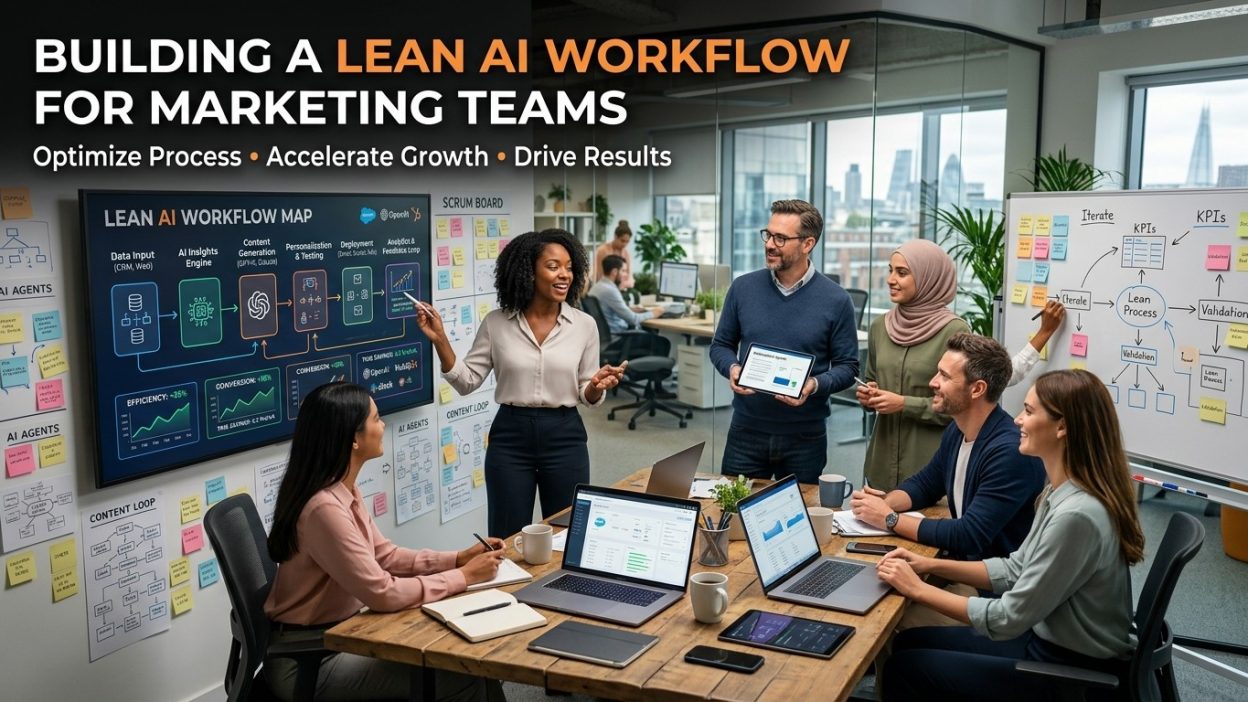
A lean AI marketing workflow connects strategy, research, creation, optimization, automation, review, and measurement without adding unnecessary tools, complexity, or operational overhead.
Marketing teams are under pressure to produce more content, analyze more data, personalize more campaigns, respond faster, and prove measurable business impact. At the same time, many teams are already overwhelmed by dashboards, disconnected platforms, repetitive tasks, approval bottlenecks, and endless manual work.
The solution is not to add AI to every marketing activity.
A better approach is to build a focused operating system where AI handles repetitive and information-heavy work while marketers retain control over strategy, creativity, quality, brand positioning, and important decisions.
An effective AI Workflow for Marketing Teams should therefore be lean by design. It should reduce friction rather than create another layer of complexity. The objective is not to create the most sophisticated automation stack. The objective is to make the existing marketing process faster, clearer, more scalable, and easier to manage.
A well-designed AI Workflow for Marketing Teams can support keyword research, content planning, competitor analysis, audience research, campaign development, customer segmentation, creative ideation, optimization, reporting, and workflow automation. But these capabilities only create value when they connect logically.
A fragmented workflow can actually make marketing slower. A marketer may use one tool to generate ideas, another to summarize data, another to create content, another to check performance, and another to automate tasks—while manually moving information between every platform.
The better model is a connected workflow with clear inputs, defined outputs, human checkpoints, and measurable outcomes.
This guide explains how to build that kind of system from the ground up.
What Is an AI Workflow for Marketing Teams?
An AI Workflow for Marketing Teams is a structured sequence of marketing tasks in which artificial intelligence assists with research, analysis, creation, decision support, automation, or optimization.
The key word is workflow.
Using an AI tool occasionally does not create a workflow. A workflow exists when information consistently moves from one stage to another and each stage has a defined purpose.
For example:
Research → Insight → Strategy → Creation → Review → Distribution → Measurement → Optimization
AI can support several steps inside that sequence.
An AI Workflow for Marketing Teams may use automation to collect research, summarize customer questions, classify themes, create content outlines, generate first drafts, identify optimization opportunities, and prepare performance summaries. Human marketers then validate the output and make strategic decisions.
The strength of an AI Workflow for Marketing Teams comes from repeatability. A team should be able to perform the same core process repeatedly without rebuilding everything from scratch.
A useful workflow also has boundaries. AI should not automatically determine brand positioning, make unsupported claims, publish sensitive information, or change major campaign strategy without appropriate review.
The workflow should define exactly where automation stops and human judgment begins.
Workflow Versus Tool Collection
Many teams unintentionally build a collection of AI tools instead of a functioning workflow.
A tool collection looks like this:
- One AI writer
- One analytics assistant
- One automation platform
- One chatbot
- One design generator
- One research tool
A workflow looks like this:
Business objective → audience research → topic intelligence → content brief → production → quality review → publication → performance analysis → next action
The distinction is important because workflows create business outcomes, while tools simply perform tasks.
Why Lean AI Workflow for Marketing Teams Matter
Marketing teams rarely suffer from a complete absence of tools. More commonly, they suffer from too much friction between tools.
An AI Workflow for Marketing Teams should reduce the number of repeated decisions and manual transitions required to complete ordinary marketing work.
A lean structure can improve:
| Area | Without a Lean Workflow | With a Lean Workflow |
|---|---|---|
| Research | Repeated manual searching | Structured research process |
| Content | Separate planning and writing | Connected content pipeline |
| Reporting | Manual data gathering | Automated summaries |
| Optimization | Occasional audits | Continuous monitoring |
| Collaboration | Long approval chains | Defined checkpoints |
| Execution | Tool-by-tool work | Process-based execution |
A lean AI Workflow for Marketing Teams also makes onboarding easier. New team members do not need to memorize dozens of undocumented processes. They can understand what happens first, what happens next, what AI handles, and when human review is required.
This reduces operational dependency on individual employees.
Another benefit is consistency. When every marketer approaches research, content creation, campaign development, and reporting differently, output quality can vary dramatically. A shared workflow establishes a common operating standard.
The goal is not to eliminate human creativity.
The goal is to eliminate avoidable repetition so creativity can receive more attention.
Start With the Marketing Objective

The biggest mistake teams make when introducing AI is starting with technology instead of a business problem.
An AI Workflow for Marketing Teams should begin with a clearly defined objective.
Examples include:
- Increase qualified organic traffic
- Produce more content without reducing quality
- Improve lead response speed
- Increase campaign testing frequency
- Reduce reporting time
- Improve customer segmentation
- Increase content conversion rates
- Identify emerging customer interests faster
A workflow built around “using AI” has no meaningful destination.
A workflow built around “reducing content production time by 30% while maintaining editorial quality” has a measurable purpose.
An AI Workflow for Marketing Teams should therefore establish three things before any automation is created:
Input: What information enters the process?
Transformation: What does AI or the marketing team do with that information?
Output: What business-ready result should come out?
For example:
Input: Search queries, customer questions, competitor pages.
Transformation: AI clusters topics and identifies recurring problems.
Output: A prioritized content map.
This simple structure prevents technology from becoming the objective itself.
Map the Existing Process Before Adding AI
Before automating a process, document how it currently works.
An AI Workflow for Marketing Teams often fails because teams automate a process that was already inefficient.
Suppose content planning currently involves five people, three spreadsheets, two messaging threads, and repeated keyword checks. Adding AI to that process may make some steps faster while leaving the structural inefficiency intact.
Start by mapping:
- What happens?
- Who performs it?
- How long does it take?
- What information is required?
- Where do mistakes occur?
- Which steps are repetitive?
- Which steps require judgment?
This creates an opportunity matrix.
| Task Type | AI Suitability |
|---|---|
| Repetitive formatting | Very high |
| Data summarization | High |
| Topic clustering | High |
| First-draft generation | High |
| Strategic positioning | Moderate |
| Brand decisions | Human-led |
| Sensitive communication | Human-led |
| Final approval | Human-led |
A good AI Workflow for Marketing Teams usually starts by automating high-volume, low-risk tasks.
Those tasks create immediate efficiency without forcing the organization to redesign everything at once.
The Five-Layer Lean Marketing Workflow
A practical structure can be divided into five layers.
Layer 1: Intelligence
Collect and organize market, audience, search, competitor, and performance information.
Layer 2: Strategy
Turn those signals into priorities, campaign concepts, content opportunities, and audience decisions.
Layer 3: Production
Create drafts, variations, briefs, metadata, creative concepts, and campaign assets.
Layer 4: Activation
Publish, distribute, personalize, route, test, and automate.
Layer 5: Learning
Measure outcomes, identify patterns, and feed those insights back into the next planning cycle.
A mature AI Workflow for Marketing Teams connects these layers rather than treating them as independent activities.
The learning layer is especially important.
Without feedback, AI simply produces more marketing material.
With feedback, the system becomes progressively more useful.
For example, if certain article structures repeatedly generate stronger engagement, those insights should inform future briefs. If certain audiences respond poorly to a campaign angle, the workflow should capture that information before another campaign uses the same assumption.
That is how a workflow becomes an intelligence loop.
Research and Intelligence Automation
Research is one of the most natural areas for AI assistance because marketers spend significant time processing information.
An AI Workflow for Marketing Teams can collect and organize:
- Search themes
- Customer questions
- Competitor positioning
- Industry developments
- Campaign results
- Sales objections
- Review themes
- Website behavior
- Existing content gaps
The objective is not to let AI decide what matters. AI should reduce the time required to find and organize potentially useful information.
For instance, a marketer could provide a large set of customer questions and ask AI to categorize them into themes such as pricing, implementation, trust, performance, integration, and comparison.
The marketer can then inspect the clusters and determine which ones align with business priorities.
Intent signals can also support this process. Understanding Intent Data Identifies gives marketers additional context around how behavioral signals can reveal buying-related research patterns.
This information can feed campaign planning, content priorities, and sales enablement.
The workflow becomes more valuable when research does not disappear after one campaign. Useful intelligence should be stored and reused.
Using AI for Audience and Customer Research
Understanding the audience is fundamental to effective marketing.
An AI Workflow for Marketing Teams can process customer interviews, survey responses, support conversations, reviews, sales notes, and publicly available feedback to identify recurring needs and concerns.
AI can help organize large amounts of unstructured information into categories such as:
Pain points
What repeatedly frustrates customers?
Desired outcomes
What results are customers trying to achieve?
Barriers
What prevents people from taking action?
Objections
Why might they reject a solution?
Language
Which phrases do customers naturally use to describe the problem?
The final category is especially valuable.
Marketing teams often describe products using internal terminology that differs from how customers actually talk. AI can identify repeated customer language and help marketers reflect that language in headlines, landing pages, advertisements, FAQs, and content.
An effective AI Workflow for Marketing Teams uses those insights as raw material, not as unquestionable conclusions.
Customer research still needs human interpretation because frequency does not always equal importance.
One customer may mention an issue repeatedly because it is extremely frustrating. Another may mention something only once because it was extremely serious.
Context matters.
Building an AI-Assisted Content Workflow
Content production is one of the areas where teams can gain significant efficiency from AI.
But a scalable AI Workflow for Marketing Teams should never be reduced to “give AI a keyword and publish the output.”
A stronger process looks like:
Business goal → Search intent → Audience problem → Research → Outline → Draft → Fact checking → Optimization → Human editing → Publication → Measurement
AI can assist with:
- Topic clustering
- Brief development
- Outline creation
- Supporting questions
- First-draft generation
- Content expansion
- Meta description ideas
- FAQ discovery
- Content gap analysis
- Content refresh suggestions
Human marketers remain responsible for positioning, originality, factual accuracy, strategic relevance, and editorial standards.
This distinction is increasingly important because large volumes of generic content can create more competition without creating more value.
A lean workflow should therefore optimize for usefulness, not production volume.
The question should not be:
“How many articles can AI create?”
It should be:
“How efficiently can the team create information that genuinely helps the intended audience?”
That shift changes the entire workflow.
Creating Better Content Briefs With AI
A strong brief can dramatically improve downstream production.
An AI Workflow for Marketing Teams can transform raw research into structured briefs containing:
| Brief Element | Purpose |
|---|---|
| Primary topic | Defines the central subject |
| Search intent | Clarifies user expectation |
| Audience | Establishes reader context |
| Content angle | Differentiates the asset |
| Supporting questions | Expands topical coverage |
| Conversion goal | Connects content to business value |
| Internal links | Supports site architecture |
| Evidence needs | Identifies verification requirements |
AI can generate an initial framework quickly.
The content strategist then reviews whether the brief actually reflects the target audience and business objective.
This is where human psychology becomes important.
A searcher does not simply want a keyword repeated. They may want reassurance, clarity, proof, comparison, instructions, or a safer decision.
An effective AI Workflow for Marketing Teams recognizes those underlying needs.
For example, a topic about marketing automation could be framed around technical capabilities, cost reduction, scalability, implementation risk, or productivity. The correct angle depends on the user’s intent.
AI can generate options.
Human strategy chooses the meaningful direction.
AI Workflow for SEO and Search Optimization
SEO creates another strong application for AI because modern optimization involves large amounts of research and structured analysis.
An AI Workflow for Marketing Teams can assist with:
- Search intent classification
- Keyword grouping
- SERP pattern analysis
- Topic clustering
- Content gap identification
- Internal-link suggestions
- Metadata drafting
- FAQ development
- Content refresh detection
- Competitor content analysis
However, AI should not simply reproduce what already ranks.
A better workflow identifies what users still need that existing content fails to provide.
That could include clearer examples, stronger comparisons, better organization, original insights, updated information, or more practical instructions.
An SEO workflow should therefore move from imitation toward information gain.
The team should ask:
“What useful understanding does this page add?”
That question is more strategic than simply asking how many keywords can be included.
An AI Workflow for Marketing Teams becomes stronger when SEO is integrated into planning rather than added after content creation.
Search intent informs the brief.
The brief guides production.
Production follows SEO structure.
Performance feeds back into the next content cycle.
That is a genuine workflow.
Connecting Intent Data With Marketing Automation
Behavioral intent can become an important input into campaign prioritization.
An AI Workflow for Marketing Teams can process signals such as account activity, content interactions, search behavior, campaign engagement, website visits, and topic interest.
When properly combined, those signals can help marketers identify which audiences may need different experiences.
For example:
Early research: Educational content.
Problem-aware: Problem-solving resources.
Solution-aware: Product education and use cases.
Evaluation: Comparison and evidence.
Commercial: Sales enablement or direct conversion paths.
Understanding Top Intent Data Sources can help teams think about which sources provide useful signals and how different data layers can complement one another.
The important point is that not every signal should automatically trigger a sales action.
An AI Workflow for Marketing Teams should include rules that consider fit, recency, context, and multiple signals before increasing priority.
AI can help identify patterns.
Humans should define what those patterns mean operationally.
AI-Assisted Campaign Planning
Campaign planning often involves extensive brainstorming, audience research, competitive analysis, messaging development, and asset coordination.
An AI Workflow for Marketing Teams can shorten the planning stage by generating structured alternatives.
For example, AI can create several campaign concepts around one objective and classify them by:
- Audience
- Problem
- Promise
- Channel
- Content format
- Conversion objective
- Testing variable
Marketers can then eliminate weak ideas and develop the strongest concepts.
This is more efficient than asking AI to independently “create a campaign.”
A campaign should begin with a strategic constraint.
For example:
Objective: Generate qualified demo requests.
Audience: Mid-market marketing teams.
Problem: Fragmented campaign execution.
Core promise: Simplify campaign coordination without increasing team workload.
AI can then help generate message variations, content ideas, landing-page structures, email concepts, and advertising angles.
The human team controls the strategic position.
The machine accelerates exploration.
That division creates a more useful AI Workflow for Marketing Teams because it increases creative range without removing strategic ownership.
Automating Repetitive Marketing Operations
Operations may be the most underrated AI opportunity.
Marketers regularly spend time:
- Renaming files
- Formatting reports
- Categorizing leads
- Summarizing meetings
- Tagging conversations
- Sorting feedback
- Preparing dashboards
- Routing requests
- Creating recurring reports
- Updating campaign records
These tasks may not be intellectually impressive, but they consume considerable time.
An AI Workflow for Marketing Teams can automate many of them through triggers and structured rules.
For example:
New feedback arrives → AI classifies topic → sentiment is estimated → issue type is assigned → relevant team is notified → summary is added to CRM.
This type of automation can provide significant operational value.
AI-assisted routing can also help prevent important information from being buried.
For broader examples of automated classification and routing, resources such as Smart Bots can provide useful conceptual context.
The key is to automate predictable decisions while keeping sensitive or high-impact decisions under appropriate human control.
AI for Reputation and Customer Feedback

Customer feedback contains valuable information, but the volume can become difficult for teams to monitor manually.
An AI Workflow for Marketing Teams can process reviews, survey responses, comments, support conversations, and social discussions to identify common themes.
AI can classify:
Positive themes: What customers appreciate.
Negative themes: Where customers experience friction.
Recurring issues: Problems appearing repeatedly.
Emerging concerns: New topics becoming more common.
Emotional patterns: Changes in customer reaction.
Sentiment analysis can help organize this information, but sentiment should not be treated as perfect truth.
Sarcasm, cultural language, mixed emotions, and industry terminology can create misleading classifications.
Resources such as AI Sentiment Analysis illustrate how AI can support broader trend and sentiment analysis.
The workflow should therefore use AI for signal detection and prioritization while humans investigate the context.
That distinction protects the brand from reacting too quickly to noisy data.
Human Review Is a Workflow Stage
Human review should not be an emergency mechanism.
It should be deliberately designed into the workflow.
An AI Workflow for Marketing Teams should identify where human intervention is mandatory and where it is optional.
For example:
| Workflow Stage | AI Role | Human Role |
|---|---|---|
| Research | Gather and summarize | Validate relevance |
| Ideation | Generate options | Select direction |
| Drafting | Produce first version | Edit and improve |
| Optimization | Identify opportunities | Approve changes |
| Publishing | Prepare assets | Final approval |
| Reporting | Summarize results | Interpret implications |
This creates accountability.
The AI is not secretly deciding.
The human is not manually performing every task.
Both have clearly defined responsibilities.
A lean workflow should also make review proportional to risk. A social caption may need lightweight review. A legal statement, public crisis response, or major brand announcement may require multiple layers of approval.
Efficiency should never mean removing appropriate oversight.
Quality Control for AI-Generated Marketing
AI-generated content can be fast, but speed can amplify errors.
An AI Workflow for Marketing Teams therefore needs a quality-control layer.
A useful checklist includes:
Accuracy
Are facts correct?
Relevance
Does the content directly address the audience’s problem?
Originality
Does it contribute meaningful information instead of repeating common statements?
Brand Alignment
Does it reflect the company’s actual positioning and voice?
Evidence
Are claims supported where necessary?
Readability
Can the intended audience understand the message quickly?
Conversion Alignment
Does the asset move naturally toward the intended next step?
Compliance
Does the content avoid unsupported, restricted, or misleading claims?
Quality control should not happen only after a mistake appears.
An effective workflow builds these checks into the production process.
The value of AI is not merely that it generates faster. It is that marketers can use the extra time created by automation for better judgment.
Building Lean Prompt and Knowledge Systems
A repeated problem with AI adoption is inconsistent prompting.
Every marketer asks the AI tool different questions and receives different output structures.
An AI Workflow for Marketing Teams can solve this by creating reusable prompt frameworks.
A good internal prompt library might contain templates for:
- Research summaries
- Persona analysis
- Content briefs
- SEO audits
- Competitor analysis
- Campaign ideation
- Email drafts
- Social variations
- Performance summaries
- Customer feedback classification
But templates should not be static forever.
Teams should improve prompts based on output quality.
The best prompt system also provides context:
Objective
What are we trying to accomplish?
Audience
Who is this for?
Input
What information should AI use?
Constraints
What should it avoid?
Format
What should the output look like?
Quality criteria
How will the marketer judge the result?
This turns prompting from trial and error into a repeatable process.
A mature AI Workflow for Marketing Teams treats prompts as operational assets rather than random instructions.
Measuring AI Workflow for Marketing Teams Efficiency
The success of automation should be measurable.
An AI Workflow for Marketing Teams should track both productivity and quality.
Useful metrics include:
| Metric | Why It Matters |
|---|---|
| Production time | Measures efficiency |
| Review time | Reveals quality burden |
| Error rate | Tracks reliability |
| Output volume | Measures capacity |
| Conversion rate | Measures business impact |
| Cost per asset | Measures efficiency |
| Campaign velocity | Measures execution speed |
| Team adoption | Measures usability |
One of the most important metrics is saved human time.
Suppose a task originally required four hours and AI reduces it to one hour. The benefit is not simply three fewer hours.
Those three hours can be reinvested into research, strategy, experimentation, customer understanding, or creative development.
That is where the real productivity gain happens.
Teams should also monitor whether AI increases rework.
If a marketer saves two hours generating a draft but spends three hours fixing poor output, the workflow has not improved.
The correct measurement is total process efficiency, not isolated AI speed.
Avoiding AI Tool Overload
More AI tools do not necessarily produce more automation.
An AI Workflow for Marketing Teams should minimize unnecessary handoffs and duplicate functionality.
Before adding a new tool, ask:
What problem does it solve?
What current step does it replace or improve?
Does it integrate with the existing process?
Will it create another place to store information?
Who will maintain it?
How will success be measured?
If the answers are unclear, the tool may create more complexity than value.
A lean stack often includes fewer systems with clearer responsibilities.
The objective is not to impress the team with the number of AI subscriptions.
The objective is to create a workflow where every major tool has a defined job.
That discipline is especially important for smaller marketing teams with limited budgets and operational capacity.
Designing the Ideal Human-AI Division of Labor
AI is generally strongest at tasks involving:
- Pattern recognition
- Summarization
- Classification
- Repetition
- Variation generation
- Large-scale information processing
- Structured transformation
Humans are generally essential for:
- Strategic judgment
- Original positioning
- Relationship management
- Ambiguous decisions
- Ethical considerations
- Brand responsibility
- Complex stakeholder alignment
- High-risk communication
An effective AI Workflow for Marketing Teams assigns tasks according to those strengths.
The framework can be summarized as:
Automate repetition.
Augment analysis.
Accelerate creation.
Protect human judgment.
This approach avoids two extremes.
The first extreme is refusing useful automation because “marketing should always be human.”
The second is assuming AI should control every decision because humans are slower.
Neither approach creates a durable marketing operation.
A hybrid workflow uses speed and scale where appropriate while preserving human accountability where it matters most.
Creating a Weekly AI Marketing Operating Rhythm
A workflow becomes easier to sustain when it is built into a repeatable rhythm.
Monday: Intelligence Review
Analyze performance, customer signals, search trends, campaign data, and current priorities.
Tuesday: Planning
Use those insights to define content, campaign, and optimization priorities.
Wednesday: Production
Use AI-assisted processes to create drafts, creative concepts, briefs, and assets.
Thursday: Review and Activation
Perform human quality checks, finalize assets, and launch approved activities.
Friday: Learning
Review early results, document insights, and identify adjustments for the next cycle.
This structure can be adapted to different teams.
The important element is continuity.
An AI Workflow for Marketing Teams becomes much more effective when intelligence flows into planning and planning flows into execution.
Without that loop, teams may use AI efficiently but still operate strategically in separate silos.
The weekly rhythm also creates accountability because the team knows when research, production, review, and learning occur.
Common Mistakes When Building AI Marketing Workflows
Automating Before Understanding
A broken process does not become efficient just because AI is added.
Chasing Tool Features
New features are not automatically business opportunities.
Removing Human Review
Automation without oversight increases risk.
Measuring Output Instead of Outcomes
More content does not necessarily mean better marketing.
Ignoring Data Quality
AI cannot compensate for incomplete or inaccurate inputs.
Creating Excessive Complexity
A workflow with too many branches becomes difficult to maintain.
Treating AI Output as Final
AI-generated material still requires evaluation.
Failing to Document the Process
Undocumented workflows collapse when key employees leave or priorities change.
Forgetting Customer Psychology
Efficiency does not replace empathy, trust, relevance, or timing.
The best AI Workflow for Marketing Teams remains strategically simple even when the underlying technology is sophisticated.
A 30-Day Implementation Roadmap
A lean workflow can be introduced gradually.
Days 1–7: Audit
Document existing processes and identify the five most repetitive marketing tasks.
Days 8–14: Prioritize
Choose one high-volume, low-risk process for initial automation.
Days 15–21: Build
Create prompts, templates, rules, review checkpoints, and documentation.
Days 22–26: Test
Run the workflow on real work and measure time, quality, and error rates.
Days 27–30: Refine
Remove unnecessary steps, improve prompts, establish ownership, and document the final process.
After the first workflow becomes stable, expand to another process.
This gradual approach is safer than attempting to automate the entire marketing department at once.
An AI Workflow for Marketing Teams should grow through validated use cases rather than technology enthusiasm.
The team learns what works.
The workflow captures those lessons.
The system improves.
Advanced AI Workflow for Marketing Teams Optimization
Once the foundation is stable, teams can introduce more sophisticated capabilities.
Predictive Prioritization
Use historical data to identify patterns associated with valuable outcomes.
Dynamic Content
Adjust messaging based on audience behavior and stage.
Automated Reporting
Generate summaries that highlight meaningful changes rather than simply displaying numbers.
Anomaly Detection
Identify unusual drops or spikes in traffic, conversions, sentiment, or campaign performance.
Cross-Channel Intelligence
Combine information from search, email, advertising, social, CRM, and website behavior.
Content Refresh Detection
Identify older assets that may require updates based on performance or changing search intent.
The progression should remain deliberate.
Complexity should be added only when it solves a measurable problem.
A lean system can eventually become sophisticated without becoming chaotic.
That is the difference between maturity and overengineering.
How AI Workflow for Marketing Teams Improve Marketing Psychology
Marketing is ultimately about human decisions.
AI can accelerate the process of understanding those decisions, but the workflow still needs to consider psychological drivers.
Customers may respond to:
- Fear of making a wrong decision
- Desire for convenience
- Need for social proof
- Concern about risk
- Desire for control
- Curiosity
- Urgency
- Identity
- Expected value
An AI Workflow for Marketing Teams can help identify these patterns across customer feedback and behavioral data.
For example, repeated questions about implementation may indicate uncertainty around complexity. Repeated questions about pricing may indicate budget concerns. Frequent comparison behavior may indicate a need for differentiation or proof.
AI can organize those patterns.
Marketing strategists should determine how to address them.
That is where technology becomes more than a productivity tool.
It becomes an interpretation layer between data and customer understanding.
The Future of Lean AI Workflow for Marketing Teams Operations

Marketing teams will likely continue to adopt more AI Workflow for Marketing Teams capabilities, but the competitive advantage will not necessarily belong to the teams using the greatest number of AI tools.
It may belong to teams with the clearest workflows.
An AI Workflow for Marketing Teams can evolve from isolated automation toward an interconnected marketing operating system in which research, content, customer insights, campaigns, and measurement continuously inform one another.
Future workflows may automatically detect shifts in audience interests, recommend content priorities, identify campaign anomalies, generate production briefs, summarize customer feedback, and surface opportunities for human decision-makers.
The important principle will remain the same:
AI Workflow for Marketing Teams should increase organizational capability, not simply increase activity.
A team that publishes twice as much low-value content is not necessarily more effective.
A team that produces the right asset faster, understands the audience better, responds to important signals sooner, and learns continuously may create more durable value.
That is the real promise of a lean AI Workflow for Marketing Teams system.
Final Framework: The Lean AI Marketing Loop
A practical model can be summarized as:
1. Capture
Collect relevant data and customer signals.
2. Understand
Use AI Workflow for Marketing Teams to classify, summarize, and organize information.
3. Decide
Let marketers determine priorities and strategy.
4. Create
Use AI to accelerate production while maintaining human editing.
5. Activate
Distribute content and campaigns through appropriate channels.
6. Measure
Track both efficiency and business outcomes.
7. Learn
Feed the results back into the next cycle.
This creates a continuous loop.
An AI Workflow for Marketing Teams becomes valuable when each cycle makes the next cycle smarter, faster, and more relevant.
The system does not need to be complicated.
It needs to be connected.
The best workflows are often the ones marketers can explain on a whiteboard in a few minutes.
That simplicity improves adoption, reduces errors, and makes future expansion easier.
Conclusion
A lean AI marketing operation is not built by adding artificial intelligence to every task. It is built by identifying repetitive work, connecting meaningful data, automating predictable processes, and protecting human judgment where strategy and accountability matter. An effective AI Workflow for Marketing Teams creates a continuous cycle from research to strategy, production, activation, measurement, and learning. The strongest systems remain simple enough to manage, flexible enough to evolve, and disciplined enough to measure. When AI removes operational friction instead of adding complexity, marketers gain more time for customer understanding, creative thinking, experimentation, and strategic decisions that ultimately create stronger marketing outcomes.
Frequently Asked Questions (FAQ)
What is an AI Workflow for Marketing Teams?
An AI Workflow for Marketing Teams is a repeatable marketing process in which AI assists with research, analysis, creation, automation, optimization, or reporting. It is different from simply using an AI tool occasionally because the workflow defines how information moves from one stage to another. A typical process may begin with research, move into strategy and content production, continue through review and activation, and finish with measurement and optimization. The objective is to reduce repetitive work while preserving human control over important marketing decisions and customer-facing communication.
How can small marketing teams start using AI Workflow for Marketing Teams ?
Small teams should begin with one repetitive, measurable, and relatively low-risk task. Examples include meeting summaries, content briefs, campaign reporting, topic clustering, customer-feedback categorization, or recurring data preparation. Document the existing process first, identify where time is being wasted, and then introduce AI into that specific step. Measure time saved, output quality, errors, and downstream business impact. Once the first process becomes stable, another workflow can be added. Starting small reduces tool overload and allows the team to learn from real operational experience.
What tasks should marketers automate first?
The best initial candidates are repetitive, high-volume, structured, and relatively low-risk tasks. Data formatting, summarization, classification, reporting preparation, content ideation, research organization, and workflow routing are often suitable. Strategic positioning, crisis communication, major brand decisions, sensitive customer communication, and legally significant content generally require stronger human oversight. A useful rule is to automate tasks where consistency and speed are more valuable than nuanced judgment. This allows marketers to capture efficiency gains without transferring important business responsibility entirely to automated systems.
Can AI replace marketing teams?
AI can automate or accelerate many marketing tasks, but marketing work also involves strategy, positioning, customer psychology, creativity, relationships, judgment, and accountability. An AI Workflow for Marketing Teams is generally more useful when AI supports employees rather than attempting to replace the entire marketing function. AI can help researchers process more information, writers produce drafts faster, analysts identify patterns, and operations teams reduce repetitive work. Human marketers remain important for deciding what matters, determining how the brand should respond, understanding context, and evaluating whether the output creates real business value.
How does AI improve content marketing?
AI can accelerate research, topic clustering, content outlining, drafting, optimization, metadata creation, FAQ development, content-gap analysis, and content-refresh identification. The biggest value comes when these capabilities are connected into one process rather than used separately. Marketers can use AI to reduce production friction while remaining responsible for originality, accuracy, search intent, audience relevance, brand voice, and final editorial quality. This allows teams to redirect saved time toward stronger research, deeper expertise, customer understanding, and better strategic content decisions instead of simply producing more low-value material.
What makes an AI Workflow for Marketing Teams “lean”?
A lean workflow contains only the steps, tools, approvals, and automations required to achieve the desired outcome. It avoids unnecessary software, duplicate tasks, complicated approval chains, and manual movement of information between systems. A lean process has clear inputs, transformations, outputs, owners, and measurement criteria. The goal is not minimal technology for its own sake. The goal is minimum unnecessary complexity. A small workflow with five well-connected steps can outperform a complicated system containing dozens of disconnected automation rules and AI applications.
How should humans and AI divide marketing responsibilities?
AI is particularly useful for repetition, summarization, classification, pattern recognition, variation generation, and large-scale information processing. Humans remain essential for strategy, ambiguity, emotional judgment, ethical considerations, positioning, relationships, and accountability. The best division of labor assigns tasks according to these strengths. AI can prepare information and recommendations, while humans decide what those recommendations mean and what action should follow. This creates a collaborative model in which marketing teams gain speed without sacrificing responsibility, creativity, customer empathy, or strategic direction.
How can marketers maintain quality when using AI?
Quality requires deliberate checkpoints. Teams should review AI-generated material for accuracy, relevance, originality, brand alignment, supporting evidence, readability, audience fit, and compliance. The level of review should match the potential risk of the output. A simple internal summary may need basic validation, while a public crisis response or major strategic campaign may require extensive human review. Teams should also monitor rework. Saving time during generation is meaningless if the output requires excessive correction later. Quality should therefore be measured across the entire workflow rather than at the generation step alone.
How many AI tools does a marketing team actually need?
There is no universal number. The more important question is whether each tool has a clear role inside the workflow. Teams should evaluate whether a new application solves a measurable problem, integrates with existing processes, reduces manual work, improves quality, or creates a meaningful capability. Adding overlapping tools can increase costs, data fragmentation, training requirements, and maintenance. A lean stack often consists of a smaller group of well-integrated systems with clearly documented responsibilities. Technology should serve the marketing process rather than forcing the process to revolve around technology.
How should companies measure the success of an AI marketing workflow?
Measure both operational efficiency and business performance. Useful metrics include production time, review time, error rate, rework, campaign velocity, content conversion, lead quality, customer engagement, and revenue-related outcomes. Time saved is valuable only when that time is redirected toward meaningful work. Teams should also compare performance before and after workflow changes. An AI Workflow for Marketing Teams is successful when it creates measurable improvement without sacrificing quality, trust, strategic consistency, or customer experience. Continuous measurement allows the workflow to evolve based on evidence rather than assumptions.