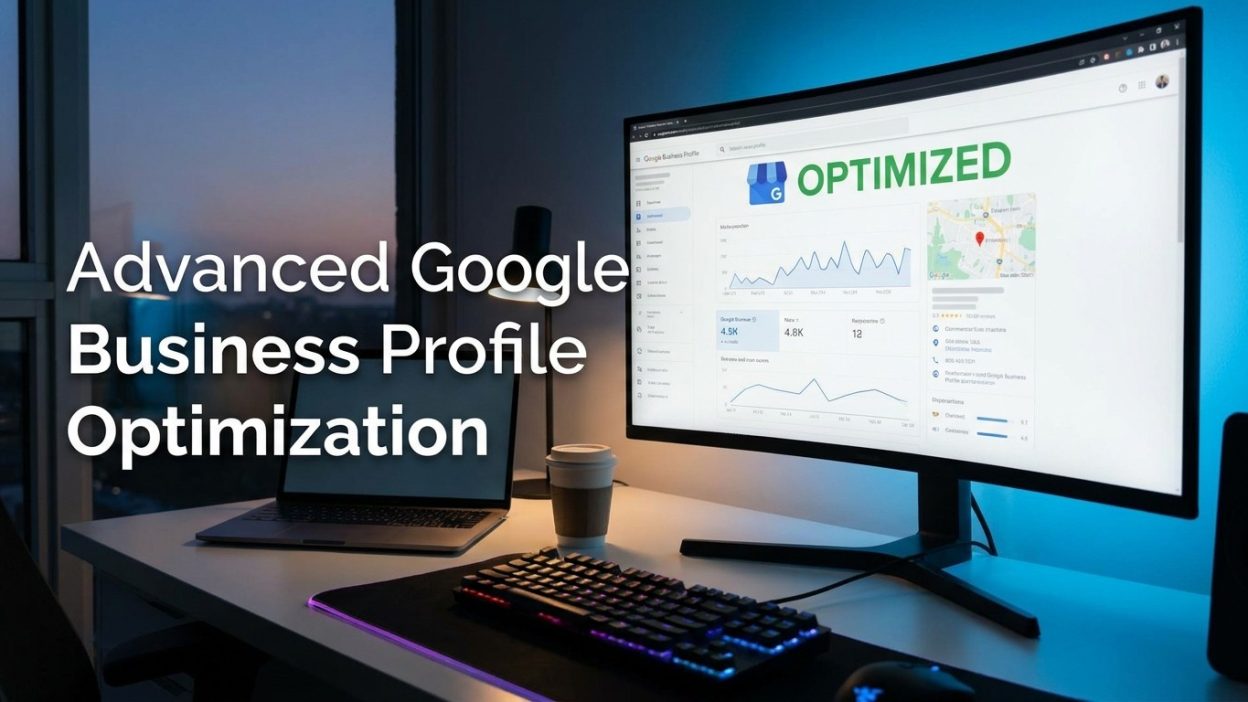
Google Business Profile Optimization helps local businesses strengthen visibility, trust, relevance, and customer actions by turning an accurate profile into a strategically managed local search asset.
A Google Business Profile is no longer just a digital business card. For a local company, it can function as a discovery channel, reputation asset, conversion surface, customer-information hub, and bridge between Google Search, Google Maps, websites, calls, directions, bookings, and in-person visits.
That is why Google Business Profile Optimization needs to go beyond filling out basic information and uploading a logo. A profile can be technically complete and still fail to attract the right searches, communicate value, or convert high-intent visitors.
Google states that local results are mainly influenced by relevance, distance, and prominence. It also recommends providing complete and detailed business information, responding to reviews, and adding useful photos and videos.
The advanced approach is therefore not about manipulating rankings. It is about making the business easier for Google to understand and easier for customers to trust.
Google Business Profile Optimization works best when information architecture, category selection, services, reviews, visuals, customer experience, website alignment, and measurement all support the same local-intent strategy.
What Is Google Business Profile Optimization?
Google Business Profile Optimization is the process of improving a business’s profile so Google can understand what the business offers while customers can quickly determine whether that business is relevant, credible, accessible, and worth contacting.
The process includes much more than adding keywords.
A strong profile should accurately communicate:
- What the business is
- What it offers
- Where it operates
- Who it serves
- When it is available
- What customers can expect
- Why people should choose it
- How customers can take the next step
Google explains that Business Profiles can show business information such as location, opening hours, website, phone number, photos, products, services, and reviews across Search and Maps.
That makes Google Business Profile Optimization partly an SEO activity and partly a customer-experience discipline.
Optimization Versus Completion
A completed profile is not necessarily an optimized profile.
Completion means the major fields are populated.
Optimization asks deeper questions:
Is the primary category the most accurate representation of the business?
Are additional categories relevant?
Do services describe actual customer needs?
Do photos reduce uncertainty?
Do review responses demonstrate expertise and care?
Does the website reinforce the same local relevance?
Does the profile answer the questions customers ask before contacting the business?
Does the call-to-action match the customer’s stage of decision-making?
These questions move Google Business Profile Optimization from administrative setup to strategic optimization.
Understanding How Google Local Ranking Works
Many businesses approach local SEO with the assumption that inserting more keywords will automatically produce higher visibility. That is not how Google describes local ranking.
Google says local results are mainly based on relevance, distance, and prominence. Relevance concerns how well the profile matches the search. Distance considers the searcher’s location relative to the business. Prominence reflects how well-known the business is and can be influenced by signals such as reviews and links from other websites.
That framework has important consequences.
Relevance
Relevance starts with accurate business information.
If a business describes itself clearly, uses an appropriate primary category, maintains useful service information, and provides complete details, Google has stronger context for matching the business to relevant searches.
Google Business Profile Optimization should therefore focus on semantic clarity instead of keyword stuffing.
Distance
Distance is largely outside a business’s control.
A business cannot legitimately force Google to treat itself as being closer to a searcher than it actually is.
This is why location strategy should focus on serving the areas where the company genuinely operates.
Prominence
Prominence is where reputation, web presence, references, reviews, and broader authority become important.
A widely recognized business with strong independent references may have stronger prominence than a new business with little external recognition.
Google explicitly says there is no way to request or pay for a better local ranking, and that ranking-system details are kept confidential.
This means legitimate Google Business Profile Optimization should build real-world and online signals rather than attempt artificial ranking shortcuts.
The Strategic Role of the Primary Category

Category selection is one of the most important foundational decisions in Google Business Profile Optimization.
The primary category should describe the core business identity as accurately as possible.
Think about the difference between:
“Restaurant”
and a more specific, accurate category that reflects the establishment’s actual primary function.
The more precise category can provide stronger contextual meaning when appropriate.
However, category relevance matters more than trying to find a category simply because it has attractive search volume.
Choosing Additional Categories
Additional categories can communicate meaningful secondary offerings, but they should not become a random list of everything the company touches.
A local contractor might provide several related services, but adding unrelated categories can confuse the business identity.
A good question is:
“If a customer saw this category without reading anything else, would it accurately describe a real part of our business?”
If the answer is no, it probably does not belong.
Google Business Profile Optimization should simplify Google’s understanding of the business, not make the entity ambiguous.
Business Name Accuracy and Local Relevance
One of the common mistakes in local SEO is artificially inserting keywords into a business name.
For example, a real company called “Riverside Dental” should not casually become “Riverside Dental Best Dentist Emergency Implant Clinic” simply to chase searches.
The profile should represent the real-world business name.
Manipulated names can create policy problems and undermine trust.
A strong optimization strategy separates brand identity from keyword targeting.
The business name establishes who the company is.
The category, services, description, website, reviews, and other legitimate signals communicate what it does.
That distinction is foundational to sustainable Google Business Profile Optimization.
Writing a High-Conversion Business Description
The business description should not read like a keyword dump.
It should explain the business clearly and naturally.
A useful structure is:
Who you are + what you provide + who you serve + where you operate + what makes you useful.
For example:
“ABC Dental provides general, cosmetic, and restorative dental care for families in the local area, with a focus on convenient appointments, clear treatment explanations, and patient-centered service.”
This type of wording serves both humans and search engines.
What the Description Should Accomplish
The description should help answer:
What do you do?
Who is it for?
Where do you serve customers?
What differentiates the experience?
What should a potential customer expect?
The goal is not to make every sentence contain a target phrase.
The goal is to create a coherent entity.
That makes Google Business Profile Optimization much more aligned with search intent.
Service Optimization for Local Search
Services can be a powerful part of the profile because they provide structured information about what a business actually offers.
Google says eligible businesses can add services, group them into categories, and include details such as descriptions and prices where applicable. It also notes that when local customers search for an offering, that service may be highlighted on the profile.
This makes service organization strategically important.
Create Customer-Centered Service Categories
Instead of organizing services according to internal company jargon, organize them around the way customers understand their needs.
A plumbing company might distinguish:
- Emergency plumbing
- Drain cleaning
- Water heater repair
- Leak detection
- Fixture installation
A marketing agency might distinguish:
- Local SEO
- Website optimization
- Google Ads management
- Reputation management
- SEO audits
The exact service structure should reflect actual offerings.
Write Useful Service Descriptions
Each description should answer the customer’s practical concern.
A good description can explain:
What the service includes.
Who needs it.
What problem it solves.
What outcome the customer can expect.
The description should remain factual.
Do not stuff cities, phone numbers, exaggerated claims, or irrelevant promotional phrases into custom service names. Google specifically identifies certain inappropriate elements in custom services as subject to rejection.
Attributes and Business Details
Attributes can reduce uncertainty.
Depending on business type, attributes may communicate details such as accessibility, parking, Wi-Fi, payment options, amenities, or other characteristics.
Google recommends providing available details such as parking or Wi-Fi when relevant.
These details seem small, but customer psychology often operates through small uncertainties.
A person deciding between two businesses may ask:
Is parking available?
Do they accept my preferred payment method?
Can I visit today?
Are they accessible?
Do they provide the specific service I need?
Google Business Profile Optimization should remove these barriers wherever the platform allows accurate information to be presented.
Hours, Special Hours, and Operational Accuracy
Incorrect hours damage trust immediately.
A customer who arrives at a closed business may remember the negative experience more strongly than any positive review.
Regular business hours should be accurate, but special hours are equally important.
Holidays, seasonal changes, closures, and schedule adjustments can affect customer decisions.
Accurate hours also make the profile more useful for high-intent searches such as “open now.”
Google highlights business hours as part of the information customers use when deciding where to go.
Therefore, operational accuracy is a core part of Google Business Profile Optimization.
Photos as Conversion Assets
Photos are often treated as decoration.
That is a mistake.
Photos can answer questions before the customer contacts the business.
An exterior photo can help people recognize the building.
An interior photo can show atmosphere.
A product photo can establish quality.
A team photo can humanize the business.
A photo of work being performed can demonstrate capability.
Google recommends clear, well-lit imagery that represents the real business and provides guidance around formats, resolution, and different photo categories.
A Strategic Photo System
Instead of randomly uploading images, build a visual library.
Consider these categories:
| Photo Type | Customer Question Answered |
|---|---|
| Exterior | What does the place look like? |
| Interior | What experience should I expect? |
| Team | Who will help me? |
| Product | What do you actually sell? |
| Service in action | Can you perform this job? |
| Equipment | What resources do you use? |
| Before and after | What transformation is possible? |
| Location context | Is this the right place? |
This makes every image serve a purpose.
Google’s official guidance recommends authentic, well-lit imagery and warns against significant alterations or excessive use of filters or AI.
Authenticity matters because customers are increasingly sensitive to the gap between marketing presentation and real experience.
Reviews: The Reputation Engine
Reviews are among the most influential elements of a local customer’s decision process.
But reputation strategy should not be reduced to “get five stars.”
Customers often evaluate:
- Number of reviews
- Recency
- Written detail
- Business responses
- Specific experiences
- Recurring themes
- Evidence of service quality
Google states that reviews can help businesses stand out and provide useful information to prospective customers. It also recommends responding professionally and honestly.
Google Business Profile Optimization should therefore include a structured review process.
Build a Genuine Review System
Ask satisfied customers for feedback after legitimate interactions.
Make the process easy.
Google allows businesses to share a review link or QR code to request reviews.
The important distinction is that businesses should ask for genuine feedback without manipulating the outcome.
Offering discounts or incentives in exchange for reviews, changing reviews, or removing negative reviews is prohibited under Google’s policy.
Responding to Reviews Strategically
A response should not simply repeat:
“Thank you for your review.”
Personalized responses demonstrate listening.
For positive reviews, acknowledge a specific element of the experience.
For negative reviews, remain professional and avoid arguing.
A strong response can:
- Acknowledge the concern
- Clarify relevant context
- Demonstrate willingness to improve
- Offer an appropriate next step
Review responses are public communication.
They are not only written for the person who left the review. Future customers can read them too.
Turning Reviews Into Search Intelligence
Review text can reveal language customers naturally use.
Suppose customers repeatedly mention:
“quick appointment,”
“friendly staff,”
“same-day repair,”
“easy parking,”
or
“clear pricing.”
Those phrases can reveal market expectations.
The business can use those insights to improve website content, service descriptions, customer experience, FAQs, and messaging.
This is one reason Google Business Profile Optimization should be connected with broader market research.
The profile becomes a source of customer intelligence.
Managing Negative Reviews Without Panic
A negative review is not automatically a crisis.
In some situations, an overly defensive response can cause more damage than the original complaint.
The best strategy is to identify the issue and respond proportionately.
If the complaint is legitimate, improvement matters more than argument.
If the review violates Google’s policies, use the appropriate reporting process rather than trying to fight publicly.
Google also notes that honest and balanced reviews can help potential customers make decisions, meaning the presence of some negative feedback does not automatically make a business look untrustworthy.
This is important psychologically.
Customers often distrust profiles that appear impossibly perfect.
Customer-Generated Photos and Information
Google can display information from multiple sources, not only the business owner.
Google explains that profile information may come from business owners, public web content, third-party data, and user contributions such as photos and reviews.
That means brands should monitor not only what they publish but also what customers contribute.
Customer photos can reveal how people experience the business in real life.
They can also highlight products, seasonal changes, or aspects the brand’s own content may overlook.
Google notes that customers can post photo updates and that businesses can respond with additional information.
Building a Content Strategy Around the Profile
Business Profile activity should not exist in isolation.
It should connect with the company’s content ecosystem.
For example, a local medical clinic might publish educational content around frequently asked questions.
A home service company might create project explanations.
A restaurant might showcase menu changes and seasonal experiences.
A professional service business might publish locally relevant expertise.
The profile can become an entry point into this broader knowledge system.
Google Business Profile Optimization becomes stronger when website content and profile information reinforce one another.
Aligning the Website With the Business Profile
A profile and website should not tell conflicting stories.
They should align on:
- Business name
- Contact information
- Core services
- Location
- Service areas
- Brand identity
- Business description
- Customer promises
- Conversion paths
Consistency makes it easier for people and platforms to understand the entity.
Google states that it may use publicly available information from websites along with profile data and other sources when compiling business information.
This means local SEO should be treated as an interconnected entity system rather than a single listing.
Local Landing Pages and Profile Relevance

Businesses operating across multiple legitimate service areas often need stronger location-specific website architecture.
For example:
/services/
/city-a/
/city-b/
/city-c/
These pages should provide genuine local value rather than duplicate a template with only the city name changed.
A quality location page might include:
- Local service context
- Relevant service details
- Local customer concerns
- Address or service-area information
- Unique testimonials
- Nearby landmarks where genuinely useful
- Localized FAQs
- Clear contact options
The objective is relevance, not doorway-page manipulation.
Google Business Profile Optimization should complement this broader local architecture.
Linking Local SEO and Paid Search
Paid advertising and local organic visibility can support each other when managed strategically.
For example, a business may use paid campaigns to capture high-intent searches while developing stronger organic local relevance over time.
A broader Google Ads Strategy can then complement the local profile rather than replace it.
The important distinction is that paid placement is not the same as organic local ranking.
Google explicitly states that paying or requesting better local ranking is not an available path.
Where Broad Match Can Fit
Advanced advertisers may use Broad Match in Google Ads to expand reach, but broad targeting requires careful conversion measurement, negative-keyword management, and strong account structure.
The lesson for local businesses is not to mix paid search settings blindly into GBP work.
Instead, treat paid and local organic systems as connected but separate acquisition channels.
Local Reputation and Search Intent
A customer searching:
“dentist near me”
is in a different psychological state from someone searching:
“how to prevent cavities.”
The first query may reflect immediate commercial intent.
The second is primarily informational.
Google Business Profile Optimization is strongest when the profile is prepared for high-intent local discovery while the website and content ecosystem support broader information needs.
This creates a logical journey:
Discovery → Evaluation → Trust → Contact → Visit → Review → Referral.
That complete loop is more valuable than ranking for an isolated keyword.
Understanding Local Ranking Through Customer Psychology
Technical optimization gets businesses discovered.
Psychology helps them get chosen.
When customers see a local profile, they often make rapid judgments based on visual credibility, rating patterns, service relevance, business information, and familiarity.
This is why Google Business Profile Optimization must address both algorithmic clarity and human decision-making.
The Trust Stack
A useful way to think about local conversion is the trust stack:
Identity
Who is this business?
Relevance
Do they provide what I need?
Proof
Do other customers trust them?
Evidence
Can I see the service, product, place, or team?
Convenience
Can I reach them easily?
Confidence
Do I understand what happens next?
Every optimization should strengthen one or more layers.
Tracking Performance
Optimization without measurement becomes guesswork.
Google provides Business Profile performance data for verified profiles. According to Google, businesses can review metrics such as searches, views, directions, calls, website clicks, messages, and bookings where applicable.
These measurements help identify where a profile succeeds and where it underperforms.
Important Metrics
| Metric | Strategic Meaning |
|---|---|
| Search terms | How customers discover the profile |
| Profile views | Visibility and interest |
| Calls | High-intent action |
| Website clicks | Deeper research behavior |
| Directions | Visit intent |
| Messages | Conversation intent |
| Bookings | Transaction intent |
| Review volume | Reputation development |
Google notes that search queries shown in Business Profile performance represent terms people used to discover the profile and cannot be directly managed.
This makes the search-query data particularly useful for discovering customer language.
Use Search Data to Improve the Strategy
Imagine your business expects customers to search for “emergency electrician,” but profile performance reveals significant discovery around “power outage electrician” or “breaker repair.”
That information can influence website content, services, FAQs, and customer messaging.
The profile becomes a feedback mechanism.
Google Business Profile Optimization should therefore be iterative.
A profile is not optimized once and abandoned.
Customer behavior changes.
Services change.
Search language changes.
Business hours change.
Products change.
Competitors change.
The strategy must evolve accordingly.
Competitive Research Without Copying
A competitor review can reveal useful patterns.
Look at:
- Primary category
- Additional categories where visible
- Service organization
- Review themes
- Photo types
- Business information
- Website messaging
- Customer questions
- Local reputation
The objective is not duplication.
Instead, identify gaps.
Maybe competitors have many reviews but poor review responses.
Maybe they have strong ratings but weak service descriptions.
Maybe they have professional photos but limited evidence of actual work.
Maybe customers repeatedly complain about unclear pricing.
These gaps create strategic opportunities.
This is where businesses seeking Google Local Ranking Secrets should focus less on “secret tricks” and more on understanding the legitimate signals that make a business more relevant and trustworthy.
Common Google Business Profile Optimization Mistakes
Keyword Stuffing
Adding the same phrase repeatedly across every field makes the profile unnatural and can create policy risks.
Fake Locations
Creating profiles for locations where the business does not genuinely operate can undermine trust and violate guidelines.
Duplicate Profiles
Unnecessary duplicates can create confusion.
Inaccurate Hours
Incorrect schedules create poor customer experiences.
Irrelevant Categories
Categories should describe real aspects of the business.
Stock-Looking Photos
Generic imagery can reduce perceived authenticity.
Review Incentives
Buying or incentivizing reviews violates Google’s policies.
Ignoring Reviews
Silence can make a business appear disengaged.
Inconsistent Website Data
Mismatched information can weaken trust.
Measuring Only Rankings
Rank position without calls, visits, bookings, leads, or revenue does not tell the entire story.
A 30-Day Optimization Framework
An organized implementation can make local improvements easier to manage.
Week 1: Foundation
Audit:
- Business name
- Address
- Phone
- Website
- Categories
- Hours
- Service areas
- Attributes
- Business description
Correct inaccurate information.
Week 2: Relevance
Build and refine:
- Service categories
- Service descriptions
- Customer-focused FAQs
- Website alignment
- Local landing pages
- Internal links
Week 3: Trust
Improve:
- Photo library
- Review-request process
- Review responses
- Customer experience documentation
- Reputation monitoring
Week 4: Measurement
Review:
- Search visibility
- Profile views
- Calls
- Website clicks
- Directions
- Messages
- Bookings
- Review growth
Then identify the biggest bottleneck.
Google Business Profile Optimization should prioritize the largest practical opportunity instead of changing everything at once.
Advanced Maintenance Routine
After the initial optimization, establish a monthly operating rhythm.
Weekly
Check:
- New reviews
- Customer questions
- Uploaded photos
- Business updates
- Critical information accuracy
Monthly
Analyze:
- Search terms
- Profile actions
- Service performance
- Review trends
- Website behavior
- Conversion outcomes
Quarterly
Reevaluate:
- Categories
- Services
- Customer needs
- Photos
- Competitive positioning
- Local landing pages
- Reputation patterns
This creates a continuous improvement system.
Integrating Local SEO and Reputation Strategy
Search visibility and reputation are not separate in the customer’s mind.
A business may appear prominently but lose the click because its reviews look concerning.
Another company may have excellent reviews but weak local visibility.
The strongest approach combines both.
That is why broader frameworks such as Local SEO And Reputation Mastery are valuable as a strategic philosophy: visibility gets attention, while credibility converts that attention into action.
Google Business Profile Optimization sits at the intersection of these two functions.
The Importance of Entity Consistency
Google does not evaluate the profile in complete isolation.
The ecosystem can include:
- Website information
- Business directories
- Reviews
- User-generated content
- Public web references
- Social profiles
- Local publications
- Third-party sources
Google states that information can be compiled from several sources, including public web content, third parties, business owners, and users.
This makes consistency important.
The more confidently the web describes the same real-world business, the easier it becomes to build coherent local visibility.
Multi-Location Businesses
Multi-location businesses need a different operational approach.
Each legitimate location should have accurate information appropriate to that location.
Location-level differences may include:
- Hours
- Address
- Phone
- Services
- Photos
- Reviews
- Local landing page
- Store-specific attributes
Google offers bulk management capabilities for larger businesses with multiple locations.
The challenge is balancing consistency with local uniqueness.
A national brand should have a consistent identity while still allowing each location to represent its actual local customer experience.
Service-Area Businesses
Service-area businesses should be particularly careful about how they represent their location and service territory.
Google explains that Business Profiles can represent businesses with a storefront or businesses that serve customers in a local area.
The profile should reflect how the business actually interacts with customers.
A company that travels to customers should not present a fictional storefront simply because the business wants to rank in a certain city.
Trust begins with truthful representation.
Profile Security and Access Management
Optimization is meaningless if unauthorized users can alter the profile.
Businesses should maintain appropriate ownership and manager access.
Access should be granted according to responsibilities.
Former employees, agencies, or vendors should not retain unnecessary control.
An advanced local SEO process therefore includes governance.
The profile is a business asset.
Treat it like one.
How to Prioritize Optimization Work
Not every change has equal value.
Use a simple prioritization framework:
Impact × Confidence ÷ Effort
For example:
Correcting inaccurate hours may have high impact and low effort.
Replacing weak photos may have moderate impact and moderate effort.
Rewriting every page on a large website may have high potential impact but significant effort.
This framework helps teams focus on actions most likely to improve customer experience and business outcomes.
Google Business Profile Optimization becomes more efficient when optimization decisions are tied to measurable business priorities.
Advanced Checklist
Before considering a profile strategically strong, verify the following:
Identity
The business is correctly represented.
Category
The primary category accurately reflects the core business.
Information
Contact details and hours are accurate.
Services
Important real-world services are clearly represented.
Description
The description communicates value without stuffing keywords.
Attributes
Useful attributes are populated where available.
Photos
Authentic and useful images cover important customer questions.
Reviews
Customers have a legitimate review-request path.
Responses
Review responses are professional and useful.
Website
The website reinforces the same business identity and local relevance.
Conversion
Call, website, direction, booking, or message actions are easy to understand.
Measurement
Performance data is reviewed regularly.
Governance
Access and ownership are controlled properly.
A profile that satisfies these principles is positioned far better than one that simply contains a large number of keywords.
What Advanced Optimization Really Means

Advanced does not mean complicated.
It means understanding relationships.
A category influences relevance.
Services provide more detail.
Photos reduce uncertainty.
Reviews provide social proof.
Responses demonstrate attention.
Website content adds depth.
External references reinforce prominence.
Performance data reveals customer behavior.
Together, these elements create a stronger local entity.
That is the real purpose of Google Business Profile Optimization.
The goal is not to fool an algorithm.
The goal is to make the business genuinely easy to understand, trust, and choose.
Future-Proofing the Profile
Google’s products and profile features can change over time, and businesses should periodically verify current policies and available functionality.
Google explicitly notes that its Business Profile policies can be modified and recommends checking for updates.
This is another reason to avoid tactics based on temporary loopholes.
Durable strategies are built around:
Accuracy.
Relevance.
Authenticity.
Customer experience.
Legitimate reputation.
Useful information.
Measurable outcomes.
These principles remain valuable even as individual interface features evolve.
Final Strategic Takeaway
Google Business Profile Optimization should be treated as an operating system for local discovery rather than a one-time listing task.
A successful profile answers the customer’s essential questions before the customer has to ask them.
It communicates the business accurately.
It demonstrates what the company does.
It provides evidence.
It reduces uncertainty.
It creates convenient next steps.
It reflects real customer experiences.
It learns from performance.
It improves over time.
When these elements work together, a Business Profile can become one of the most important touchpoints in the local customer journey.
The strongest businesses do not chase mysterious ranking tricks. They build stronger relevance, stronger prominence, stronger trust, and stronger experiences.
That is the foundation of sustainable Google Business Profile Optimization.
Conclusion
Advanced Google Business Profile Optimization is about building a complete local discovery and conversion system, not simply filling profile fields. Accurate categories, services, hours, attributes, authentic photos, genuine reviews, thoughtful responses, aligned website content, and ongoing performance analysis work together to strengthen relevance and trust. Businesses should focus on real customer intent, truthful representation, and measurable actions such as calls, visits, clicks, messages, and bookings. As Google’s local ecosystem evolves, durable strategies will continue to depend on accuracy, authenticity, customer experience, reputation, and useful information. When these principles are managed consistently, a Business Profile becomes a living local marketing asset capable of supporting visibility, credibility, and sustainable customer acquisition.
Frequently Asked Questions (FAQ)
What is the main purpose of Google Business Profile Optimization?
The main purpose is to make a business profile more relevant, trustworthy, useful, and conversion-friendly for customers searching through Google Search and Maps. It also helps Google better understand the business, its offerings, and legitimate local context.
How often should a Google Business Profile be optimized?
A profile should receive continuous maintenance rather than a single optimization session. Businesses should monitor reviews and accuracy regularly, review performance data monthly, and conduct broader strategic audits quarterly or whenever services, hours, locations, or customer needs change.
Does adding more keywords improve local rankings?
Not necessarily. Local ranking is mainly based on relevance, distance, and prominence according to Google. Keyword stuffing can reduce readability and may create policy risks. Accurate categories, services, business information, reputation, and overall relevance are more sustainable priorities.
Do Google reviews directly guarantee better rankings?
No ranking improvement is guaranteed from reviews alone. Google identifies prominence as one of the main local ranking factors and notes that reviews and positive ratings can contribute to prominence. Reviews also influence trust and customer decision-making.
How many photos should a Business Profile have?
There is no single universal number that guarantees better results. The better approach is to build a useful collection covering exterior, interior, products, services, team members, work, and other areas relevant to customer decisions. Google recommends authentic, well-lit imagery that represents the real business.
Should a business respond to every Google review?
Businesses should make a consistent effort to respond appropriately to reviews. Google recommends professional, polite, relevant responses and notes that replies demonstrate that customer feedback matters. Responses should add value rather than repeat the same generic sentence every time.
Can a business pay Google for higher local rankings?
Google states that there is no way to request or pay for a better local ranking. Local visibility depends primarily on relevance, distance, and prominence rather than a payment for improved organic local position.
What Business Profile metrics are most important?
The most useful metrics depend on the business model, but searches, profile views, calls, website clicks, direction requests, messages, and bookings can reveal different stages of customer intent. Google provides these performance metrics for verified profiles where applicable.
How can a business improve trust through its profile?
Trust can be strengthened through accurate information, authentic photos, genuine customer reviews, professional review responses, clear service information, transparent operating hours, and consistent website information. The goal is to reduce uncertainty before a customer decides to contact or visit the business.
Is Google Business Profile Optimization enough for local SEO?
No. A strong Business Profile is important, but broader local SEO can also involve the business website, local content, reputation, relevant links and citations, customer experience, technical SEO, and other legitimate signals. The profile should function as part of a wider local search ecosystem rather than as a standalone tactic.