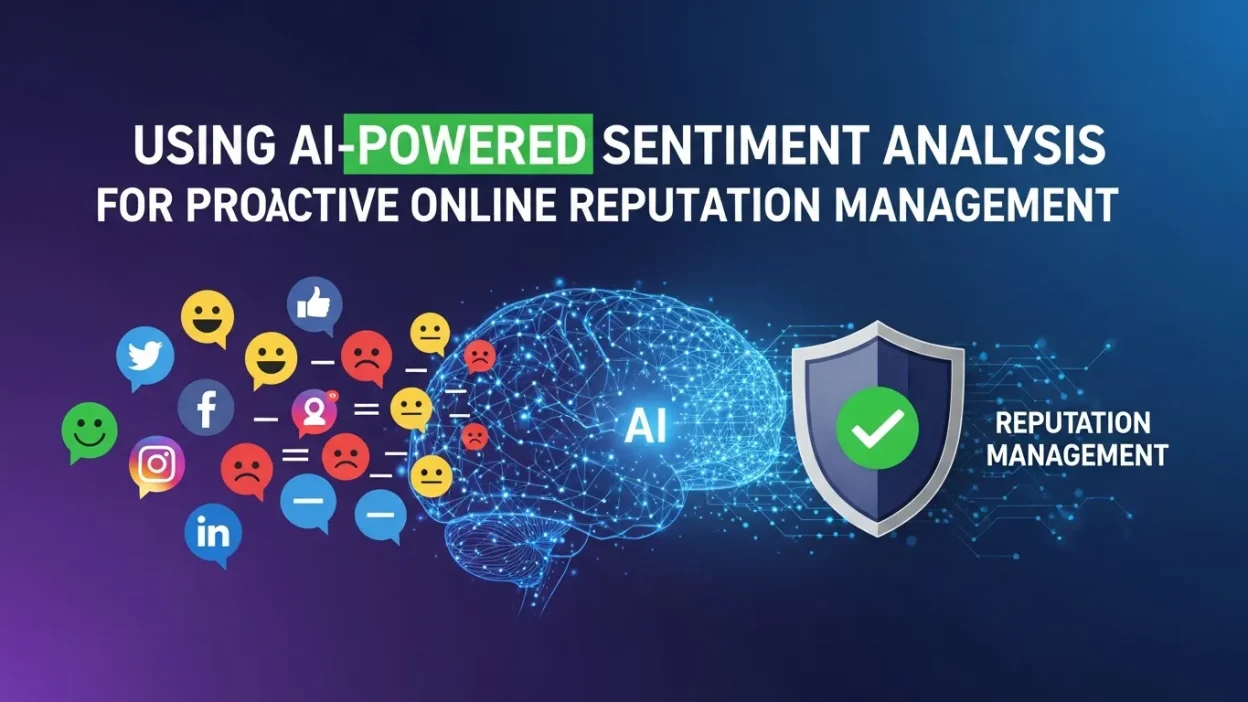
AI-Powered Sentiment Analysis is transforming how businesses monitor perception, detect risks early, and manage online reputation proactively in a fast-moving digital landscape.
AI-Powered Sentiment Analysis enables organizations to monitor customer emotions, predict reputation risks, and respond proactively. By combining AI, social listening, and customer feedback strategies, brands can protect trust, manage crises effectively, and build sustainable online reputation management systems.
What Is Sentiment Analysis?
Sentiment analysis is an advanced technology that uses artificial intelligence, machine learning, and natural language processing (NLP) to detect, interpret, and classify emotions, opinions, and attitudes expressed across digital content. Unlike basic keyword-based tools, this technology evaluates context, intent, and emotional nuance to determine whether sentiment is positive, negative, or neutral.
Modern sentiment analysis systems analyze multiple content formats, including:
- Text: Customer reviews, social media comments, blog posts, news articles, and forum discussions
- Audio: Call center recordings, customer support conversations, voice messages, and podcasts
- Video: Social media videos, brand mentions, interviews, and customer testimonials
What makes this technology especially powerful is its ability to understand tone, sarcasm, slang, and cultural context. For example, a sentence that appears positive on the surface may actually convey frustration or irony—something traditional monitoring tools often fail to identify. Deep learning models trained on massive datasets help recognize these subtleties with a high degree of accuracy.
In the context of online reputation management, sentiment analysis plays a critical role by continuously monitoring brand mentions, identifying shifts in public perception, and uncovering emerging reputation risks before they escalate. By transforming unstructured data into actionable insights, it enables businesses to respond proactively, personalize customer engagement, and protect long-term brand trust in a rapidly evolving digital environment.
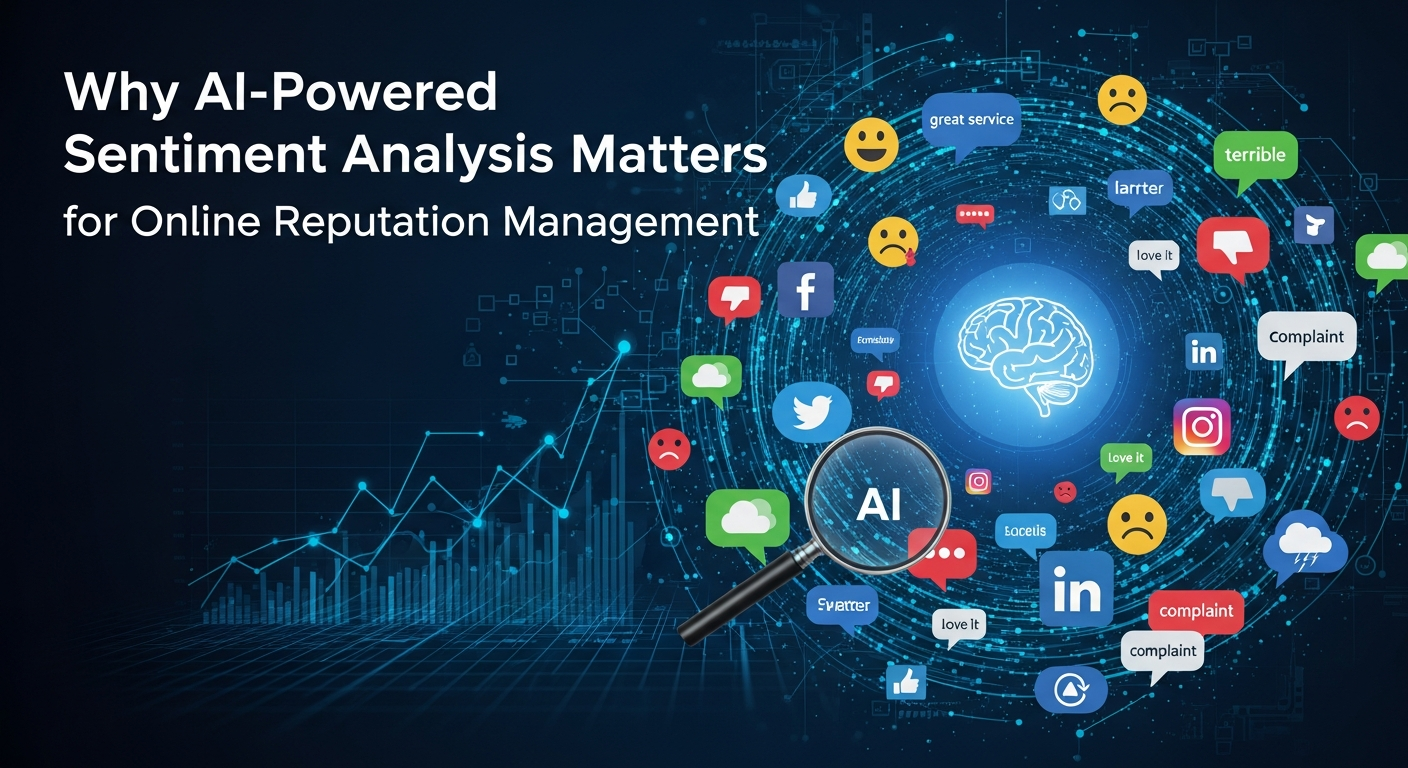
Why AI-Powered Sentiment Analysis Matters for Online Reputation Management
Why You Need Online Reputation Management Today
Customers trust online opinions more than advertisements. A single negative review or viral post can damage years of brand building.
AI-Powered Sentiment Analysis helps brands:
- Detect reputation risks early
- Convert negative feedback into growth opportunities
- Protect brand credibility at scale
This approach supports sustainable online reputation management instead of reactive damage control.
How AI-Powered Sentiment Analysis Works
Core Technologies Used
- AI chatbots and machine learning
- Natural language processing (NLP)
- Predictive analytics
- Social media monitoring systems
Key Capabilities
- Emotion detection
- Contextual analysis
- Real-time monitoring
- Trend forecasting
- Multilingual sentiment tracking
This enables AI-driven online reputation management across platforms.
Key Features of AI-Powered Sentiment Analysis
| Feature | Description | Business Benefit |
|---|---|---|
| Emotion Detection | Identifies anger, joy, frustration, and trust | Improves response tone |
| Real-Time Monitoring | Tracks are mentioned instantly | Faster crisis response |
| Contextual Analysis | Detects sarcasm and intent | Avoids misinterpretation |
| Trend Forecasting | Predicts reputation risks | Proactive ORM |
| CRM Integration | Links sentiment with CX data | Better decisions |
Proactive Online Reputation Management Explained
What Is Proactive Online Reputation Management?
It means preventing reputation damage before it spreads.
AI-Powered Sentiment Analysis enables:
- Early warning alerts
- Risk prioritization
- Faster response workflows
- Crisis prevention
This is the foundation of advanced online reputation management.
How to Monitor Business Reputation Online Using AI
Essential Channels to Monitor
- Google reviews
- Social media platforms
- Forums and blogs
- News mentions
- Video platforms
Using online reputation management with AI and social listening, brands gain a unified reputation view.
Customer Review Management with AI
What Is Customer Review Management?
It involves collecting, analyzing, and responding to customer feedback.
AI-Powered Sentiment Analysis helps:
- Detect fake reviews
- Prioritize high-risk negative reviews
- Identify recurring complaints
- Improve customer feedback strategy
This is critical for business reputation management.
How to Manage a Negative Review Effectively
Steps:
- Acknowledge the concern
- Respond with empathy
- Offer resolution
- Take the conversation offline
- Learn from feedback
Handled correctly, negative reviews become growth opportunities for e-commerce and service brands.
Removing Negative Content and Fake Reviews
How to Remove Fake Reviews
- Report to platforms
- Provide evidence
- Use online reputation management services
- Publish authoritative content to outrank negativity
Recovering online reputation is faster when AI monitoring detects threats early.
Social Media Monitoring and Sentiment Analysis
What Is Social Media Monitoring?
Tracking mentions, engagement, and sentiment across platforms.
Combined with AI-Powered Sentiment Analysis, it enables:
- Influencer risk detection
- Viral crisis prevention
- Brand safety in digital marketing
Crisis Management Using AI-Powered Sentiment Analysis
How to Create a Crisis Management Plan
- Define alert thresholds
- Assign response roles
- Prepare response templates
- Monitor sentiment shifts
- Review post-crisis data
AI ensures real-time crisis detection, not a delayed reaction.
Deepfakes and AI Reputation Risks
Deepfakes AI reputation management is now essential.
AI helps:
- Detect manipulated videos
- Monitor brand misuse
- Verify visual content authenticity
Trust protection is critical in digital reputation management.
Integrating Customer Experience with Reputation Strategy
Integrating customer experience improves:
- Brand perception
- Customer loyalty
- Long-term reputation strength
AI-Powered Sentiment Analysis connects feedback with CX data.
Video Testimonials and Trust Building
Why Video Testimonials Matter
- Higher trust than text
- Strong emotional signals
- Powerful brand authority indicators
Building trust with video testimonials strengthens sentiment signals.
ROI of Online Reputation Management
Key metrics:
- Sentiment improvement
- Review ratings growth
- Crisis response time
- Conversion lift
- Brand loyalty
Tools like Google Analytics, SEMrush, and Ahrefs help measure ROI.
Industry-Specific ORM Applications
Online Reputation Tips for Real Estate Agents
- Monitor local reviews
- Optimize Google Business Profile
- Highlight video testimonials
E-Commerce Reputation Management
- Monitor product sentiment
- Convert complaints into insights
- Automate review analysis
Personal Branding vs Reputation
Difference of Personal Branding vs Reputation
- Branding = what you say
- Reputation = what others experience
AI-Powered Sentiment Analysis measures reputation, not claims.
Corporate Reputation Management
What Is Corporate Reputation Management?
Managing stakeholder trust across:
- Customers
- Employees
- Media
- Investors
AI enables controlling companies’ online reputation at scale.
Reputation Management in Digital Marketing
AI supports:
- Search engine reputation management
- Reputation management in social media
- Integrated marketing strategies
This ensures brand consistency and resilience.
The Future of AI-Powered Sentiment Analysis
Emerging trends:
- Predictive sentiment analytics
- Automated branding
- Voice and video sentiment analysis
- AI-driven trend forecasting
Brands adopting early gain a long-term advantage.
Conclusion
AI-Powered Sentiment Analysis is no longer optional—it is essential for proactive online reputation management. By detecting emotional signals early, guiding crisis prevention, and improving customer experience, AI empowers brands to protect trust, scale reputation efforts, and build resilience in an increasingly transparent digital world.
FAQs
1. What is sentiment analysis?
Sentiment analysis is a technology that evaluates emotions, opinions, and attitudes expressed in digital content. It goes beyond surface-level words to understand tone, intent, and emotional direction, helping businesses interpret how people truly feel about a brand, product, or service across online channels.
2. How does artificial intelligence support brand reputation control?
Artificial intelligence enables brands to identify emerging risks early by analyzing large volumes of customer conversations in real time. It helps prioritize critical issues, highlight recurring complaints, and guide faster, more informed responses—reducing damage before problems escalate.
3. Can technology identify fake or manipulated reviews?
Yes, intelligent systems can flag suspicious behavior such as repeated patterns, unnatural language, duplicate accounts, or abnormal posting frequency. However, actual removal usually requires reporting the content to the hosting platform and following its review and compliance procedures.
4. Why are emotions more important than star ratings?
Star ratings offer limited insight because they lack context. Emotional analysis reveals customer intent, trust level, and underlying concerns. A three-star review with positive emotion may indicate satisfaction, while a five-star rating with frustration can signal hidden issues.
5. How accurate is emotion-based content analysis?
Accuracy is high when models are trained on diverse, high-quality datasets and updated regularly. Continuous learning allows systems to adapt to new language patterns, slang, and cultural nuances, improving interpretation over time.
6. How does AI support crisis prevention and response?
By detecting sudden shifts in negative conversations or unusual spikes in complaints, AI provides early warnings. This allows brands to investigate issues quickly, clarify misinformation, and take corrective action before situations turn into full-scale public crises.
7. Is this technology suitable for small businesses?
Absolutely. Many modern tools are scalable and budget-friendly, allowing small businesses to track customer sentiment, identify problems early, and compete with larger brands without needing large teams or complex infrastructure.
8. Does automation replace human decision-making?
No. Automation enhances human judgment rather than replacing it. While technology processes large datasets efficiently, human expertise is still essential for interpreting context, crafting responses, and making strategic decisions that require empathy and creativity.
9. Which industries benefit the most from sentiment insights?
Industries with high customer interaction gain the most value, including e-commerce, real estate, healthcare, financial services, hospitality, and consumer brands. These sectors rely heavily on trust, reviews, and public perception to drive growth.
10. What does the future of reputation control look like?
The future is predictive, automated, and emotion-driven. Businesses will increasingly rely on intelligent systems to forecast risks, personalize engagement, and maintain trust proactively—shifting from reactive damage control to long-term brand resilience.