Understanding Online Reputation Management in SEO

SEO Reputation Management

Every click, search, and review shapes perception. SEO reputation management determines whether your brand is trusted, ignored, or rejected in today’s search-driven digital world.

This guide explains SEO reputation management, how online reputation management integrates with SEO, and how businesses can monitor, protect, and strengthen digital trust using reviews, content, AI-powered tools, and proactive brand strategies.

What Is SEO Reputation Management?

SEO reputation management is the strategic process of influencing how a brand, business, or individual is perceived in search engine results. It combines online reputation management (ORM) with search engine optimization (SEO) to ensure that positive, accurate, and brand-aligned content dominates the search engine results pages (SERPs).

Unlike traditional reputation management, which focuses on public relations or customer service alone, SEO reputation management directly addresses what users see when they search your brand name, products, executives, or services.

This includes:

  • Reviews and ratings
  • News articles and blogs
  • Social media profiles
  • Videos and images
  • Third-party listings and forums

Because search engines are often the first point of trust validation, search engine reputation management plays a decisive role in brand credibility.

Introduction to Online Reputation Management

Online reputation management is the practice of monitoring, influencing, and managing how a brand or individual is perceived across digital platforms. Every review, social mention, forum discussion, or search result contributes to public perception.

For example, if a potential customer searches for a local restaurant and sees consistent negative reviews, trust is instantly lost—regardless of the actual quality of the business. This is why ORM is critical to both brand survival and growth.

When ORM is combined with SEO, brands gain control over visibility. Positive content ranks higher, while outdated, irrelevant, or harmful content is pushed lower in search results. This synergy creates a powerful system for proactive online reputation management.
How SEO Reputation Management and ORM Work Together

 SEO Reputation Management

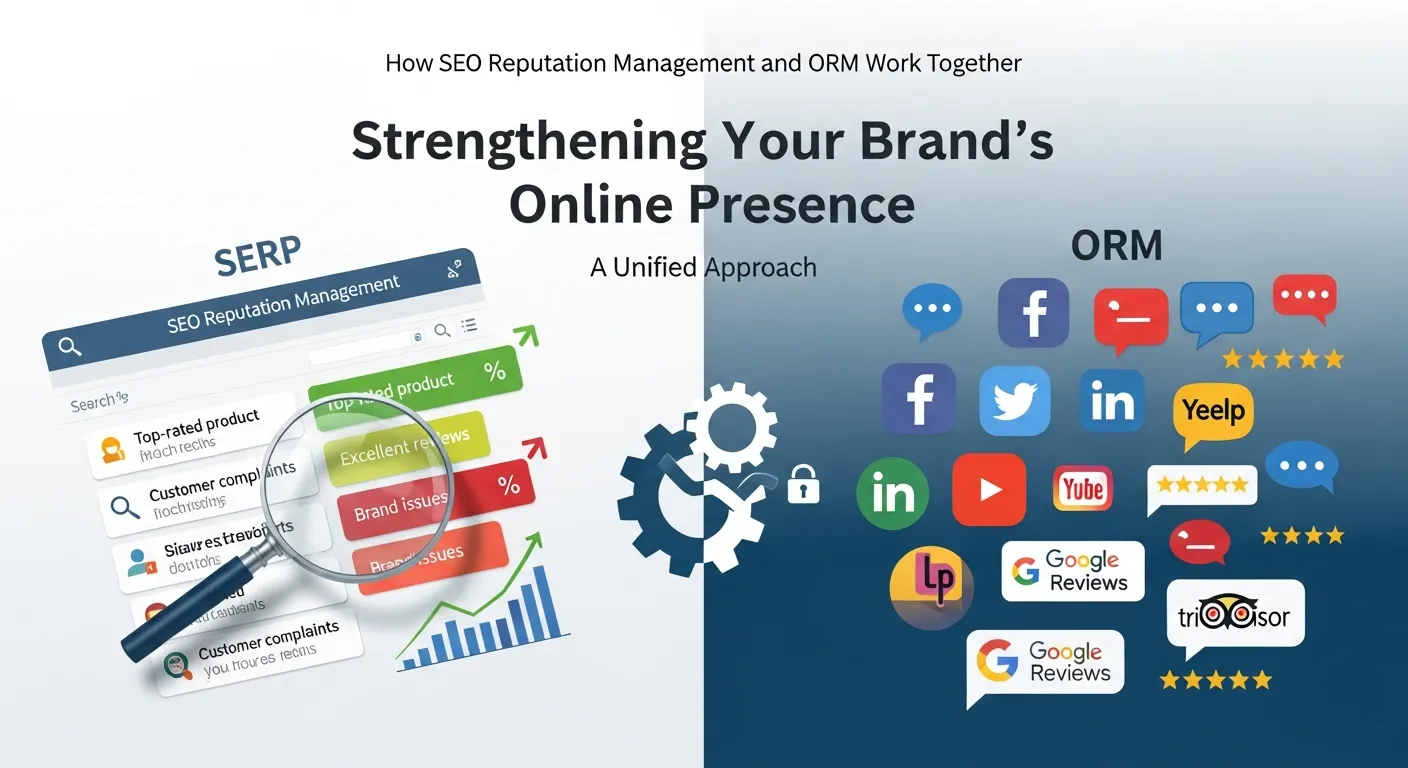
SEO Reputation Management and Online Reputation Management (ORM) are two sides of the same coin. SEO controls what people see in search results, while ORM influences how they feel about what they see. When aligned, they create a powerful system for visibility, trust, and long-term brand resilience.

Control Over Search Results

SEO determines which pages appear on the first page of Google, but ORM ensures that those high-ranking assets tell the right story about your brand. Ranking alone is not enough—what ranks matters just as much.

By strategically optimizing and ranking:

  • Your official website and service pages
  • SEO-optimized blog content
  • Branded social media profiles
  • Press releases and authoritative media coverage
  • Knowledge panels and business listings

You occupy valuable search real estate with positive, accurate, and brand-aligned content. This naturally pushes negative, outdated, or misleading results further down the SERPs, where they receive far less visibility. This suppression-through-optimization approach is a core principle of advanced online reputation management and search engine reputation management.

Managing Customer Sentiment Through Search Signals

Customer sentiment directly impacts both SEO and ORM. Reviews are no longer just social proof—they are measurable ranking factors.

Search engines evaluate signals such as:

  • Review volume and consistency
  • Review freshness and frequency
  • Average star ratings
  • Keywords and sentiment within review content

From an ORM perspective, customer review management focuses on amplifying positive feedback while transforming negative reviews into growth opportunities. Responding professionally, resolving complaints publicly, and showing accountability not only rebuilds trust but also sends strong quality signals to search engines.

When SEO and ORM work together, reviews become assets that improve rankings, credibility, and conversion rates simultaneously.

Establishing Credibility and Trust at Scale

SEO builds authority with algorithms through backlinks, technical optimization, content relevance, and site performance. ORM builds credibility with real people by shaping narratives, managing perceptions, and reinforcing brand values across digital touchpoints.

When integrated, SEO Reputation Management and ORM:

  • Increase qualified organic traffic
  • Improve engagement and conversion rates
  • Strengthen brand equity and brand perception
  • Reduce the long-term impact of negative content
  • Support sustainable online reputation management

This alignment ensures that your brand is not only discoverable but also trustworthy at every stage of the customer journey. In today’s search-first world, visibility without trust is fragile—and trust without visibility is invisible.

Why SEO Reputation Management Matters More Than Ever

Today’s consumers trust search results more than advertisements. Before making a decision, people Google your brand, read reviews, scan headlines, and judge credibility within seconds. One negative result on page one can outweigh years of brand-building and paid marketing investment.

Search behavior has fundamentally changed how trust is formed. Buying decisions are now search-driven, reviews directly influence both local and global visibility, and negative content spreads faster than positive experiences. With AI and automation amplifying both praise and criticism at scale, SEO Reputation Management is no longer optional—it is a business necessity.

This is why the question is no longer why you need online reputation management, but how well you are managing it.

Core SEO Reputation Management Strategies

Online Reputation Management

Claim and Optimize All Digital Assets

Controlling your digital footprint is the foundation of effective SEO Reputation Management. Unclaimed or outdated profiles leave room for misinformation, negative sentiment, and brand confusion.

Key platforms to claim and optimize include Google Business Profile, Yelp, Bing Places, Trustpilot, and relevant industry directories. Ensuring consistent NAP (Name, Address, Phone) data across all platforms strengthens local SEO signals, improves trust with search engines, and supports long-term business reputation management. Fully optimized profiles also increase your chances of occupying multiple first-page results with brand-controlled assets.

Encourage and Manage Positive Reviews

Customer reviews are powerful trust signals and measurable SEO assets. They influence click-through rates, local rankings, and purchase decisions simultaneously.

Effective customer review management involves proactively asking satisfied customers for feedback, sending direct review links to reduce friction, and responding to every review—positive or negative—with professionalism. Avoiding fake or incentivized reviews is critical, as search engines and consumers can easily detect manipulation. Over time, this approach strengthens how customer feedback builds trust and reinforces sustainable online reputation management.

Monitor Brand Mentions Continuously

You cannot manage what you do not see. Continuous monitoring allows brands to detect issues early, respond faster, and prevent small complaints from becoming reputation crises.

Social media monitoring tracks brand mentions, sentiment, and conversations across platforms, forums, blogs, review sites, and news outlets. Combined with search monitoring, this practice explains how to monitor business reputation online effectively and supports proactive online reputation management rather than reactive damage control.

Respond to Negative Feedback Professionally

Negative reviews are inevitable, but long-term damage is not. How a brand responds often matters more than the complaint itself.

A professional response acknowledges the issue, demonstrates accountability, offers a clear path to resolution, and moves sensitive discussions offline when necessary. This approach shows transparency and empathy—two qualities consumers value deeply. When handled correctly, brands can transform negative reviews into growth opportunities for e-commerce businesses and service providers alike.

Content Marketing for Reputation Control

High-quality content is one of the most effective tools in SEO Reputation Management. Search engines prioritize fresh, authoritative, and relevant content, making content marketing a powerful method for shaping brand perception.

Educational blog posts, case studies, video testimonials, press releases, and thought leadership articles help dominate branded search results. This strategy supports removing negative content through suppression rather than deletion by replacing harmful visibility with positive, brand-aligned assets.

Leverage Social Media for Search Visibility

Social media profiles frequently rank on the first page of Google for branded searches, making them essential reputation assets. An active and consistent social presence helps control brand messaging, strengthens trust signals, and supports reputation management in social media ecosystems.

Platforms such as LinkedIn, Facebook, Instagram, and even YouTube function as both engagement channels and high-authority SERP results. When optimized correctly, they reinforce brand credibility while protecting against reputation volatility.

Tools and Technologies for SEO Reputation Management

 SEO Reputation Management

Effective SEO Reputation Management depends on visibility, speed, and accuracy. Using the right tools allows brands to monitor conversations, control search results, and respond before small issues become reputation risks.

Essential Tools Used in SEO Reputation Management

  • Google Alerts
    Tracks brand mentions across the web and delivers notifications when new content appears, supporting basic online reputation monitoring.
  • SEMrush and Ahrefs
    Help monitor branded keyword rankings, backlinks, competitor activity, and search engine reputation management performance.
  • Brand24 and Mention
    Provide real-time social listening, capturing mentions from social media, blogs, forums, and news sources while analyzing sentiment trends.
  • Trustpilot and Reputology
    Centralize customer review management, enabling faster responses and better tracking of customer feedback across platforms.
  • Hootsuite
    Supports reputation management in social media by monitoring brand conversations, managing responses, and maintaining message consistency.

Advanced AI-Powered Reputation Technologies

  • AI-powered sentiment analysis to detect emotional tone and emerging risks
  • AI-driven online reputation management for large-scale monitoring and automation
  • Machine learning models that identify negative content patterns early
  • Automated alerts and response workflows for faster crisis intervention

Together, these tools form a comprehensive technology stack that supports proactive SEO Reputation Management, helping brands maintain trust, visibility, and long-term digital authority.

Measuring the Success of SEO Reputation Management

Key performance indicators include:

  • Branded search result quality
  • Review ratings and volume
  • Sentiment trends
  • Social engagement
  • Organic traffic and conversions

Reputation improvement is gradual, making consistency essential.

Future Trends in SEO Reputation Management

SEO Reputation Management is evolving rapidly as technology, search behavior, and consumer trust dynamics change. Brands that anticipate these trends gain a significant advantage in visibility, credibility, and long-term reputation control.

AI-Driven Reputation Intelligence

AI-driven online reputation management is shifting ORM from reactive to predictive. Instead of responding after damage occurs, AI systems analyze patterns, sentiment shifts, and behavioral signals to identify risks early.

Key advancements include:

  • Predictive risk detection using machine learning
  • Automated monitoring and response workflows
  • Real-time sentiment and trend forecasting
  • Scalable management across multiple platforms

AI is also becoming essential in deepfakes AI reputation management, where manipulated videos, images, or audio can threaten brand credibility. Advanced AI tools help detect synthetic media, verify authenticity, and protect digital identity at scale.

Voice Search and Featured Snippets

As voice assistants like Google Assistant, Alexa, and Siri become mainstream, search results are increasingly driven by trust and clarity. Voice search favors brands with strong authority, consistent messaging, and positive online reputation signals.

Brands that dominate:

  • Featured snippets
  • FAQ-rich content
  • Local search results

Are more likely to be selected as spoken answers, making SEO Reputation Management a critical factor in voice-first visibility.

Video-First Reputation Building

Video content is becoming one of the most influential trust signals in search and conversion journeys. Video testimonials, behind-the-scenes content, and short-form videos humanize brands and strengthen emotional credibility.

This trend supports:

  • Video testimonials online reputation strategies
  • Building trust with video testimonial campaigns
  • Higher engagement and improved dwell time
  • Stronger visibility on platforms like YouTube, TikTok, and Google SERPs

Search engines increasingly prioritize video-rich results, making video a core asset in sustainable online reputation management.

Customer Advocacy as a Reputation Engine

Customer advocacy is emerging as one of the most powerful organic reputation drivers. Authentic customer voices carry more weight than branded messaging and scale trust faster than paid advertising.

Well-structured advocacy programs help:

  • Encourage genuine reviews and testimonials
  • Amplify positive sentiment across channels
  • Strengthen social proof and brand authority
  • Support controlling companies’ online reputation naturally

In the future of SEO Reputation Management, brands that invest in AI intelligence, voice visibility, video credibility, and customer advocacy will not just protect their reputation—they will turn it into a competitive advantage.

Conclusion 

SEO reputation management is no longer optional—it is the foundation of digital trust. By integrating online reputation management with SEO, monitoring sentiment, managing reviews, leveraging AI, and publishing authoritative content, brands can control perception, recover from setbacks, and build long-term credibility in an increasingly competitive digital landscape.

FAQs:

1. What is SEO reputation management?

SEO reputation management is the practice of shaping how a brand, business, or individual appears in search engine results. It focuses on ranking positive, accurate, and authoritative content while pushing down negative, outdated, or misleading information. The goal is to control first impressions where most decisions begin—on Google.

2. How is SEO reputation management different from ORM?

Online Reputation Management (ORM) covers perception across reviews, social media, forums, and news platforms. SEO reputation management is a specialized subset of ORM that concentrates specifically on search engines, branded keywords, and SERP visibility. Together, they ensure both visibility and trust are aligned.

3. Can SEO remove negative content from Google?

SEO cannot directly delete content unless it violates the platform or legal guidelines. Instead, it suppresses negative results by outranking them with stronger assets such as optimized web pages, blog content, press coverage, videos, and social profiles. This approach is often more effective and sustainable than removal.

4. How long does SEO reputation management take to work?

Timelines vary depending on competition, content strength, and the severity of negative exposure. Minor improvements can appear within a few weeks, but meaningful and lasting reputation control typically requires consistent effort over several months. SEO reputation management is an ongoing strategy, not a one-time fix.

5. What role do reviews play in SEO reputation management?

Reviews are critical trust and ranking signals. Search engines evaluate review volume, freshness, star ratings, and sentiment, especially for local SEO. Effective customer review management improves visibility, increases conversions, and reinforces positive brand perception across search results.

6. How does AI improve SEO reputation management?

AI enhances reputation management by automating monitoring, analyzing sentiment at scale, detecting early warning signs, and predicting potential risks. AI-driven online reputation management allows brands to respond faster, manage large data volumes, and stay proactive rather than reactive.

7. Is SEO reputation management important for small businesses?

Absolutely. Small and local businesses depend heavily on search results, Google Business Profiles, and reviews for credibility and sales. A single negative result or poor rating can significantly impact revenue, making SEO reputation management essential for survival and growth.

8. What industries benefit most from SEO reputation management?

Industries where trust directly influences decisions benefit the most. These include healthcare, real estate, e-commerce, finance, legal services, SaaS, hospitality, and professional services. In highly competitive or regulated sectors, reputation in search results can determine success or failure.

9. Can individuals use SEO reputation management?

Yes. Individuals use SEO reputation management to protect personal branding, manage career-related searches, suppress unwanted content, and build authority online. Executives, entrepreneurs, job seekers, and public figures commonly rely on it for long-term reputation protection.

10. Should businesses hire SEO reputation management services?

Hiring professional SEO reputation management services is recommended when negative content persists, competition is intense, or reputational risk is high. Experts bring advanced tools, proven strategies, and scalability that are difficult to manage internally, especially during crises or rapid growth.


Previous Article

Brand Reputation Management: Why It Matters and How to Master It

Next Article

How to Manage Your Business Online Reputation

Write a Comment

Leave a Comment

Your email address will not be published. Required fields are marked *

Subscribe to our Newsletter

Subscribe to our email newsletter to get the latest posts delivered right to your email.
Pure inspiration, zero spam ✨