Sentiment and Voice Data helps brands understand how people feel, what they say, and where response opportunities appear, turning scattered signals into clearer business action.
Most teams collect feedback, but very few know how to use it well. A survey result sits in one dashboard, call notes live in another, social comments pile up somewhere else, and customer support keeps handling the same issues without a shared pattern. That is where Sentiment and Voice Data becomes useful. It gives shape to the noise. It helps teams understand not just what customers are saying, but how they are feeling when they say it.
This matters because customer experience is rarely a single moment. It is a sequence of moments. A user may feel uncertain while reading a landing page, frustrated during checkout, relieved after support responds, and loyal only if the whole journey feels coherent. Sentiment and Voice Data makes those emotional shifts visible.
The goal is not to collect more data for the sake of data. The goal is to turn emotion, language, and context into practical decisions. That could mean fixing a product issue sooner, improving response timing, refining a message, or adjusting the way outreach is handled. When teams treat Sentiment and Voice Data as a working system instead of a reporting layer, the value compounds quickly.
What Sentiment and Voice Data Really Means
Sentiment and Voice Data refers to the combination of emotional signals and direct customer language. Sentiment tells you how people feel. Voice tells you how they describe their experience, what words they use, and which problems come up repeatedly. Together, they create a clearer picture than either signal would on its own.
A sentiment score alone is too shallow. A quote alone can be too specific. But when you combine them, you begin to see patterns. That is the strength of Sentiment and Voice Data. It captures both tone and meaning, which makes it more useful for marketing, product, support, and leadership teams.
For example, customers may all say a feature is “good,” but the surrounding comments may reveal frustration about setup time or confusion about pricing. Sentiment and Voice Data helps you see the gap between surface approval and real experience. That gap is often where the best improvements live.
Why This Data Matters More Than Ever
Customers are leaving more signals than ever before. They write reviews, send support tickets, reply to emails, record calls, share comments, and complete surveys. Yet many teams still read this information one channel at a time. That creates blind spots. Sentiment and Voice Data solves that by linking emotional response to actual customer language across multiple touchpoints.
This matters because modern customers expect fast understanding. They do not want to repeat the same complaint in five different places. They want brands to recognize patterns and act on them. When Sentiment and Voice Data is used properly, teams can respond with more confidence and less guesswork.
It also helps brands prioritize. Not every issue deserves the same level of urgency. Some problems affect revenue. Some affect retention. Some affect trust. Sentiment and Voice Data allows teams to separate isolated comments from repeated pain points, which makes decisions more strategic.
The Psychology Behind Customer Language

People rarely describe their experience in a purely logical way. They blend fact with emotion. A customer might say a dashboard is confusing, but what they often mean is that they feel uncertain, rushed, or unsupported. Sentiment and Voice Data helps translate those emotional signals into clearer operational actions.
That is important because emotion drives behavior. Frustrated users churn faster. Confused users delay purchase. Satisfied users recommend more often. When you understand the emotional layer, you can respond more effectively. Sentiment and Voice Data gives that layer structure.
It also reveals how tone changes across the journey. Early-stage prospects may sound curious. Active customers may sound practical. Unhappy users may become terse or repetitive. The language shift itself is a clue. Sentiment and Voice Data helps teams identify those shifts early, before they become larger business problems.
Turning Feedback Into a Working System
The real power of data appears when it is used consistently. A one-time review of comments can produce a few ideas, but a working system produces ongoing improvement. Sentiment and Voice Data becomes powerful when it feeds into decision-making on a regular basis.
That system usually starts with collection. Then it moves to classification, then interpretation, then action. The action step matters most. If the data only produces reports, it remains passive. If it changes product priorities, messaging, support scripts, or workflow design, it becomes valuable.
A strong system also protects teams from overreacting. One negative comment does not define the brand. One positive comment does not prove success. Sentiment and Voice Data helps create balance by showing repeated patterns over time.
Real Time Brand Alerts Setup and Fast Response
Timely awareness is one of the biggest advantages of modern monitoring. Real Time Brand Alerts Setup allows teams to notice sudden shifts in tone, mention volume, or issue escalation before a small problem turns into a larger one. This is especially valuable when reputation or trust is at stake.
The best alert systems are not loud for the sake of being loud. They are selective. They highlight meaningful shifts, unusual spikes, or urgent negative patterns. When paired with Sentiment and Voice Data, alerts become smarter because they are tied to emotional context instead of raw volume alone.
For example, a sudden cluster of negative comments around a product update may indicate a bug, confusing messaging, or a broken workflow. Real Time Brand Alerts Setup helps teams catch that moment while it is still manageable. Sentiment and Voice Data then helps explain what is actually happening and how serious it is.
Safe Brand Monitoring Engine for Long Term Trust
Monitoring only works when people trust the process. A Safe Brand Monitoring Engine is important because teams often deal with customer language, private feedback, or sensitive reputation issues. You need data handling that is reliable, secure, and controlled.
A safe monitoring system does more than protect information. It also protects decision quality. If data is incomplete, duplicated, or poorly organized, teams may act on the wrong signal. Sentiment and Voice Data is only useful when the underlying collection and analysis process is clean.
This is why governance matters. Clear access rules, organized tagging, consistent labeling, and secure storage all support better insight. When Sentiment and Voice Data is managed through a Safe Brand Monitoring Engine, teams can move faster without losing confidence in the data.
Practical Outreach Workflow That Starts With Insight
Feedback only creates value when someone acts on it. A Practical Outreach Workflow ensures that the right people respond to the right signal at the right time. That might mean customer success reaching out, support following up, sales adjusting the message, or product teams reviewing a recurring issue.
The workflow should be simple enough to execute under pressure. First identify the issue. Then decide who owns it. Then choose the response. Then track the outcome. Sentiment and Voice Data supports each step by showing not just what happened, but how strongly it affected the customer.
When outreach is guided by real language from real users, the response feels more human. That matters. People can tell when a brand is reacting to a template versus a genuine concern. Sentiment and Voice Data makes outreach more personal because it ties action to actual customer expression.
High Converting Outreach Strategy and Message Fit
The best outreach is not just quick. It is relevant. A High Converting Outreach Strategy uses what customers actually say to shape the timing, tone, and content of the response. That makes the message feel helpful instead of generic.
If a user sounds confused, the response should clarify. If a user sounds annoyed, the response should acknowledge the issue without sounding defensive. If a user sounds ready to buy but uncertain about one detail, the message should remove friction. Sentiment and Voice Data helps teams make those distinctions.
A strong outreach strategy also respects context. Not every mention needs a sales reply. Not every complaint needs a long explanation. Sometimes the best action is a direct fix, a concise apology, or a helpful resource. Sentiment and Voice Data shows which response is likely to work best.
Where Sentiment and Voice Data Comes From
The data usually comes from multiple sources. Reviews, surveys, interviews, support tickets, call transcripts, social comments, community posts, and email replies all contribute different layers of meaning. Each source has strengths and limitations.
Surveys are useful for structured feedback. Calls are useful for nuance. Support tickets are useful for recurring pain points. Social comments are useful for raw emotional reaction. Sentiment and Voice Data becomes strongest when it combines all of them in a single interpretive framework.
The challenge is consistency. Different sources use different language styles. Some are short and blunt. Some are detailed. Some are emotional. Some are technical. Good analysis does not flatten those differences. It respects them. Sentiment and Voice Data is most useful when the source context stays visible.
Why Raw Sentiment Scores Are Not Enough
A score without explanation can mislead. A customer may leave a negative score because of shipping delay, not product dissatisfaction. Another may write a glowing comment but still mention one serious pain point. Sentiment and Voice Data gives those details meaning.
This is why context matters as much as categorization. A simple positive or negative label does not tell the whole story. Was the person upset about price, speed, quality, communication, or expectations? The answer changes the next action. Sentiment and Voice Data helps separate the issue from the emotion around the issue.
When teams rely only on sentiment scores, they often miss the real lesson. They see the direction but not the reason. Sentiment and Voice Data closes that gap.
How Teams Can Use the Data Better
The best teams do not wait for a quarterly review. They use sentiment insights continuously. Product managers use it to prioritize fixes. Support leads use it to improve scripts. Marketers use it to refine messaging. Leadership uses it to understand customer health.
The main advantage is alignment. When everyone looks at Sentiment and Voice Data through the same lens, the organization can move together. The support team can flag a trend, product can validate it, and marketing can adjust positioning if needed.
That alignment reduces wasted effort. It prevents departments from solving the wrong problem. It also creates faster learning loops, which are critical in competitive markets. Sentiment and Voice Data supports that rhythm by keeping customer voice visible.
Tables, Tags, and Triage
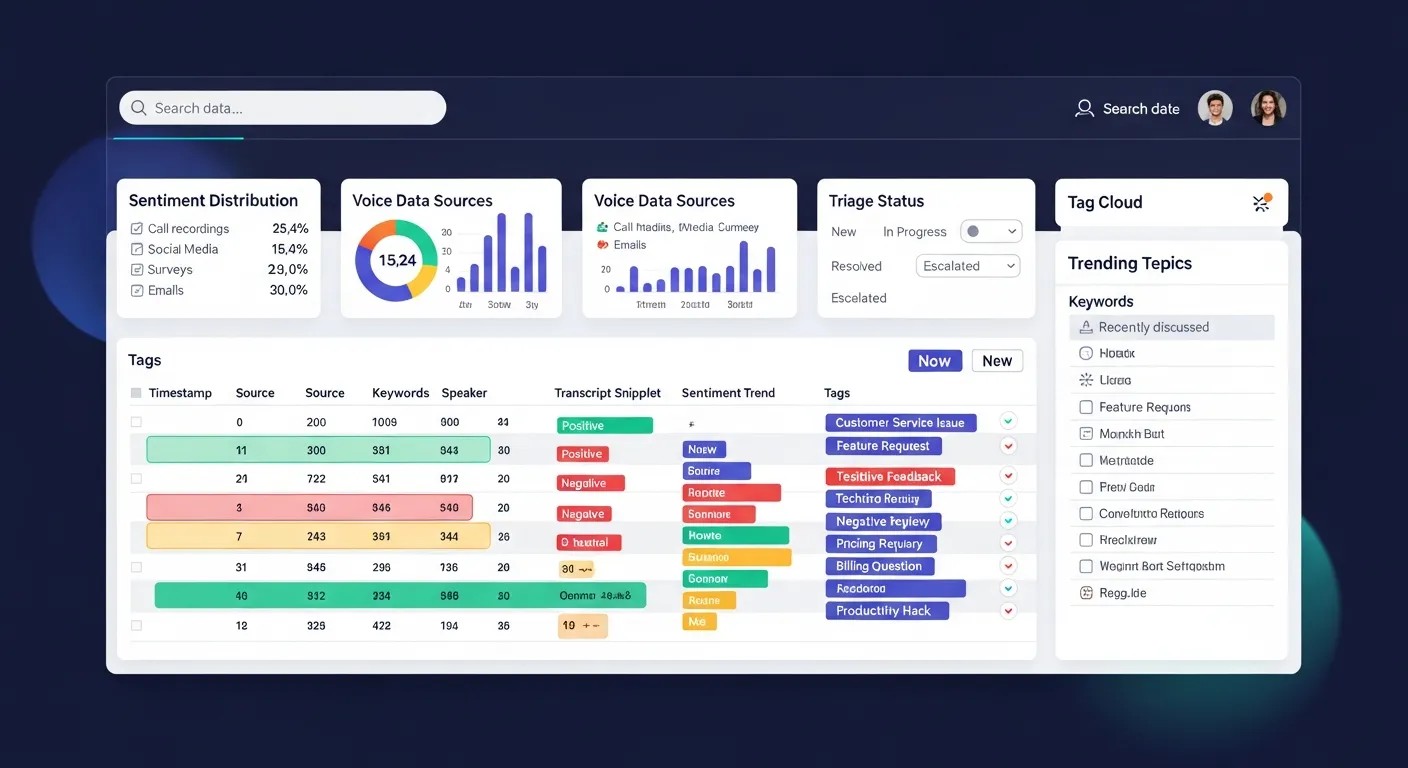
A useful workflow often starts with a simple table. Even a basic structure can help teams prioritize the next move.
| Signal Type | What It Usually Means | Best Next Step |
|---|---|---|
| Strong negative spike | A sudden issue or broken expectation | Investigate quickly |
| Repeated neutral confusion | Messaging or UX may be unclear | Improve explanation |
| Positive but weak engagement | Satisfaction is present but shallow | Strengthen value cues |
| Repeated objection language | A recurring barrier is blocking action | Address root cause |
This kind of triage makes Sentiment and Voice Data operational instead of theoretical. The goal is not perfect analysis. The goal is useful action.
Building Better Customer Understanding
The more you work with customer language, the better you understand what customers care about. People often reveal priorities through repetition. If the same phrases appear again and again, that is rarely accidental.
Sentiment and Voice Data helps brands notice those repeated phrases and identify whether they reflect product value, friction, confusion, or delight. That understanding improves every major customer-facing function.
It also builds empathy. Teams start hearing customers more clearly. That shift matters because customers are more likely to stay loyal when they feel understood. Sentiment and Voice Data gives organizations a way to operationalize empathy.
Content, Messaging, and Voice Alignment
Messaging often fails when it sounds polished but does not match what customers actually say. The strongest brands reflect the language their audience uses. Sentiment and Voice Data makes that easier.
When teams analyze how people describe a problem, they can mirror that language in content, ads, product pages, and support materials. The result is cleaner alignment. Customers feel like the brand is speaking their language instead of forcing a corporate script.
That alignment is especially important in competitive markets. If your messaging feels distant, people may ignore it. If it feels familiar and relevant, they are more likely to pay attention. Sentiment and Voice Data helps close that distance.
What to Do When Signals Conflict
Sometimes the numbers and the words do not agree. You may see steady engagement but lukewarm comments. You may see strong sentiment but low conversion. That is not a failure. It is information.
Conflicting signals usually mean the customer journey has uneven parts. Maybe the product is good but the onboarding is weak. Maybe the audience likes the brand but does not fully trust the offer. Sentiment and Voice Data helps isolate where the disconnect appears.
When signals conflict, do not force a quick conclusion. Instead, review source types, journey stage, and audience segment. That is often where the explanation becomes clear. Sentiment and Voice Data becomes especially valuable in these moments because it adds nuance to the story.
Creating a Repeatable Operating Habit
Insights only matter when they become part of the routine. A repeatable habit might mean reviewing customer language weekly, checking alerts daily, or updating a shared sentiment summary each month.
The exact rhythm does not matter as much as consistency. A regular process keeps the team aware of what customers are feeling and saying. Over time, Sentiment and Voice Data becomes a normal input into strategy rather than a special report.
That habit also improves response speed. Teams get better at spotting patterns, faster at escalating issues, and more confident when making decisions.
Common Mistakes to Avoid
One major mistake is reading feedback without tracking follow-up. If no one knows what happened after the issue was raised, the data loses value. Another mistake is using overly broad categories that hide the real problem.
A third mistake is ignoring positive comments. Positive sentiment often reveals what is working and what should be reinforced. Sentiment and Voice Data should help teams understand both risk and strength.
Another common error is treating every signal as urgent. Good prioritization matters. Not all feedback is equal, and not every negative comment requires immediate action. The point of Sentiment and Voice Data is clarity, not panic.
Business Impact That Goes Beyond Reporting
When used properly, this kind of insight affects more than the dashboard. It can improve retention, reduce churn, sharpen messaging, and strengthen customer trust. It can also help teams spend time on the issues that matter most.
That is the true value of Sentiment and Voice Data. It does not just describe the customer experience. It helps shape it.
Strategic Applications Across the Organization
Different teams can use the same insight in different ways. Marketing can refine headlines and proof points. Product can prioritize usability fixes. Support can improve response templates. Leadership can monitor health trends. Sales can detect objections earlier.
That shared view creates coherence. The customer does not experience your company as separate departments. They experience one brand. Sentiment and Voice Data helps the brand speak more consistently across all those touchpoints.
Why Human Judgment Still Matters
Automation is helpful, but it should not replace judgment. Machines can cluster words and score tone, but humans understand context, irony, urgency, and nuance better than any simple model.
The strongest programs combine analysis with review. They use systems to surface patterns and people to interpret them. That balance keeps Sentiment and Voice Data grounded in reality.
Building Trust Through Better Response

When customers feel heard, trust grows. When they see that feedback leads to action, loyalty strengthens. That is one of the most valuable outcomes of using Sentiment and Voice Data well.
The idea is simple but powerful: listen carefully, respond thoughtfully, improve consistently.
The Long View
Short-term sentiment can be noisy. Long-term patterns are more meaningful. A brand that tracks only the latest comment misses the bigger story. Sentiment and Voice Data becomes most powerful when it reveals how feelings change over time.
That long view supports smarter strategy. It tells you whether improvements are actually working. It shows whether a recurring issue has been resolved. It highlights whether the audience is becoming more confident or more cautious.
Key Takeaways
Sentiment and Voice Data is most valuable when it connects emotion to action.
It becomes stronger when paired with Real Time Brand Alerts Setup, a Safe Brand Monitoring Engine, a Practical Outreach Workflow, and a High Converting Outreach Strategy.
It works best when teams focus on patterns, context, and response quality instead of raw scores alone.
It helps organizations move from passive listening to active improvement.
Conclusion
Sentiment and Voice Data matters because customer language is never just noise. It carries emotion, intent, friction, approval, hesitation, and opportunity all at once. Teams that learn how to read those signals can respond faster, improve customer experience, and make smarter decisions across marketing, support, product, and leadership. The goal is not to collect every possible comment. The goal is to understand the right ones, in the right context, and act on them with consistency. When Sentiment and Voice Data becomes part of the operating rhythm, it stops being a reporting exercise and starts becoming a competitive advantage.
Frequently Asked Questions (FAQ)
1. What is Sentiment and Voice Data?
Sentiment and Voice Data combines emotional tone with customer language to help teams understand what people feel and what they mean.
2. Why is it useful for brands?
It helps brands identify pain points, improve customer experience, and make better decisions based on real feedback.
3. Is sentiment score alone enough?
No. Sentiment score is useful, but Sentiment and Voice Data is more powerful when context and language are included.
4. Where does this data usually come from?
It often comes from reviews, surveys, support tickets, calls, social comments, and direct feedback.
5. What is Real Time Brand Alerts Setup used for?
It helps teams notice urgent changes in brand tone or mention volume quickly so they can respond before issues grow.
6. Why is a Safe Brand Monitoring Engine important?
It protects both data quality and trust by keeping monitoring secure, organized, and reliable.
7. How does outreach connect to this data?
A Practical Outreach Workflow helps teams respond in a structured way, while a High Converting Outreach Strategy makes messages more relevant.
8. Can this improve customer retention?
Yes. When teams understand customer emotion and act on it well, they often reduce churn and strengthen loyalty.
9. Should humans still review the data?
Yes. Human judgment is still essential for context, nuance, and prioritization.
10. What is the biggest benefit of using it well?
The biggest benefit is turning scattered customer signals into clear, useful action that improves the business over time.